
Nonlinear Inequalities Worksheets
Nonlinear inequalities in 12th grade math help pre-calculus students analyze polynomial and rational expressions across different parts of the number line. These free, ready-to-print PDF worksheets are designed for immediate classroom use, homework, review, tutoring, intervention, or independent practice. Students strengthen critical-value analysis, sign testing, interval notation, and domain reasoning while developing skills expected throughout the 12th grade curriculum.
About This Collection of Worksheets
Nonlinear inequalities require 12th grade students to think beyond finding isolated solutions. Instead, they identify the values where a polynomial or rational expression can change sign, use those values to divide the number line into intervals, and determine which sections make the original inequality true. Rational expressions add another layer because values that make a denominator zero must remain excluded even when equality would otherwise allow an endpoint.
This collection separates those ideas into focused activities before bringing them together in complete problems. Students find boundary values, test quadratic intervals, analyze signs of factored expressions, interpret graph behavior, decide whether endpoints belong, solve polynomial and rational inequalities, identify domain restrictions, translate solutions into interval notation, choose correct interval answers, correct mistakes, and audit proposed solutions. This progression gives students repeated practice with the full sign-analysis process from setup through final notation.
Teachers can use these worksheets throughout a 12th grade pre-calculus inequalities unit for guided lessons, independent practice, homework, intervention, review stations, or assessment preparation. Parents, tutors, and homeschool educators can also target individual trouble spots such as finding critical values, checking rational restrictions, or choosing brackets and parentheses correctly. The mix of algebraic, graphical, matching, multiple-choice, and error-analysis activities helps students understand both the process and the reasoning behind nonlinear inequality solutions.

Paul’s Teacher Tip
Have students create a short checklist before solving: find zeros, find restrictions, make intervals, determine signs, choose intervals, check endpoints. For rational inequalities, require them to mark denominator zeros differently from numerator zeros so they remember those values can never be included. When possible, use factored form for sign analysis because students can inspect the sign of each factor more easily than repeatedly substituting into an expanded expression. Repeated factors deserve special attention because the sign may stay the same instead of switching at that boundary. Before writing the final answer, have students compare the inequality symbol with the endpoint type and then check the original domain one last time.
Worksheet Collection Skill Spotlights
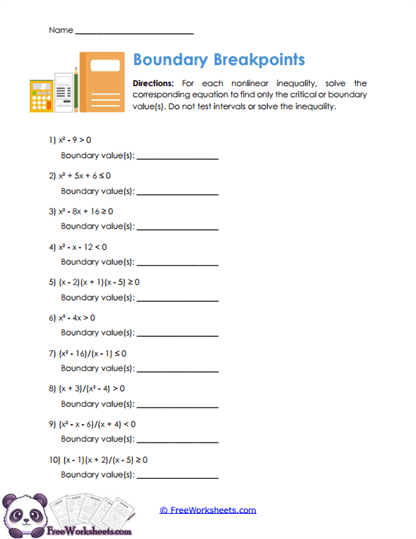
Boundary Values
What Kids Do:
Students examine ten quadratic, polynomial, and rational inequalities and identify the values where each expression may change sign or become undefined. They factor polynomial expressions, solve factors equal to zero, and inspect denominators for excluded values without completing the later interval-testing steps.
Target Skill:
This activity isolates the critical first stage of nonlinear inequality solving. Students strengthen factoring, zero identification, denominator restrictions, and the distinction between roots and undefined values while learning how critical numbers divide the number line into later sign-analysis intervals.
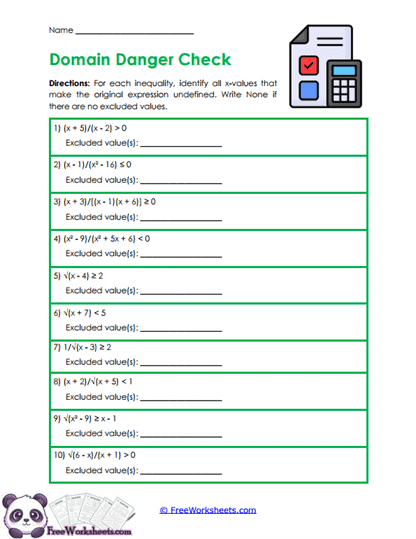
Domain Restrictions
What Kids Do:
Students inspect ten nonlinear and rational expressions and identify every x-value that makes the original expression undefined. They focus on variable expressions in denominators, solve each denominator equal to zero, and write None when an expression has no domain restrictions.
Target Skill:
Students develop the habit of checking the domain before solving a rational inequality. The worksheet reinforces division-by-zero restrictions, numerator-versus-denominator reasoning, and the important rule that excluded denominator values can never appear in a final solution set.
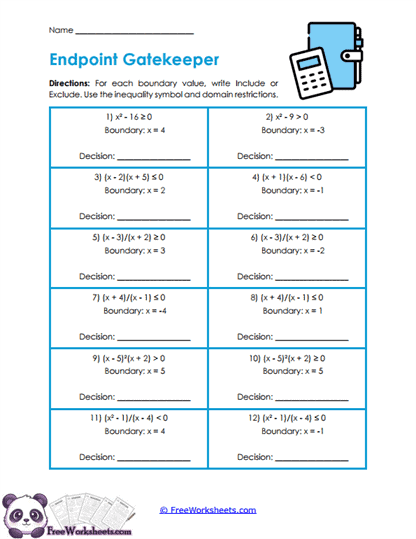
Endpoint Rules
What Kids Do:
Students review twelve nonlinear inequality boundaries and decide whether each one should be included or excluded from the final solution. They consider whether equality is allowed and whether the original expression is defined at that value before choosing the appropriate endpoint treatment.
Target Skill:
This activity strengthens the logic behind brackets and parentheses in interval notation. Students learn that polynomial zeros may be included when equality is permitted, while denominator restrictions remain excluded regardless of the inequality symbol.
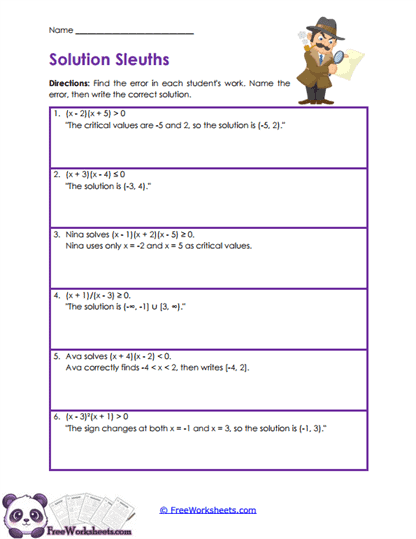
Error Sleuths
What Kids Do:
Students analyze six worked nonlinear inequality solutions containing mistakes with critical values, interval signs, endpoint choices, or rational-domain restrictions. They locate the first incorrect step, explain the specific problem, and then correct the solution completely.
Target Skill:
Error analysis helps students connect all stages of nonlinear inequality solving instead of treating them as separate procedures. The worksheet reinforces critical-value accuracy, sign-chart reasoning, endpoint decisions, domain restrictions, and clear mathematical explanation.
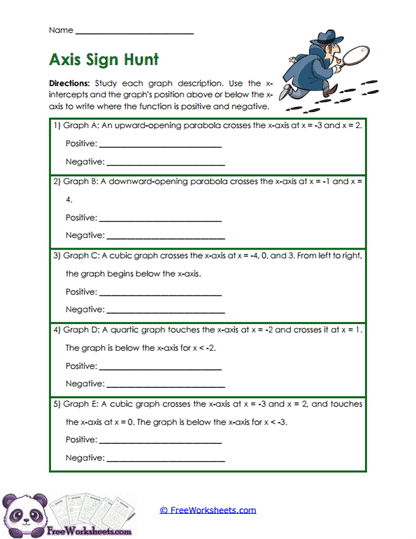
Graph Signs
What Kids Do:
Students study five descriptions of polynomial graphs, including parabolas, cubics, and a quartic. They use x-intercepts and information about where each graph lies above or below the horizontal axis to determine positive and negative intervals and express those regions in interval notation.
Target Skill:
Students connect graphical behavior with algebraic sign analysis. The activity reinforces that values above the x-axis correspond to positive function values, values below correspond to negative ones, and touching versus crossing an intercept affects whether the sign changes.
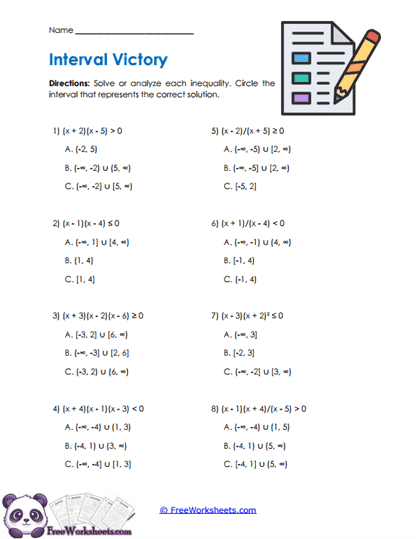
Interval Choices
What Kids Do:
Students solve or analyze eight polynomial and rational inequalities and select the correct interval notation from several closely related options. They verify critical values, sign regions, split intervals, and whether each endpoint should be included or excluded before making a choice.
Target Skill:
This multiple-choice format develops careful final-answer checking. Students reinforce complete sign analysis, rational restrictions, interval direction, endpoint notation, and the ability to distinguish answers that share the same boundaries but represent different solution regions.
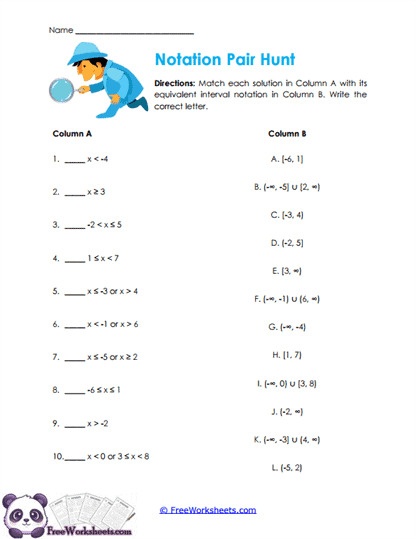
Interval Match
What Kids Do:
Students match ten written inequality descriptions with equivalent interval notation. They work with single intervals, rays extending toward infinity, included and excluded finite endpoints, and split solutions made from two separate parts of the number line.
Target Skill:
Students build fluency translating between inequality language and interval notation. The worksheet reinforces parentheses, brackets, infinity notation, unions, and the 12th grade ability to communicate nonlinear inequality solutions accurately and efficiently.
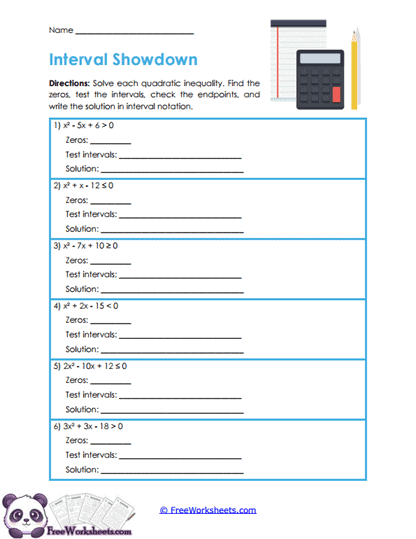
Interval Testing
What Kids Do:
Students solve six quadratic inequalities by factoring to find zeros, dividing the number line into intervals, selecting test values from each section, and determining where the expression is positive or negative. They then write the complete solution using correct interval notation and endpoint rules.
Target Skill:
This activity develops the full sign-testing process for quadratic inequalities. Students learn that roots create boundaries rather than complete solutions and that the actual answer comes from identifying which intervals satisfy the original inequality.
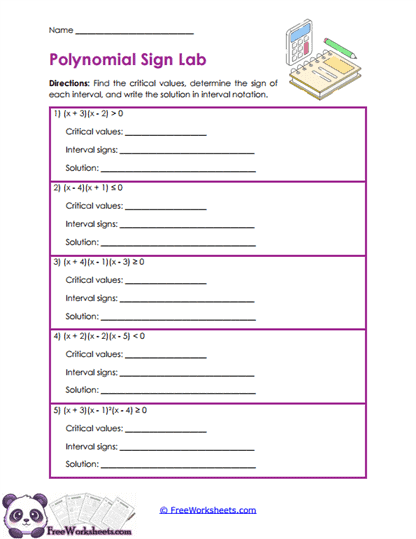
Polynomial Intervals
What Kids Do:
Students solve five factored polynomial inequalities from beginning to end. They find each zero, construct the resulting number-line intervals, determine the sign of the polynomial in every section, choose the regions that satisfy the inequality, and decide whether the zeros themselves belong.
Target Skill:
Students extend quadratic interval reasoning to higher-degree polynomial expressions. The worksheet reinforces multiplicity, factor signs, interval analysis, endpoint inclusion, and the organized procedure needed for solving more complex polynomial inequalities.
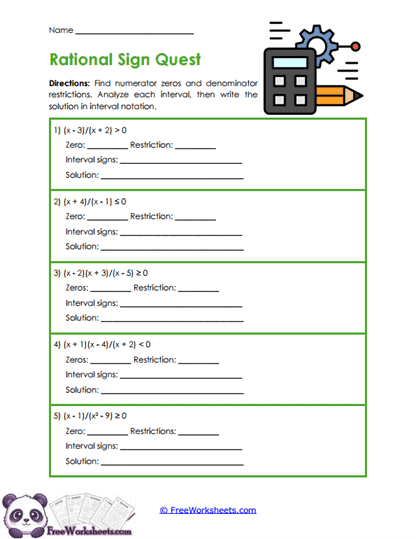
Rational Intervals
What Kids Do:
Students solve five rational inequalities by locating numerator zeros and denominator restrictions, arranging all critical values on a number line, determining the sign of the rational expression in each interval, and writing the final solution while excluding undefined values.
Target Skill:
This activity combines polynomial sign reasoning with rational-function domain rules. Students strengthen numerator-versus-denominator analysis, sign testing, vertical restrictions, interval notation, and the rule that denominator zeros remain excluded from every final solution.
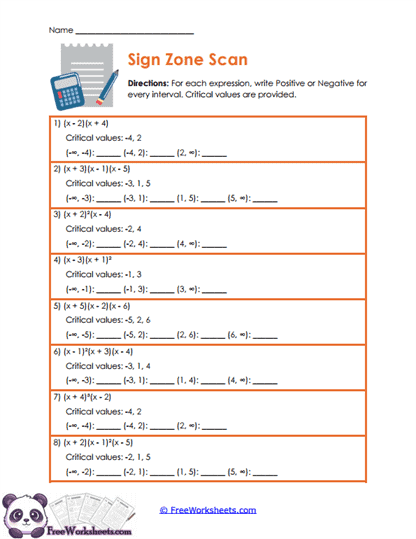
Sign Zones
What Kids Do:
Students analyze eight factored polynomial expressions whose critical values are already provided. For each number-line interval, they determine the sign of every factor and combine those signs to decide whether the complete expression is positive or negative.
Target Skill:
This focused worksheet builds the sign-analysis skill used throughout nonlinear inequalities. Students reinforce multiplication of positive and negative factors, interval reasoning, and the special behavior of repeated factors whose even multiplicity may prevent a sign change.
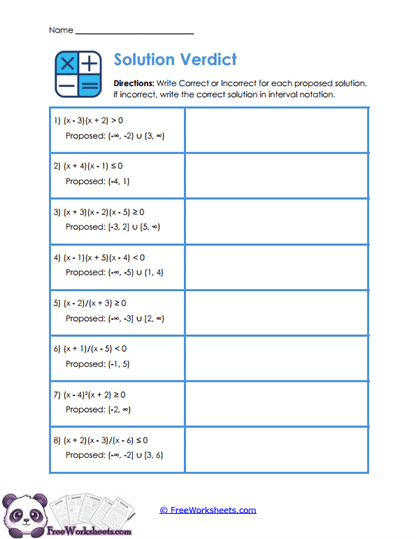
Solution Audit
What Kids Do:
Students inspect eight proposed solutions to polynomial and rational inequalities and decide whether each interval answer is correct. They verify the critical values, sign regions, domain restrictions, and endpoint choices, then rewrite any proposed solution that fails one of those checks.
Target Skill:
Students develop independent verification skills by treating every final solution as something that must be justified. The activity reinforces the complete nonlinear inequality process and helps students catch subtle mistakes involving split intervals, excluded values, and endpoint notation.