
Trigonometry Review Worksheets
Trigonometry review in math helps pre-calculus students reconnect angle measures, unit-circle values, identities, graphs, equations, and triangle-solving strategies. These free, ready-to-print PDF worksheets are designed for immediate classroom use, homework, review, tutoring, intervention, or independent practice. Students strengthen exact-value recall, graph analysis, identity reasoning, equation solving, and method selection while reinforcing key 12th grade curriculum skills.
About This Collection of Worksheets
A strong trigonometry review helps 12th grade students reconnect skills that are often taught in separate lessons but depend on one another. Degree-radian conversions support unit-circle work, reference angles help determine exact trig values, quadrant signs guide equation solving, and graph features reveal how sine, cosine, and tangent functions behave. Students also revisit identities and triangle-solving strategies so they can move more confidently among symbolic, graphical, and geometric forms.
The worksheets in this collection cover a broad range of pre-calculus trigonometry skills. Students match degree and radian measures, recall unit-circle coordinates, evaluate exact trig values, determine reference angles and quadrant signs, analyze sine, cosine, and tangent graph features, match and prove identities, solve trig equations over restricted intervals, choose appropriate triangle-solving methods, and diagnose common errors. Together, the activities provide a cumulative review that emphasizes both fluency and reasoning.
Teachers can use these worksheets for end-of-unit review, pre-calculus test preparation, warm-ups, homework, intervention, independent practice, or targeted refreshers before calculus. Parents, tutors, and homeschool educators can also choose individual pages based on whether a student needs help with the unit circle, identities, equations, graph transformations, or triangle methods. Because the collection moves across many major trig topics, it works well for identifying gaps and rebuilding connections among previously learned skills.

Paul’s Teacher Tip
Have students build their review around a few dependable anchors instead of trying to memorize every trig fact separately. The relationship 180° = π radians, the unit-circle coordinate rule (cos θ, sin θ), and the quadrant sign pattern can rebuild a surprising amount of forgotten information. When solving trig equations, require students to identify the reference angle and then check every valid quadrant inside the stated interval. For identities, encourage them to work from the more complicated side and use one known identity at a time rather than changing both sides together. In triangle problems, have students identify whether the triangle is right or oblique before choosing a formula.
Worksheet Collection Skill Spotlights
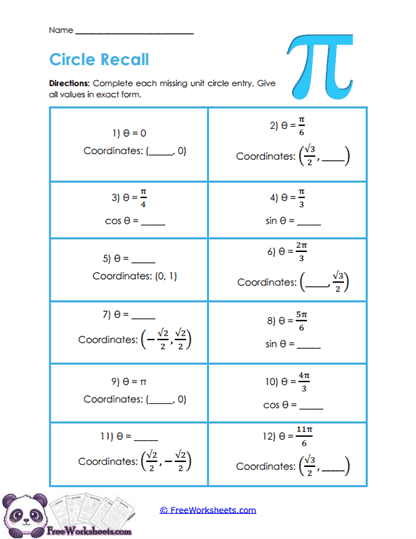
Circle Recall
What Kids Do:
Students complete twelve unit-circle prompts involving missing angles, coordinates, sine values, and cosine values. They work forward from special angles to exact coordinates and backward from coordinates to angle measures while using familiar axis locations and special-angle patterns.
Target Skill:
This activity strengthens unit-circle fluency and the connection between coordinates and trigonometric values. Students reinforce that cosine is the horizontal coordinate, sine is the vertical coordinate, and exact values depend on both the reference angle and the quadrant.
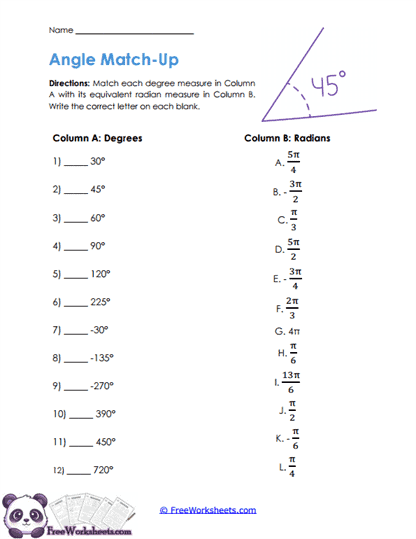
Degree Radians
What Kids Do:
Students match twelve angle measures written in degrees with equivalent radian measures. The set includes common special angles, negative rotations, and angles larger than one full turn, requiring students to recognize standard conversions across several types of angle measures.
Target Skill:
Students develop flexible fluency between the two major systems of angle measurement. The worksheet reinforces the benchmark relationship 180° = π radians and prepares students to work more efficiently with the unit circle, trig graphs, identities, and equations.
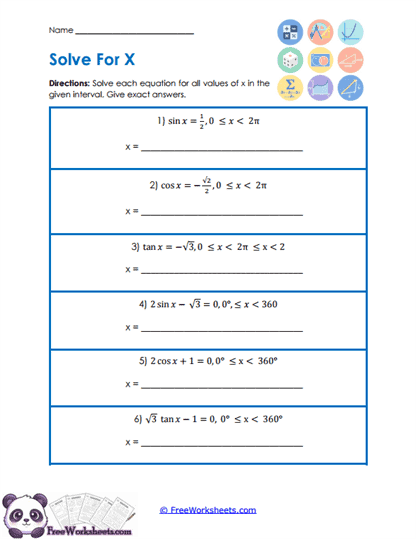
Equation Solve
What Kids Do:
Students solve six sine, cosine, and tangent equations over stated degree or radian intervals. They isolate the trig function, identify a reference angle from an exact value, determine which quadrants satisfy the required sign, and list every valid angle inside the permitted interval.
Target Skill:
This worksheet combines algebra, exact trig values, quadrant reasoning, and periodic behavior. Students strengthen complete-solution thinking by recognizing that trigonometric equations can have multiple valid answers and that every answer must respect the stated interval.
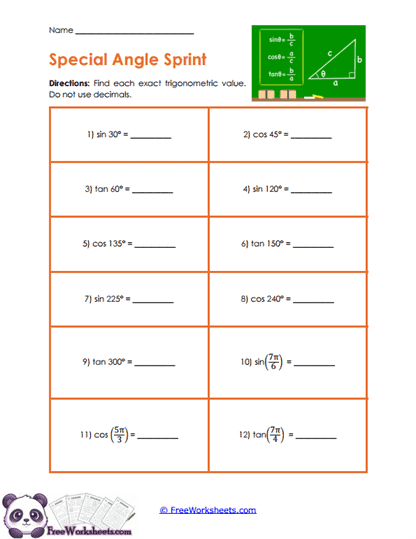
Exact Trig
What Kids Do:
Students find exact sine, cosine, and tangent values for twelve special angles written in degrees and radians. They determine the reference angle, recall the appropriate unit-circle or special-triangle value, and then apply the correct positive or negative sign based on the quadrant.
Target Skill:
Students build fluency with exact trigonometric evaluation without depending on decimal approximations. The activity reinforces special angles, reference angles, unit-circle values, quadrant signs, and the relationship among sine, cosine, and tangent.
Identity Match
What Kids Do:
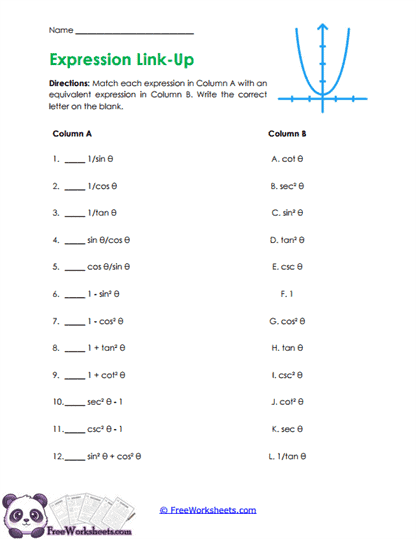
Students match twelve trigonometric expressions with equivalent forms using reciprocal, quotient, and Pythagorean identities. They recognize relationships among sine, cosine, tangent, cotangent, secant, and cosecant and identify simplified expressions involving squared trig functions.
Target Skill:
This activity strengthens rapid recognition of foundational identities used throughout pre-calculus. Students learn to distinguish reciprocal, quotient, and Pythagorean structures and build the pattern awareness needed for simplification, verification, and equation solving.
Identity Proofs
What Kids Do:
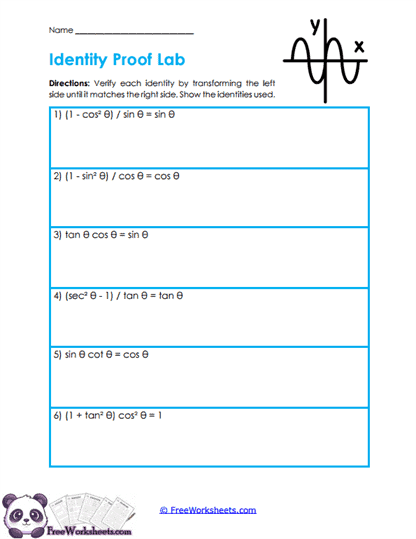
Students verify six trigonometric identities by choosing one side of each statement and transforming it step by step until it matches the other. They apply reciprocal, quotient, and Pythagorean identities along with algebraic simplification while keeping each transformation mathematically equivalent.
Target Skill:
Students develop formal trig reasoning rather than simple formula recall. The worksheet reinforces strategic identity selection, equivalent-expression thinking, clear algebraic organization, and the habit of transforming one side of an identity until the target form appears.
Method Choice
What Kids Do:
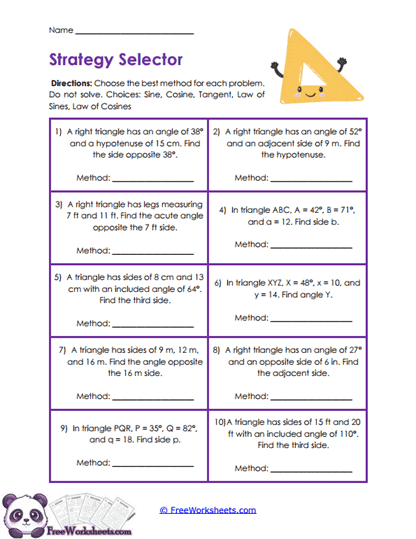
Students examine ten triangle situations and choose the most appropriate solving method without completing the calculations. They decide among sine, cosine, tangent, the Law of Sines, and the Law of Cosines by looking at whether the triangle is right or oblique and which sides and angles are known.
Target Skill:
This activity develops strategic method selection across right-triangle and general-triangle problems. Students learn to analyze the information provided before choosing a formula, which helps reduce unnecessary work and strengthens independent pre-calculus problem solving.
Reference Angles
What Kids Do:
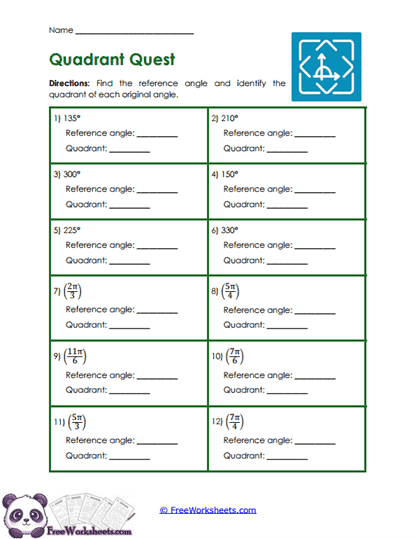
Students work with twelve angles in degrees and radians and identify both the quadrant containing the terminal side and the corresponding acute reference angle. They compare each angle with familiar axis benchmarks and determine its distance from the nearest x-axis.
Target Skill:
Students reinforce a central tool for evaluating and solving trigonometric expressions outside the first quadrant. The worksheet builds fluency with quadrant location, special-angle relationships, degree-radian interpretation, and the idea that reference angles are always positive and acute.
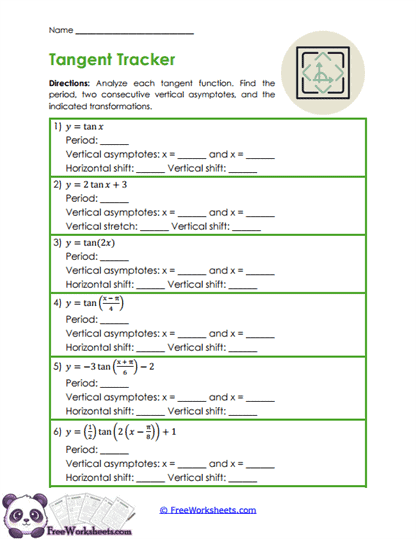
Tangent Features
What Kids Do:
Students analyze six transformed tangent functions and identify the period, horizontal shift, vertical asymptotes, vertical shift, and other graph changes. They compare each equation with the parent tangent function and determine how coefficients and input changes affect one central cycle.
Target Skill:
Students strengthen their understanding of tangent as a periodic function with vertical asymptotes. The activity reinforces the tangent period rule, undefined inputs, horizontal and vertical transformations, and the distinction between shifts, stretches, and reflections.
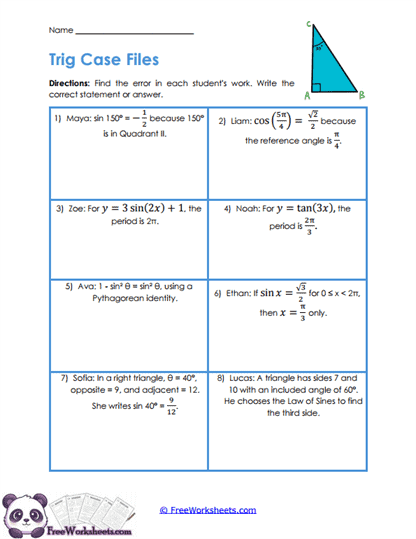
Trig Errors
What Kids Do:
Students review eight incorrect trigonometry statements or worked examples involving exact values, reference angles, periods, identities, equation solutions, right-triangle ratios, and triangle-solving methods. They identify the first incorrect idea, explain it clearly, and replace it with correct reasoning.
Target Skill:
This cumulative error-analysis activity helps students distinguish conceptual mistakes from arithmetic ones across several major trig topics. Students reinforce exact values, quadrant signs, graph periods, identity rules, complete equation solutions, and appropriate method selection.
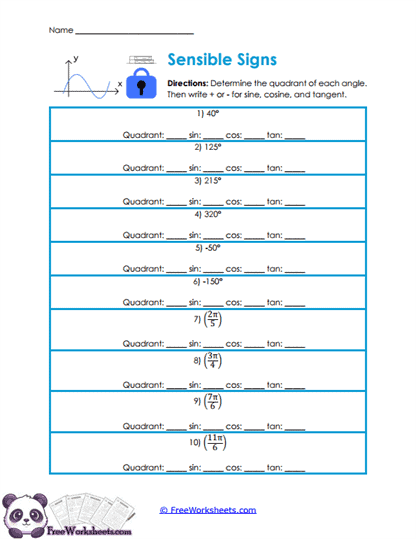
Trig Signs
What Kids Do:
Students examine ten degree and radian angles, locate each terminal side by quadrant, and determine whether sine, cosine, and tangent are positive or negative. They use coordinate-plane reasoning rather than calculating exact numerical trig values.
Target Skill:
Students strengthen the connection between trig signs and coordinates on the unit circle. The worksheet reinforces cosine as the x-coordinate, sine as the y-coordinate, tangent as their ratio, and the repeating sign pattern across all four quadrants.
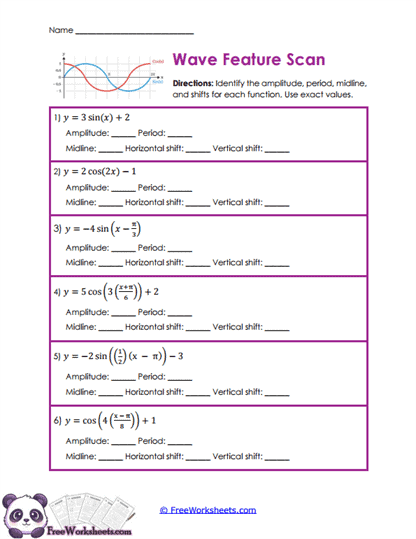
Wave Features
What Kids Do:
Students analyze six sine and cosine equations and identify amplitude, period, midline, horizontal shift, and vertical shift. They interpret numbers inside and outside the trig function and account for reflections or changes in cycle length when they appear.
Target Skill:
This worksheet develops efficient analysis of transformed sinusoidal functions. Students reinforce how coefficients control amplitude and period, how vertical shifts determine the midline, and how horizontal changes affect graph position without needing to construct a full value table.