
Vectors Worksheets
Vectors in 12th grade math help pre-calculus students describe magnitude, direction, components, and relationships in motion and geometry. These free, ready-to-print PDF worksheets are designed for immediate classroom use, homework, review, tutoring, intervention, or independent practice. Students strengthen component analysis, magnitude and direction skills, vector operations, and applied problem solving while reinforcing key 12th grade curriculum goals.
About This Collection of Worksheets
Vectors give 12th grade students a mathematical way to describe quantities that have both size and direction. Students learn how vectors differ from scalars, how component form describes horizontal and vertical movement, and how magnitude and direction work together to describe a vector completely. These ideas connect coordinate geometry, trigonometry, algebra, and real-world motion in a way that makes vector work an important part of pre-calculus.
The worksheets in this collection build those skills through a variety of focused and mixed activities. Students classify vectors and scalars, create component forms from coordinate points, review key vector concepts, calculate magnitudes and direction angles, add and subtract vectors, apply scalar multiplication, break vectors into components, create unit vectors, calculate dot products, and solve travel and motion applications. Together, these activities help students connect symbolic calculations with the geometric meaning behind vector operations.
Teachers can use these worksheets throughout a 12th grade pre-calculus vector unit for guided instruction, independent classwork, homework, intervention, review, tutoring, or assessment preparation. Parents and homeschool educators can also choose individual pages to target specific needs such as component form, magnitude, direction, unit vectors, or dot products. The collection moves from foundational vocabulary into calculations and applications, making it useful for both skill building and cumulative review.

Paul’s Teacher Tip
Encourage students to sketch a quick arrow or coordinate plane whenever direction or signs begin to feel confusing. For component form, repeat the rule terminal minus initial until the subtraction order becomes automatic. When students find direction angles, have them predict the quadrant before using inverse tangent so they can catch calculator answers that do not fit the vector’s location. For magnitude and unit-vector work, remind them that squaring removes the effect of negative components but does not change the vector’s original direction. In application problems, separate the work into two stages: combine the vectors first, then interpret the magnitude or direction of the resultant.
Worksheet Collection Skill Spotlights
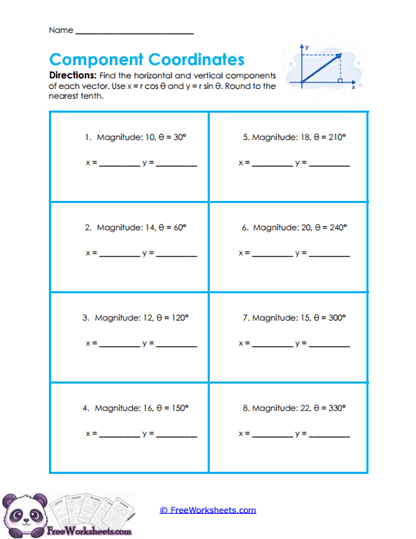
Component Breakdown
What Kids Do:
Students work through eight vectors given by magnitude and direction angle. They use cosine to calculate each horizontal component and sine to calculate each vertical component, then round the results to the nearest tenth while checking whether each component should be positive or negative.
Target Skill:
This activity connects trigonometry directly with vector representation. Students reinforce standard-position angles, sine and cosine, quadrant signs, and the formulas used to convert a vector from magnitude-direction form into horizontal and vertical components.
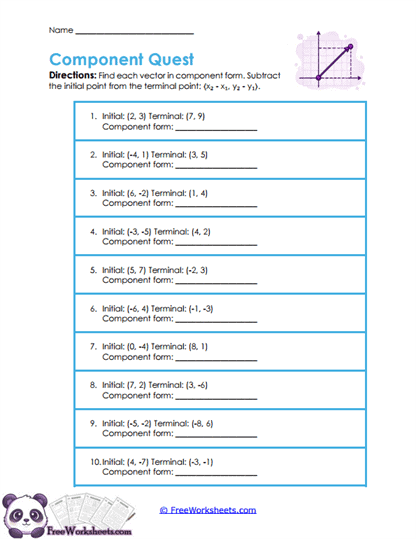
Component Moves
What Kids Do:
Students use ten pairs of initial and terminal coordinates to write vectors in component form. They subtract the starting x-coordinate from the ending x-coordinate and do the same with the y-values, working carefully with positive and negative coordinates.
Target Skill:
Students develop fluency describing displacement through horizontal and vertical change. The worksheet reinforces coordinate subtraction, sign accuracy, and the rule that component form is found using terminal minus initial, which supports later vector operations.
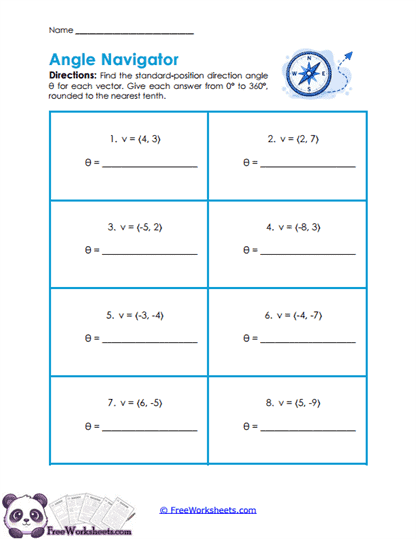
Direction Angles
What Kids Do:
Students find the standard-position direction angles of eight vectors written in component form. They use the horizontal and vertical components with inverse tangent, identify the correct quadrant, adjust the reference angle when needed, and report answers between 0° and 360°.
Target Skill:
This worksheet strengthens the connection between vector components and directional angle measure. Students reinforce inverse trigonometry, quadrant reasoning, standard-position angles, and the need to interpret calculator results rather than accepting them without checking direction.
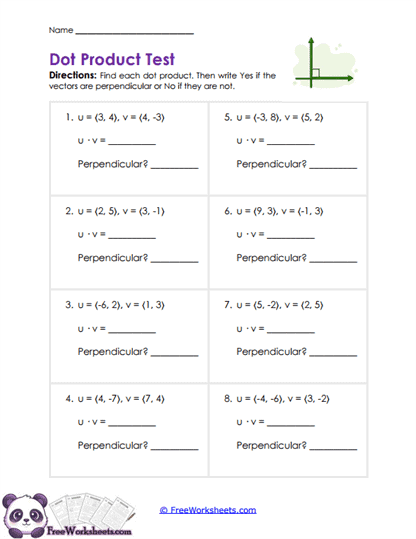
Dot Products
What Kids Do:
Students calculate the dot product for eight pairs of vectors by multiplying corresponding components and then adding the products. After each calculation, they decide whether the two nonzero vectors are perpendicular based on whether the final dot product equals zero.
Target Skill:
Students learn how an algebraic calculation can reveal a geometric relationship between vectors. The activity reinforces signed-number multiplication, component matching, dot-product structure, and the condition for identifying perpendicular vectors.
Magnitude Practice
What Kids Do:
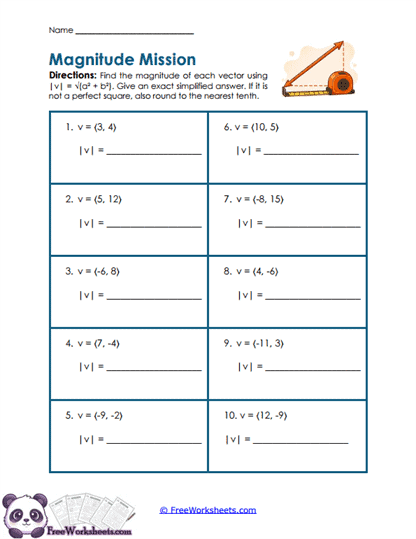
Students find the magnitude of ten vectors written in component form. They square the horizontal and vertical components, add those results, take the square root, and leave exact values when appropriate or round nonperfect-square answers to the nearest tenth.
Target Skill:
This activity reinforces the magnitude formula and its connection to the Pythagorean theorem. Students build accuracy with squaring signed numbers, square roots, exact versus approximate answers, and interpreting magnitude as the length of a vector.
Scalar Changes
What Kids Do:
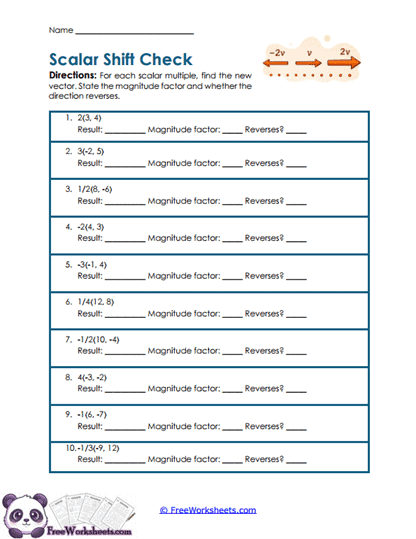
Students multiply ten vectors by positive, negative, fractional, and whole-number scalars. They apply the scalar to both components, write the resulting vector, identify the factor by which the magnitude changes, and decide whether the vector reverses direction.
Target Skill:
Students develop a conceptual understanding of scalar multiplication beyond simply multiplying numbers. The worksheet reinforces component operations, magnitude scaling, direction reversal with negative scalars, and shortening or lengthening when the scalar has magnitude below or above one.
Unit Directions
What Kids Do:
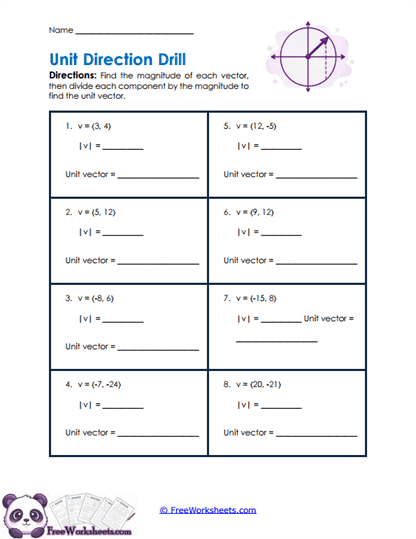
Students turn eight vectors into unit vectors by first calculating each original magnitude and then dividing both components by that magnitude. They preserve the signs of the original components and can check their work by confirming that the resulting vector has length one.
Target Skill:
This activity develops the idea of separating direction from size. Students reinforce magnitude calculations, component division, radical or fractional forms, and the definition of a unit vector as a vector pointing in the same direction with magnitude exactly one.
Vector Addition
What Kids Do:
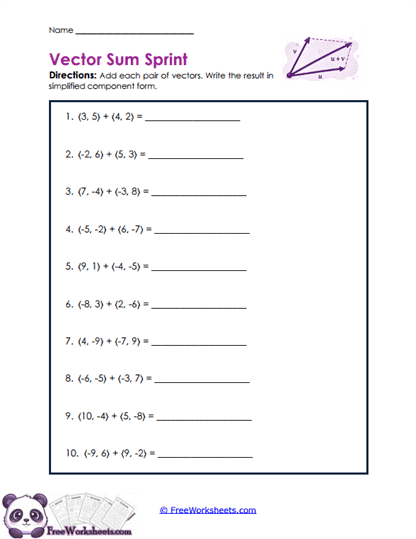
Students add ten pairs of vectors written in component form. They combine the horizontal components separately from the vertical components, simplify positive and negative integer sums, and write each resultant as one new vector.
Target Skill:
Students build fluency with component-wise vector addition. The worksheet reinforces keeping corresponding components aligned, working accurately with signed numbers, and understanding a resultant vector as the combined horizontal and vertical effect of two original vectors.
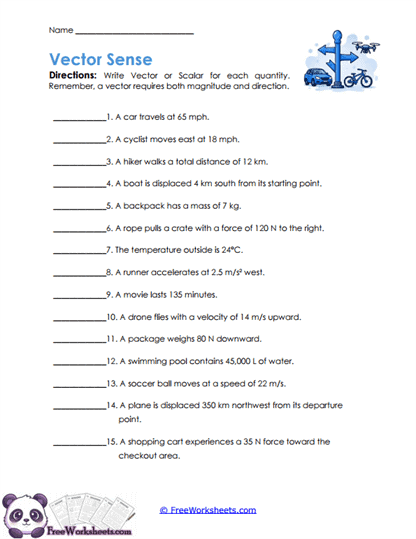
Vector Basics
What Kids Do:
Students read fifteen real-world descriptions involving speed, distance, mass, force, temperature, displacement, and similar measurements. They decide whether each quantity is a vector or scalar by checking whether both magnitude and direction are provided.
Target Skill:
This worksheet builds the conceptual foundation for all later vector work. Students learn that scalars describe size only while vectors include size and direction, strengthening their ability to distinguish related ideas such as speed versus velocity and distance versus displacement.
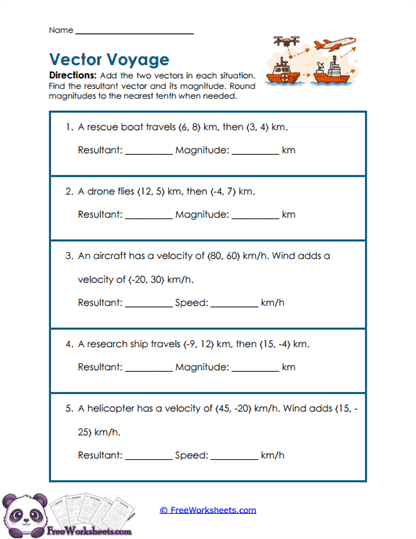
Vector Journeys
What Kids Do:
Students solve five applied problems involving boats, drones, aircraft, ships, and helicopters. They add two movement or velocity vectors component by component to find a resultant and then calculate the magnitude of that resultant to interpret the overall distance or speed.
Target Skill:
Students combine multiple vector skills in realistic motion settings. The activity reinforces vector addition, magnitude, signed components, resultants, and the interpretation of vectors in navigation and velocity situations rather than treating operations as isolated calculations.
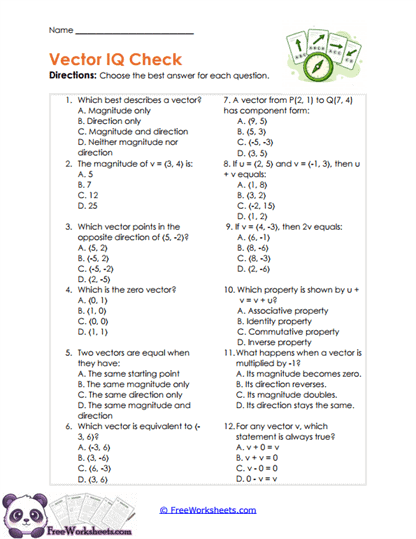
Vector Review
What Kids Do:
Students answer twelve multiple-choice questions covering vector vocabulary, magnitude, component form, the zero vector, equivalent vectors, addition, scalar multiplication, perpendicularity, and basic dot-product ideas. The mixed format requires both recognition and short calculations.
Target Skill:
This cumulative review helps students connect separate vector ideas into one coherent topic. Students reinforce terminology, properties, operations, component reasoning, and geometric relationships while identifying which concepts may need additional review before an assessment.
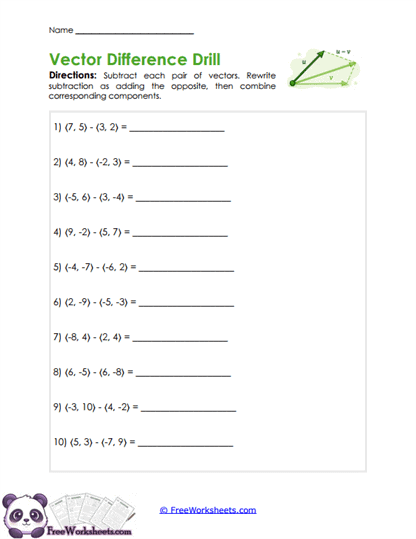
Vector Subtraction
What Kids Do:
Students complete ten vector subtraction problems by rewriting each subtraction as addition of the opposite vector. They change both signs of the second vector, combine corresponding components, simplify signed-number calculations, and write the final result in component form.
Target Skill:
Students develop a reliable method for subtracting vectors without losing track of signs. The worksheet reinforces additive inverses, component alignment, integer operations, and the idea that subtracting a vector is equivalent to adding a vector pointing in the opposite direction.