
Exponential Functions Worksheets
Exponential functions in 12th grade math help pre-calculus students recognize multiplicative patterns, interpret growth and decay, and model changing quantities over time. These free, ready-to-print PDF worksheets are built for immediate classroom use, homework, review, tutoring, intervention, or independent practice. Students strengthen rate interpretation, function evaluation, transformations, and exponential modeling while developing skills aligned with 12th grade curriculum goals.
About This Collection of Worksheets
Exponential functions give 12th grade students a way to describe quantities that change by a constant factor rather than a constant amount. Students learn to recognize exponential patterns in tables and equations, identify growth and decay rates, interpret initial values and multipliers, and evaluate functions at different inputs. These ideas help students connect symbolic rules with patterns that appear in finance, technology, population change, depreciation, medicine, and other real-world settings.
The worksheets in this collection move from recognition into deeper analysis and modeling. Students classify exponential relationships, calculate common ratios, identify growth and decay rates, analyze function parameters, match percent changes with factors, evaluate functions, write equations from tables, identify graph features, interpret transformations, build models from situations, correct modeling mistakes, and use exponential functions to make predictions. This variety helps students understand both how exponential functions are built and how they behave.
Teachers can use these pages throughout a 12th grade pre-calculus unit for guided instruction, independent work, homework, review stations, intervention, or assessment preparation. Parents, tutors, and homeschool educators can also select individual worksheets based on whether a student needs more practice with rates, tables, function features, transformations, or real-world modeling. The progression from basic pattern recognition to prediction gives students repeated opportunities to connect equations, data, graphs, and context.

Paul’s Teacher Tip
Have students look for the multiplier first whenever they are deciding whether a relationship is exponential. A constant difference suggests linear change, while a constant ratio points toward exponential change. When working with growth and decay, remind students that the factor is not the same as the percent rate: 1.08 means 8% growth, while 0.80 means 20% decay. For graph features and transformations, encourage students to identify the parent function before analyzing shifts or reflections. In modeling problems, have them label the starting value, rate, factor, and time unit before writing the equation so every number has a clear meaning.
Worksheet Collection Skill Spotlights
Digital Growth
What Kids Do:
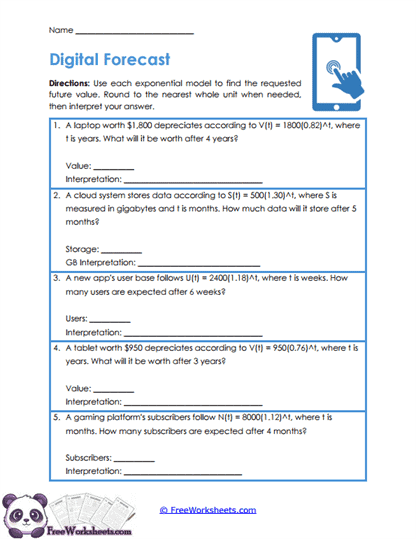
Students evaluate five exponential models involving laptop depreciation, cloud storage, app users, tablet value, and gaming subscriptions. They substitute a given time into each model, calculate the resulting output, and then explain what that value means using the units and setting from the original situation.
Target Skill:
This activity develops function evaluation and contextual interpretation at the same time. Students reinforce growth and decay behavior, exponent substitution, calculator use, and the idea that an exponential model connects an input such as time with a meaningful real-world output.
Equation Builder
What Kids Do:
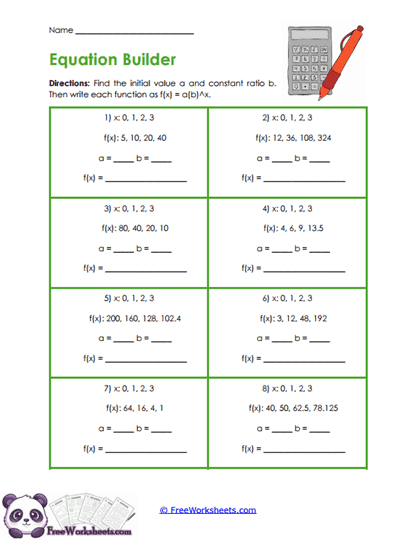
Students analyze eight tables whose outputs change by a constant multiplicative factor. They identify the starting value when the input is zero, calculate the common ratio between consecutive outputs, decide whether the pattern represents growth or decay, and write the matching exponential function.
Target Skill:
Students strengthen the connection between numerical data and symbolic exponential models. The worksheet reinforces initial values, constant ratios, function construction, and the 12th grade skill of recognizing how repeated multiplication appears in tabular form.
Exponent Inputs
What Kids Do:
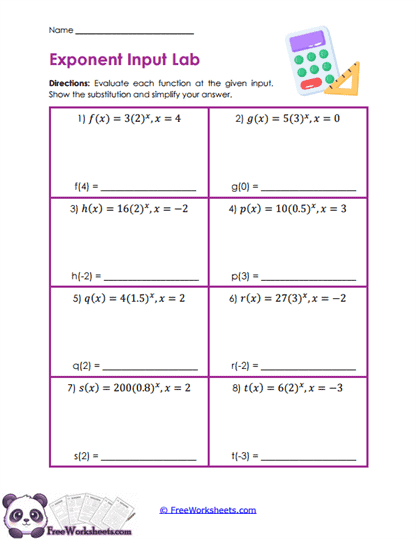
Students evaluate eight exponential functions at specified input values, including positive numbers, zero, and negative numbers. They replace the variable in the exponent with the given value, apply exponent rules carefully, and simplify the resulting expression to find the function output.
Target Skill:
This worksheet develops fluency with function notation and exponential evaluation. Students review positive, zero, and negative exponents while building a stronger understanding of how exponential outputs change as the input moves through different values.
Factor Pairing
What Kids Do:
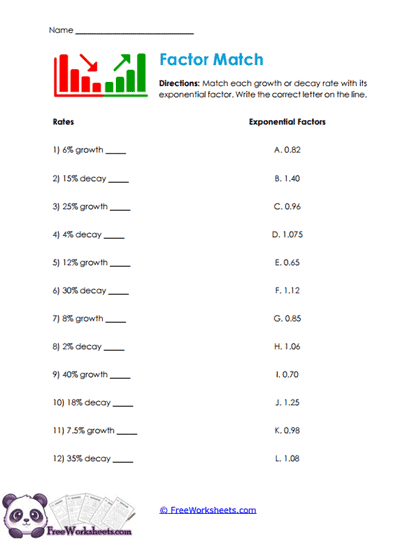
Students match twelve growth and decay percentages with the correct exponential multipliers. They convert growth rates by adding the decimal rate to one and convert decay rates by subtracting the decimal rate from one before finding the matching factor.
Target Skill:
Students build accuracy moving between verbal percent change and exponential factors. The activity reinforces the difference between a rate and a multiplier and prepares students to construct correct growth and decay models from written situations.
Feature Search
What Kids Do:
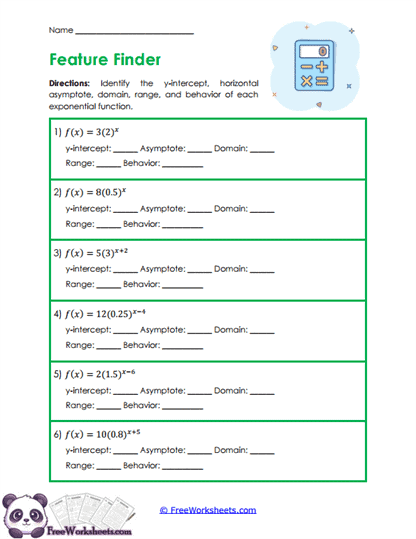
Students analyze six exponential functions and determine each function’s y-intercept, horizontal asymptote, domain, range, and end behavior. The set includes basic growth and decay equations as well as shifted functions, so students must consider how changes in the equation affect the graph.
Target Skill:
This activity develops a deeper understanding of exponential graphs beyond plotting individual points. Students reinforce function evaluation, asymptotes, domain and range, vertical shifts, and long-term behavior while learning how equation structure predicts graph features.
Growth Check
What Kids Do:
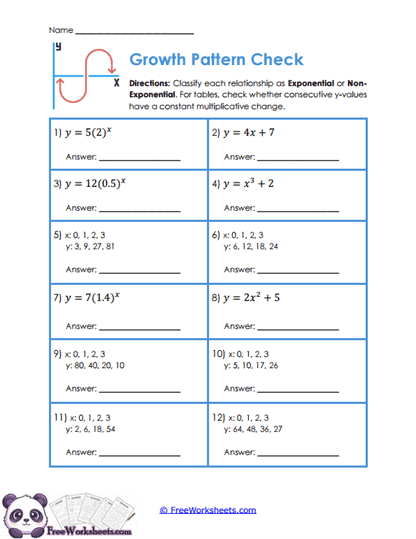
Students inspect twelve equations and tables and decide whether each relationship is exponential. For tables, they compare consecutive outputs to determine whether a constant ratio exists, while equations require them to distinguish variables in exponents from polynomial powers.
Target Skill:
Students learn to recognize the defining structure of exponential functions across multiple representations. The worksheet reinforces constant multiplicative change, constant ratios, and the distinction between exponential, linear, and polynomial relationships.
Model Errors
What Kids Do:
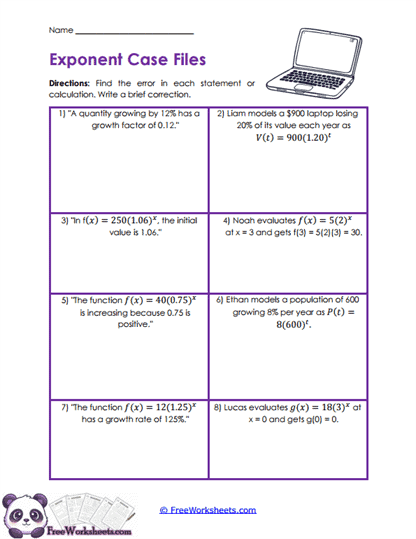
Students examine eight incorrect exponential statements or worked models involving starting values, growth factors, decay factors, function evaluation, and percent rates. They identify the specific mistake, explain why the setup is incorrect, and rewrite the model or calculation properly.
Target Skill:
Error analysis helps students understand what each part of an exponential function represents. The activity reinforces initial values, factors, rates, exponents, and evaluation while building stronger self-checking habits for 12th grade pre-calculus modeling.
Model Writing
What Kids Do:
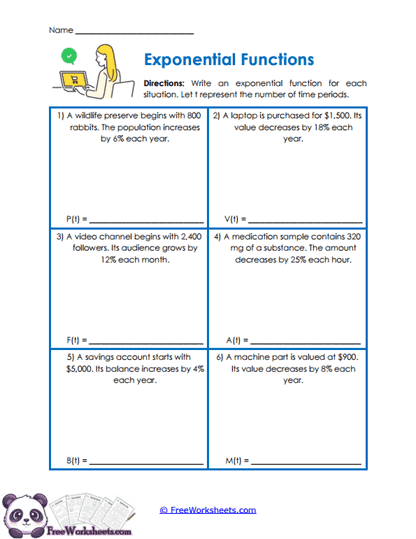
Students read six real-world situations involving wildlife, technology, medicine, savings, and depreciation. They identify the initial amount, decide whether the quantity grows or decays, convert the percent change into the correct multiplier, and write an exponential function using the appropriate time variable.
Target Skill:
Students translate verbal descriptions into mathematical models. The worksheet reinforces initial-value reasoning, percent-to-factor conversion, growth versus decay, and the connection between repeated percent change and exponential equations.
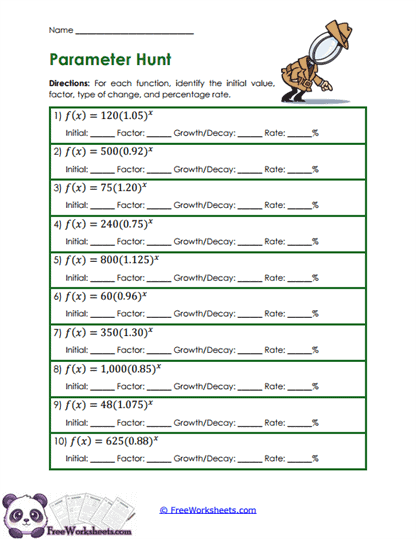
Parameter Search
What Kids Do:
Students examine ten exponential functions and identify the initial value, exponential factor, growth or decay classification, and percent rate of change. They interpret the coefficient and repeated multiplier separately so they can explain what each part of the function means.
Target Skill:
This activity strengthens structural understanding of exponential equations. Students learn to distinguish the starting amount from the growth or decay factor and convert that factor into a meaningful percentage rate.
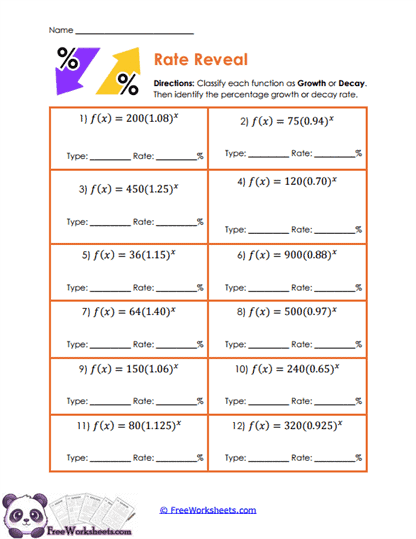
Rate Reveal
What Kids Do:
Students study twelve exponential functions and decide whether each represents growth or decay by comparing the base factor with one. They then convert each factor into the corresponding percent increase or decrease and describe the function’s rate of change.
Target Skill:
Students build fluency interpreting exponential factors. The worksheet reinforces that factors above one represent growth, factors between zero and one represent decay, and the distance from one determines the actual percent rate.
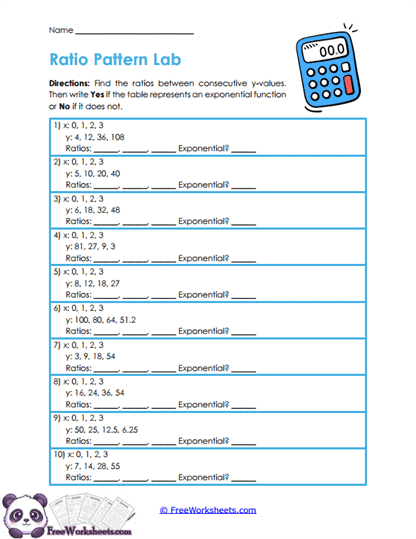
Ratio Patterns
What Kids Do:
Students work through ten tables and divide each new output by the previous output to calculate consecutive ratios. They compare those ratios to determine whether the relationship is exponential and identify whether a constant factor greater than or less than one indicates growth or decay.
Target Skill:
This worksheet strengthens numerical recognition of exponential behavior. Students learn to use constant ratios instead of constant differences and build the reasoning needed to move from table patterns into exponential equations.
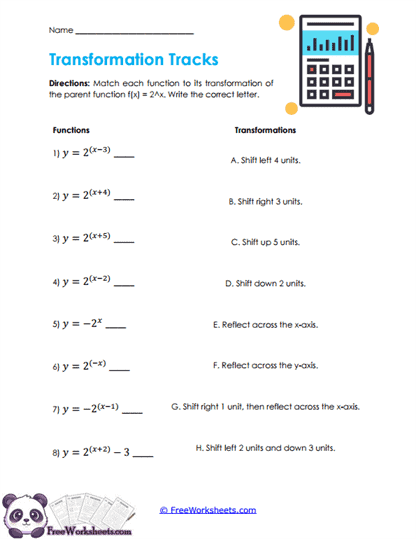
Transformation Match
What Kids Do:
Students compare eight transformed exponential equations with a parent function and identify the corresponding graph movement. They analyze horizontal shifts, vertical shifts, reflections across horizontal or vertical axes, and combinations of transformations based on changes inside and outside the exponential expression.
Target Skill:
Students develop efficient graph analysis by connecting equation changes with transformations of a parent exponential function. The activity reinforces shift direction, reflections, and the distinction between changes made inside the exponent and changes made outside the function.