
About This Worksheet
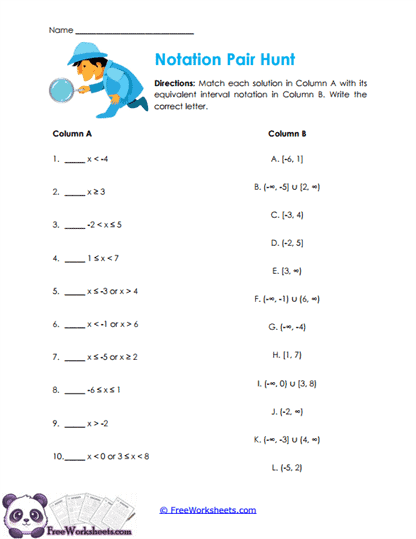
This worksheet helps twelfth-grade Pre-Calculus students practice matching inequality statements with equivalent interval notation. Students work with ten solution descriptions in one column and a bank of interval forms in another. The examples include single intervals, rays extending forever, and solutions made from two separate pieces.
The activity focuses on translating between two common ways of describing a solution set. Students must pay close attention to whether endpoints are included, whether the solution goes left or right on the number line, and whether two intervals need to be joined together.
What Students Practice
Students practice turning statements such as “x is less than 4” or “x is at least 3” into interval notation. They also work with compound conditions such as values less than one number or greater than another.
The worksheet reinforces the meaning of parentheses and brackets. A bracket means the endpoint is included, while a parenthesis means it is not. Values extending toward infinity always use parentheses because infinity is not an actual endpoint.
Students also practice recognizing unions. When a solution has two separate pieces on the number line, those intervals are written together as one combined solution.
Why This Skill Matters
Interval notation is the standard way to write many nonlinear inequality solutions. Students may understand which numbers work but still need to communicate that answer clearly and correctly.
This skill is especially important with polynomial and rational inequalities because their solution sets often contain more than one interval. Accurate endpoint notation shows whether each boundary value belongs in the solution.
Common Challenges
Students may confuse brackets and parentheses. Remind them that included finite endpoints use brackets, while excluded endpoints use parentheses.
Another common mistake is using a bracket with infinity. Infinity is not a number that can be included, so it always gets a parenthesis.
Students may also misread an “or” statement as one continuous interval. When the solution has a gap in the middle, it must be written as two separate intervals joined together.
How To Use It
Teachers can use this worksheet as interval-notation review before or after solving nonlinear inequalities. It works well for matching practice, partner work, homework, or a quick check for understanding.
Parents and homeschool teachers can ask, “Is the endpoint included?” and “Does the solution keep going forever or stop somewhere?” Those two questions help students choose the correct interval form.
Grade Alignment
This worksheet is intended for Grade 12 Pre-Calculus students using interval notation with nonlinear inequalities. It reinforces exact communication of solution sets and endpoint behavior.
Students should already understand inequality symbols and number-line solutions. After this practice, they are ready to select and evaluate full interval solutions for nonlinear inequalities.