
About This Worksheet
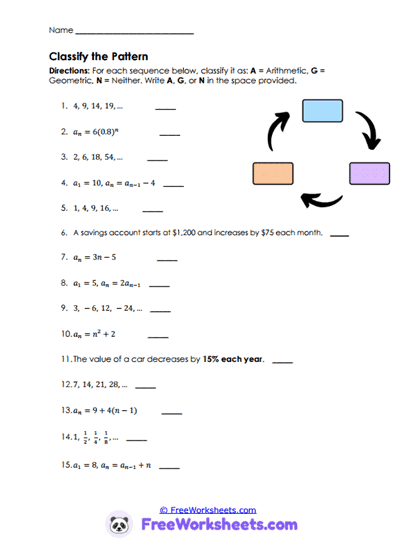
This worksheet is all about spotting patterns fast and figuring out what kind of sequence you’re looking at. Students work through a mix of number patterns, formulas, recursive rules, and real-world situations to decide whether each sequence is arithmetic, geometric, or neither. Some patterns look obvious at first but get tricky once students actually test them. It’s a good mix of quick thinking and careful reasoning.
Curriculum and Grade Alignment
This worksheet supports Algebra 2 standards involving sequence classification and pattern analysis. Students practice identifying common differences, common ratios, and patterns hidden inside formulas and contexts. Before working on this activity, students should already know the basics of arithmetic and geometric sequences. This type of practice builds the foundation for explicit formulas and long-term growth modeling later on.
Student Tasks
Students classify each sequence as arithmetic, geometric, or neither. They’ll look at sequences shown as formulas, recursive definitions, tables, and real-world growth situations. Some problems involve increasing patterns, while others shrink over time. Students also practice recognizing that not every pattern fits neatly into one category.
Common Challenges and Misconceptions
Students sometimes assume that every pattern with multiplication must be geometric, even when the ratio changes. Others focus only on whether numbers go up or down instead of checking if the change stays consistent. Recursive formulas can also confuse students because the pattern is described differently than in a normal list of terms. Reminding students to compare consecutive terms carefully usually helps clear things up.
Implementation Guidance
This worksheet works great as a warm-up, stations activity, or quick classification challenge. Teachers can encourage students to explain why they chose arithmetic or geometric instead of only writing the answer. Parents helping at home can ask students to test two or three jumps in the sequence before deciding. That extra checking step catches a lot of mistakes.
Details and Features
The worksheet includes recursive formulas, explicit formulas, number lists, and real-world sequence examples. Students work through both positive and negative patterns as well as percentage growth and decay. The layout is clean and quick to follow, making it useful for independent practice or review sessions. The variety keeps the activity from feeling repetitive.