
About This Worksheet
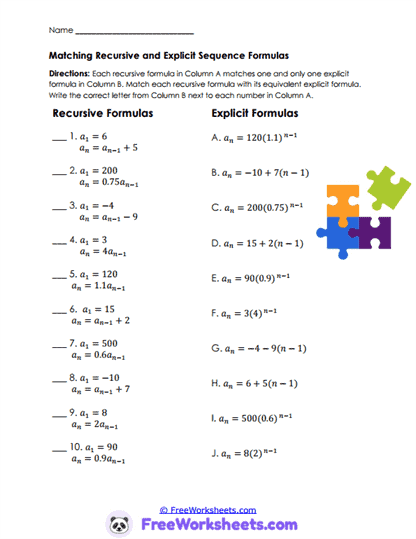
Recursive and explicit formulas describe the same sequence in different ways. This worksheet helps students connect recursive rules with equivalent explicit formulas through pattern analysis and reasoning. Students strengthen their understanding of how sequences grow over time. The activity builds flexibility in interpreting sequence notation and structure.
Curriculum and Grade Alignment
This worksheet supports Algebra 2 standards involving recursive and explicit sequence formulas. The main learning goal is to recognize equivalent representations of arithmetic and geometric sequences. Students should already understand common differences, common ratios, and sequence notation before beginning. The next learning step is advanced sequence modeling and series. This aligns with high school algebra standards involving sequences.
Student Tasks
On this worksheet, students will match recursive formulas to equivalent explicit formulas. They will analyze sequence growth patterns and identify arithmetic or geometric relationships. Students also compare formulas based on starting values and rates of change. Several problems require reasoning about recursive definitions.
Common Challenges and Misconceptions
Some students may confuse the common difference with the common ratio. Others may struggle to recognize how recursive and explicit forms describe the same pattern. A common mistake is overlooking the starting term when comparing formulas. Teachers can help by encouraging students to generate sample terms from each formula.
Implementation Guidance
This worksheet works well after students have learned both recursive and explicit forms. Teachers can model how to compare formulas by generating several terms before assigning practice. Parents helping at home can ask students to explain how the formulas produce the same sequence. Verbal reasoning strengthens conceptual understanding.
Details and Features
The worksheet includes matching tasks involving arithmetic and geometric sequence formulas. Students practice comparing recursive and explicit representations systematically. The printable format supports organization and analytical reasoning. The matching structure reinforces connections between multiple algebraic forms.