
About This Worksheet
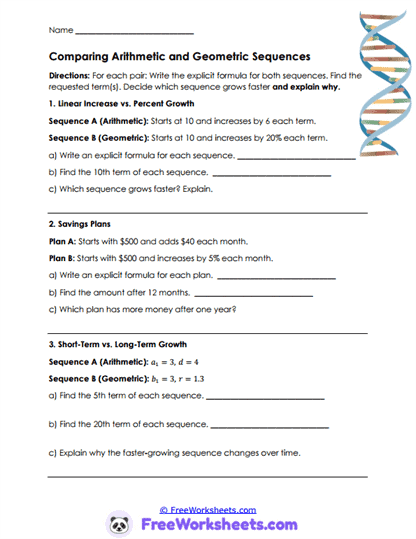
This worksheet puts arithmetic and geometric sequences head-to-head so students can really see the difference between steady growth and fast growth. At first, some arithmetic sequences seem bigger, but geometric patterns eventually explode way past them. Students compare formulas, calculate terms, and explain which sequence grows faster over time. The problems are designed to feel more like real decision-making instead of just plugging numbers into formulas.
Curriculum and Grade Alignment
This worksheet supports Algebra 2 standards involving arithmetic and geometric sequence formulas, growth comparisons, and long-term behavior analysis. Students practice writing explicit formulas, evaluating terms, and interpreting how sequences change over time. Before starting, students should already know how to identify common differences and common ratios. This lesson helps students build intuition about linear versus exponential growth.
Student Tasks
Students compare arithmetic and geometric sequences using formulas, tables, and real-world scenarios. They calculate terms far into the sequence, determine which pattern grows faster, and explain why. Some problems involve savings accounts, subscriber growth, and percent increase situations. Students also practice defending their reasoning in complete sentences instead of giving one-word answers.
Common Challenges and Misconceptions
A lot of students think the sequence with the larger starting number will always stay larger. Others focus too much on early terms and miss how geometric growth eventually overtakes arithmetic growth. Percentage growth situations can also trip students up because they require multiplication instead of addition. Encouraging students to compare several later terms usually helps the pattern become obvious.
Implementation Guidance
This worksheet works really well for class discussions because students often disagree at first about which sequence grows faster. Teachers can pause after a few problems and ask students to predict long-term behavior before calculating. Parents helping at home can encourage students to explain what happens “over time” instead of only solving for one term. The conversational setup makes it easier for students to connect the math to real situations.
Details and Features
The worksheet includes arithmetic formulas, geometric formulas, percent growth, long-term comparisons, and real-world modeling situations. Students solve multi-step comparison problems and justify conclusions using sequence vocabulary. The printable format leaves room for calculations and written explanations. The problems gradually increase in difficulty while staying approachable.