
About This Worksheet
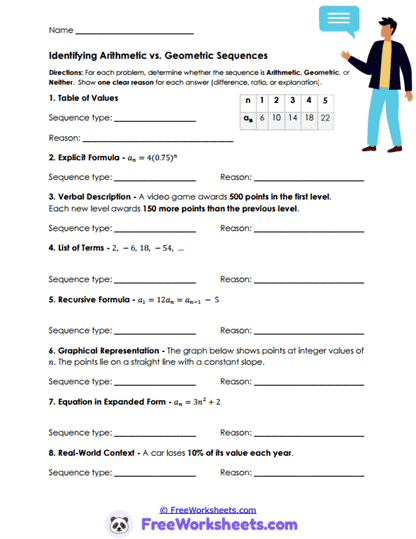
Sequences can grow through repeated addition, repeated multiplication, or other changing patterns. This worksheet helps students identify whether a sequence is arithmetic, geometric, or neither using tables, formulas, verbal descriptions, and graphs. Students practice recognizing common differences and common ratios in many forms. The activity strengthens pattern recognition and algebraic reasoning.
Curriculum and Grade Alignment
This worksheet supports Algebra 2 standards involving arithmetic and geometric sequences. The main learning goal is to classify sequences based on how terms change. Students should already understand basic multiplication, subtraction, and pattern recognition before beginning. The next learning step is writing recursive and explicit formulas. This aligns with high school algebra sequence standards.
Student Tasks
On this worksheet, students will classify sequences as arithmetic, geometric, or neither. They will analyze tables, equations, verbal descriptions, recursive formulas, and real-world situations. Students also explain their reasoning using common differences or common ratios. Several problems require interpreting patterns from multiple representations.
Common Challenges and Misconceptions
Some students may confuse multiplying by a ratio with adding a difference. Others may focus only on whether numbers increase or decrease without checking consistency. A common mistake is assuming all growing patterns are arithmetic. Teachers can help by encouraging students to compare consecutive terms carefully.
Implementation Guidance
This worksheet works well as an introduction to sequence classification. Teachers can model how to test for common differences and ratios before assigning independent work. Parents helping at home can ask students to explain why a pattern is arithmetic or geometric. Verbal explanation helps strengthen conceptual understanding.
Details and Features
The worksheet includes sequence classification problems using tables, formulas, graphs, and real-world contexts. Students practice identifying structure and justifying conclusions mathematically. The printable format provides organized space for reasoning and explanations. The varied representations support deeper understanding of sequence behavior.