
About This Worksheet
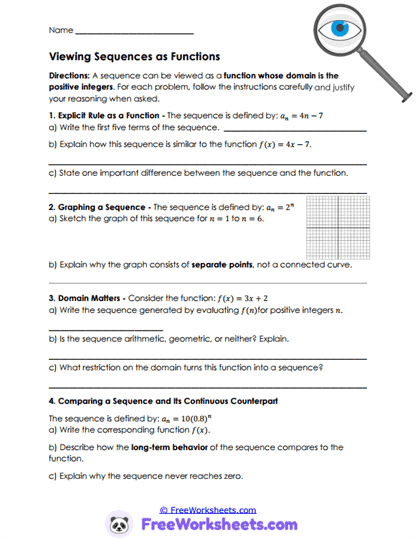
This worksheet helps students think about sequences in a slightly different way – as functions with restricted domains. Instead of viewing sequences as just lists of numbers, students connect them to equations, graphs, and function behavior. The activities focus on understanding why sequence graphs look like separate dots instead of continuous lines and how functions can generate sequence terms.
Curriculum and Grade Alignment
This worksheet supports Algebra 2 standards involving sequences as functions, domain restrictions, and graph interpretation. Students practice connecting explicit sequence rules to function notation and discrete graphs. Before starting, students should already understand basic function notation and arithmetic or geometric sequence formulas. This lesson helps bridge algebraic functions and sequence concepts together.
Student Tasks
Students generate terms from sequence formulas, compare sequences to continuous functions, and graph discrete sequence points. They explain why sequences use only certain domain values and analyze how restricting the domain changes the graph. Some questions involve comparing long-term sequence behavior to its related function. Students also justify why sequences appear as individual points instead of connected curves.
Common Challenges and Misconceptions
A lot of students want to connect the points on a sequence graph like a normal function graph. Others struggle with the idea that sequences only use specific domain values instead of all real numbers. Students may also confuse the explicit formula with the generated sequence itself. Reinforcing that sequences use whole-number inputs only usually helps clear things up.
Implementation Guidance
This worksheet works especially well after students have already practiced explicit sequence formulas. Teachers can project sequence graphs and ask students why the graph is not continuous. Parents helping at home can encourage students to compare sequence inputs to normal function inputs. Those conversations help students understand why sequences are considered discrete.
Details and Features
The worksheet includes explicit formulas, sequence graphs, domain restrictions, function comparisons, and discrete modeling tasks. Students analyze sequence behavior visually and algebraically while practicing written explanations. The printable design provides room for graph sketches and reasoning. The conversational tone keeps the ideas approachable even when the concepts become more abstract.