
About This Worksheet
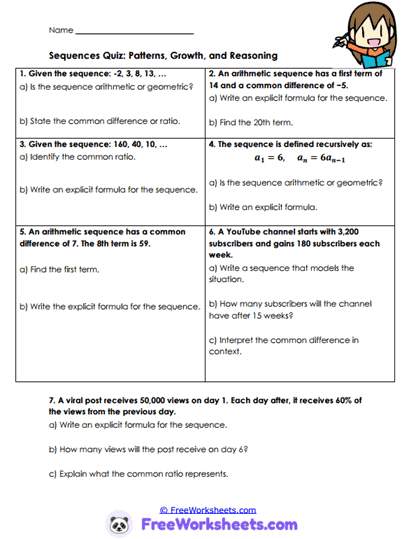
This worksheet mixes together arithmetic and geometric sequence skills in a fast-paced review format. Students identify patterns, write formulas, calculate terms, and explain what the numbers mean in context. Some problems are straightforward while others require students to slow down and really think about how the sequence changes. The variety keeps students from relying on memorized shortcuts alone.
Curriculum and Grade Alignment
This worksheet supports Algebra 2 standards involving arithmetic sequences, geometric sequences, recursive rules, explicit formulas, and sequence modeling. Students practice identifying sequence behavior and applying formulas in both numeric and contextual situations. Before beginning, students should already understand sequence vocabulary and formula structure. This worksheet serves as strong review and reinforcement practice.
Student Tasks
Students identify sequence types, calculate missing terms, write formulas, and solve real-world growth problems. They work with recursive rules, explicit formulas, and verbal descriptions. Some problems involve checking whether a pattern grows by addition or multiplication, while others focus on interpreting what sequence values mean in context. Students also explain reasoning on selected questions.
Common Challenges and Misconceptions
Students often rush into calculations before identifying the type of sequence correctly. Recursive notation can also confuse students because it looks different from explicit formulas. Another common issue is treating percent growth like repeated addition instead of repeated multiplication. Encouraging students to label the common difference or ratio first can help organize their thinking.
Implementation Guidance
This worksheet works well as review before a quiz or assessment on sequences. Teachers can use it as station work, homework, or quick partner practice. Parents helping at home can ask students to explain how they decided whether the sequence was arithmetic or geometric before solving. The conversational wording helps students stay focused without getting intimidated by the algebra.
Details and Features
The worksheet includes arithmetic sequences, geometric sequences, recursive formulas, explicit formulas, growth modeling, and interpretation questions. Students complete mixed review problems that combine procedural fluency with conceptual reasoning. The printable design includes space for calculations and written explanations. The problems vary in style to encourage flexible thinking.