
About This Worksheet
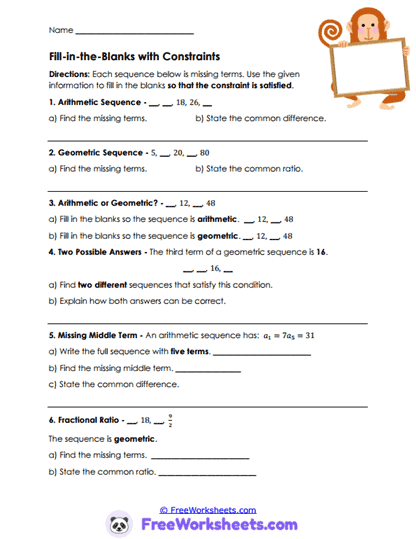
Sometimes sequences give you just enough information to figure out the whole pattern – and that’s exactly what students practice here. This worksheet focuses on filling in missing numbers while deciding whether a pattern is arithmetic or geometric. Students use clues like common differences, common ratios, and partial terms to complete sequences correctly. Some problems even have more than one possible answer, which pushes students to think more deeply instead of just hunting for one number.
Curriculum and Grade Alignment
This worksheet supports Algebra 2 sequence standards focused on arithmetic and geometric reasoning. Students practice identifying patterns, finding missing terms, and explaining how they know a sequence works. Before starting, students should already know how to find a common difference and common ratio. This kind of work helps prepare students for writing recursive and explicit formulas later on.
Student Tasks
Students will fill in missing values in arithmetic and geometric sequences using the clues provided. Some questions ask them to explain why a sequence works, while others ask for multiple valid solutions. They’ll also practice finding middle terms, identifying sequence types, and reasoning through patterns that aren’t immediately obvious. The problems gradually get more challenging as students move through the worksheet.
Common Challenges and Misconceptions
A lot of students accidentally use addition when the pattern is actually multiplication. Others notice the first step in the pattern but forget to check whether the pattern stays consistent all the way through. One of the trickiest parts is understanding that some sequence problems can have more than one correct answer depending on the rules. Encouraging students to explain their reasoning out loud can really help slow down careless mistakes.
Implementation Guidance
This worksheet works really well as partner practice or small-group discussion work because students naturally compare strategies. Teachers can pause after a few questions and ask students how they knew whether a sequence was arithmetic or geometric. Parents helping at home can ask questions like, “What’s happening between the numbers?” instead of jumping right to the answer. That simple shift usually helps students notice the pattern themselves.
Details and Features
The worksheet includes arithmetic sequences, geometric sequences, missing middle terms, and open-ended pattern questions. Students work with whole numbers, fractions, and multi-step reasoning tasks. The printable layout gives students room to test ideas and show calculations. The mix of straightforward and tricky problems keeps students thinking the whole time.