
About This Worksheet
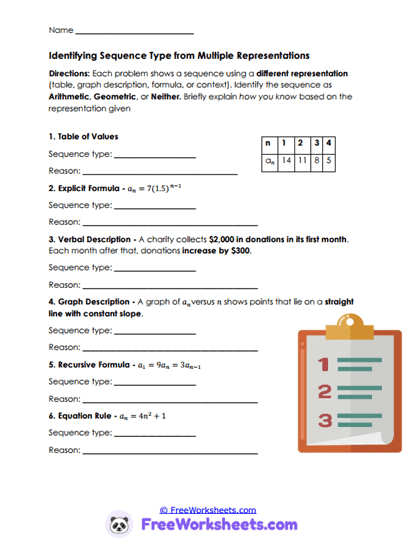
This worksheet feels a little like detective work. Students are given sequences in different forms – tables, formulas, descriptions, graphs, and recursive rules – and they have to figure out what type of pattern is hiding underneath. The goal isn’t just getting the right label, but explaining why the sequence works the way it does. Students practice looking for clues that point to arithmetic growth, geometric growth, or neither.
Curriculum and Grade Alignment
This worksheet supports Algebra 2 sequence standards involving multiple representations of arithmetic and geometric sequences. Students strengthen their ability to recognize patterns no matter how the information is presented. Before starting, students should already understand common differences and common ratios. This lesson helps bridge basic pattern recognition into more advanced sequence modeling.
Student Tasks
Students identify whether each sequence is arithmetic, geometric, or neither using tables, verbal descriptions, formulas, graphs, and recursive equations. They also explain their reasoning using sequence vocabulary like “common difference” and “common ratio.” Several questions ask students to justify answers instead of simply labeling the sequence. This pushes students to think more carefully about how patterns behave.
Common Challenges and Misconceptions
One big challenge is switching between different sequence representations. Students may recognize arithmetic patterns in a list but struggle when the same idea appears in a formula or graph description. Another common issue is confusing linear-looking growth with multiplicative growth. Encouraging students to test consecutive terms step by step usually helps them spot the correct pattern.
Implementation Guidance
This worksheet works especially well for review days or mixed-practice lessons because students see sequences in many different formats. Teachers can have students compare answers in pairs and defend their reasoning. Parents helping at home can focus on asking students what changes between terms instead of asking for the final answer immediately. Those conversations help students build stronger reasoning habits.
Details and Features
The worksheet includes sequence classification using tables, formulas, recursive rules, graphs, and contextual situations. Students explain reasoning using algebra vocabulary and compare multiple representations. The printable design gives enough room for written explanations and calculations. The variety keeps students engaged while reinforcing core sequence concepts.