
About This Worksheet
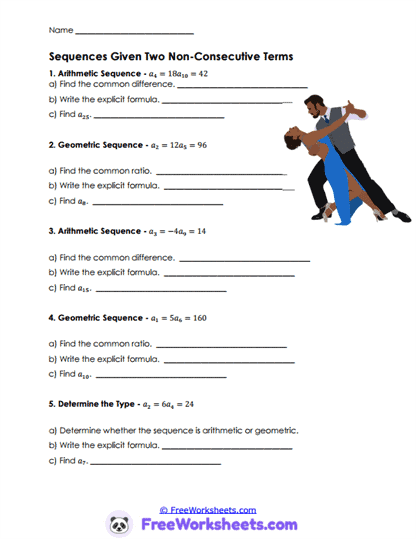
Not every sequence gives away the rule right away – and that’s what makes this worksheet fun. Students are given non-consecutive terms and have to work backwards to uncover the pattern hiding underneath. Some sequences are arithmetic, some are geometric, and some require a little detective work before the formula finally clicks. The focus is on reasoning, not memorizing shortcuts.
Curriculum and Grade Alignment
This worksheet supports Algebra 2 standards involving arithmetic and geometric sequence formulas using non-consecutive terms. Students practice solving for common differences, common ratios, and explicit formulas from limited information. Before beginning, students should understand how explicit formulas are structured for both arithmetic and geometric sequences. This lesson strengthens algebraic reasoning and pattern reconstruction skills.
Student Tasks
Students use pairs of non-consecutive terms to determine sequence rules and write explicit formulas. They solve for missing common differences or ratios and calculate later terms in the sequence. Some problems ask students to first identify whether the sequence is arithmetic or geometric before building the formula. The worksheet also includes mixed practice where students explain how they know which type of sequence they’re working with.
Common Challenges and Misconceptions
Students sometimes use the wrong term numbers when setting up formulas, especially with larger subscripts. Geometric sequences can also become tricky because students may try adding instead of multiplying. Another common issue is forgetting that arithmetic and geometric formulas behave very differently when terms are far apart. Having students label the term numbers clearly before solving usually helps prevent mistakes.
Implementation Guidance
This worksheet works great for independent practice once students already understand basic sequence formulas. Teachers can encourage students to write out smaller examples if they get stuck. Parents helping at home can ask students to explain whether the pattern changes by addition or multiplication before solving anything. That simple question often points students in the right direction immediately.
Details and Features
The worksheet includes arithmetic sequences, geometric sequences, non-consecutive term analysis, formula writing, and term evaluation. Students solve both direct and mixed classification problems while explaining their reasoning. The printable format provides room for setup work and calculations. The problems emphasize algebraic thinking more than repetitive computation.