
About This Worksheet
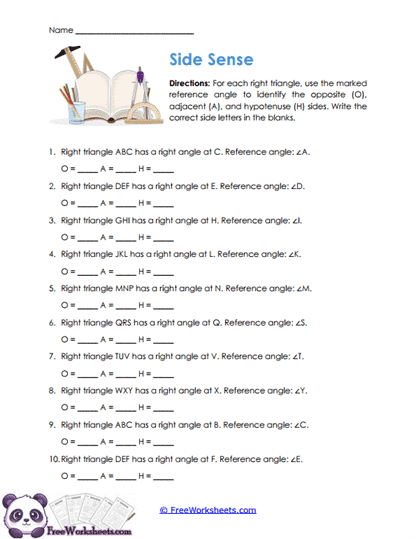
This worksheet helps tenth-grade students practice identifying the opposite, adjacent, and hypotenuse sides of a right triangle from a chosen reference angle. Students work through ten right-triangle descriptions and label each side as O for opposite, A for adjacent, or H for hypotenuse. The important idea is that the hypotenuse always stays the same, while the opposite and adjacent sides can change depending on which acute angle is being used as the reference.
For example, if a right triangle has its right angle at C and the reference angle is ∠A, students first identify the side across from C as the hypotenuse. Then they look at ∠A: the side directly across from that angle is opposite, while the remaining non-hypotenuse side touching ∠A is adjacent. This gives students the foundation they need before choosing sine, cosine, or tangent.
What Students Practice
Students practice locating the hypotenuse by finding the side opposite the 90° angle. They then use the marked reference angle to decide which leg is opposite and which leg is adjacent. This helps students understand that side names depend on perspective.
The worksheet also reinforces triangle notation. Students must read the triangle letters carefully and identify sides by their endpoints. This combines geometry vocabulary with the side relationships needed for right-triangle trigonometry.
Why This Skill Matters
SOH-CAH-TOA only works when students correctly identify the side roles. If the opposite and adjacent sides are mixed up, they may choose the wrong trig ratio even if every later calculation is correct. This worksheet gives focused practice on that first important step.
Understanding side roles also helps students make sense of trigonometry rather than memorizing formulas blindly. Sine, cosine, and tangent each compare particular sides relative to a chosen angle. Knowing those sides makes the ratios much easier to understand.
Common Challenges
Students may assume the bottom or horizontal side is always adjacent. Remind them that “adjacent” means the non-hypotenuse side touching the reference angle. The triangle can be turned any direction and the relationship still works the same way.
Another common mistake is changing the hypotenuse when the reference angle changes. The hypotenuse never changes because it is always opposite the right angle. Only opposite and adjacent switch when the reference angle changes.
How To Use It
Teachers can use this worksheet as the first practice page in a SOH-CAH-TOA unit. It works well for guided instruction, independent work, homework, or a quick prerequisite check before students choose trig ratios. Drawing one sample triangle and changing the reference angle can clearly show how opposite and adjacent switch roles.
Parents and homeschool teachers can use a simple order: find the 90° angle first, identify the hypotenuse, and then look at the reference angle. Ask, “Which side is across from this angle?” for opposite, and the remaining leg becomes adjacent.
Grade Alignment
This worksheet is designed for Grade 10 geometry and supports CCSS HSG-SRT.C.6, which asks students to understand that side ratios in right triangles are properties of the acute angles and to define the trigonometric ratios. Correct identification of opposite, adjacent, and hypotenuse sides is the foundation for that standard.
Students should already understand right triangles and angle notation. After this practice, they can move into deciding whether sine, cosine, or tangent is the correct ratio to use.