
About This Worksheet
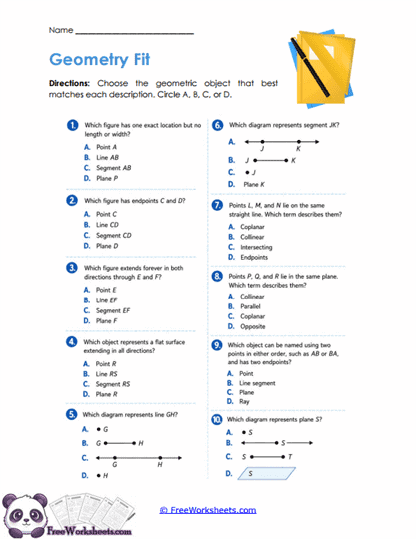
This worksheet helps tenth-grade students choose the geometric object or relationship that best matches each description or diagram. Students answer ten multiple-choice questions covering points, lines, segments, planes, collinear points, coplanar points, endpoints, and geometric naming. The mixed format gives students a final review of the main ideas from the entire topic.
For example, one question may ask which figure has one exact location but no length or width, while another asks which object has two endpoints. Other questions use diagrams and ask students to identify whether the picture represents a line, segment, or plane. Students must use both vocabulary and visual clues to select the correct answer.
What Students Practice
Students practice distinguishing among basic geometric objects and relationships. They review definitions, notation, endpoints, collinearity, coplanarity, and alternate naming. This gives them a broad check of foundational geometry understanding.
The worksheet also strengthens test-style reasoning. Several answer choices may look reasonable at first, so students must read the question carefully and eliminate choices that do not match the full definition. This helps them become more precise.
Why This Skill Matters
Foundational geometry vocabulary appears in nearly every later topic. Students who can quickly identify a point, line, segment, plane, or geometric relationship have an easier time reading diagrams and understanding more advanced problems.
The multiple-choice format also helps students practice recognizing the best answer among close alternatives. That skill is useful on quizzes, tests, and standardized assessments where small differences in wording matter.
Common Challenges
Students may choose a familiar word without checking the full definition. Remind them that a point has no length, a segment has two endpoints, and a line continues forever in both directions. Exact wording matters.
Another common mistake is confusing collinear and coplanar. Collinear points lie on one line, while coplanar points lie in the same plane. Several points can be coplanar without being collinear.
How To Use It
Teachers can use this worksheet as an end-of-topic review, quiz preparation, homework, or a short assessment. Because it mixes many skills together, it is useful for checking whether students can recognize concepts without the questions being grouped by type.
Parents and homeschool teachers can ask the student to explain why the three wrong choices do not fit. This adds useful reasoning practice and helps make the correct definition more memorable.
Grade Alignment
This worksheet is intended for Grade 10 geometry and supports CCSS HSG-CO.A.1 by reviewing precise definitions and representations of points, lines, segments, planes, and related geometric ideas. The mixed multiple-choice format gives students a broad final review of the topic.
Students should already understand the basic vocabulary and notation from the unit. After this practice, they are ready to use these foundational ideas in more advanced geometry topics.