
About This Worksheet
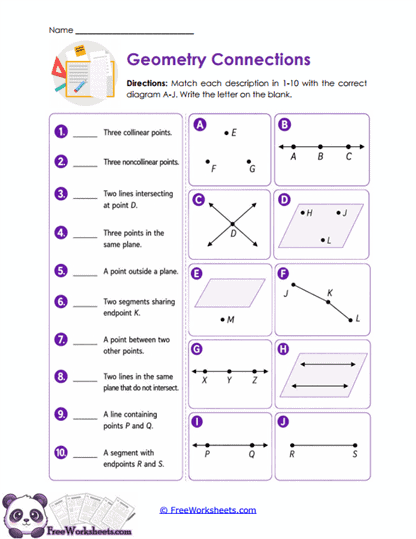
This worksheet helps tenth-grade students match written geometric descriptions with the correct diagrams. Students work through ten statements involving collinear points, noncollinear points, intersecting lines, coplanar points, shared endpoints, points between other points, and lines in the same plane. They then connect each description to a lettered picture. This gives students a broad review of how geometry vocabulary appears visually.
For example, one description may ask for three collinear points, while another asks for three noncollinear points. A different prompt may describe two segments sharing an endpoint or two lines intersecting at a point. Students must compare the wording with the features shown in each diagram.
What Students Practice
Students practice identifying geometric relationships from pictures and matching them with precise descriptions. They review collinearity, coplanarity, intersections, shared endpoints, and point placement. This helps strengthen visual interpretation.
The worksheet also requires careful comparison. Some diagrams may contain similar objects, but only one matches the exact description. Students must look at labels, connections, and plane placement before choosing.
Why This Skill Matters
Geometry problems often describe a relationship in words and expect students to understand what the corresponding diagram should look like. This worksheet helps build that connection between language and visual structure.
The skill also supports proofs and constructions. Students need to recognize whether points are collinear, whether objects lie in the same plane, or whether lines intersect before they can make valid geometric conclusions. Strong matching practice helps make those relationships easier to spot.
Common Challenges
Students may match a diagram because it contains the right number of points without checking whether the relationship is correct. Remind them that three points may be collinear, noncollinear, or coplanar depending on how they are placed. The arrangement matters.
Another common mistake is confusing segments that share an endpoint with intersecting lines. A shared endpoint means the segments meet exactly at one endpoint, while lines can cross anywhere. Encourage students to focus on the specific wording.
How To Use It
Teachers can use this worksheet as a cumulative review of foundational geometry relationships. It works well for independent practice, partner work, homework, or a quick assessment. Asking students to explain one match aloud can reveal whether they understand the vocabulary.
Parents and homeschool teachers can have students read each description and say what the picture should contain before looking at the choices. This makes the matching more thoughtful and reduces guessing.
Grade Alignment
This Grade 10 worksheet supports CCSS HSG-CO.A.1 by reinforcing precise geometric definitions and relationships involving points, lines, segments, and planes. It also strengthens the diagram-reading skills needed for later proof work.
Students should already know basic geometry vocabulary. After this practice, they are ready for more detailed identification and multiple-choice geometry questions.