
About This Worksheet
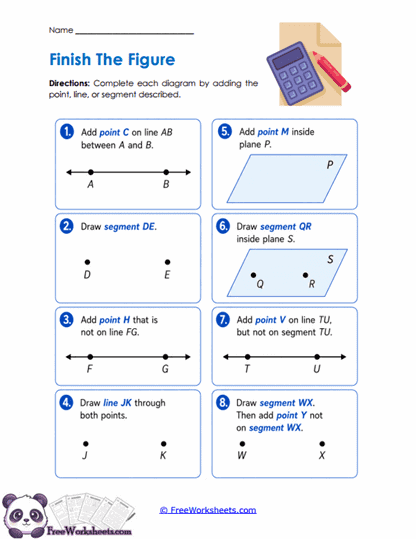
This worksheet helps tenth-grade students practice completing geometric diagrams from written directions. Students work through eight partially finished figures and add the point, line, or segment described in each prompt. Some problems ask them to place a point between two others, draw a line through existing points, or add a point that lies inside or outside a plane. This gives students a chance to turn geometry language into a correct visual model.
For example, one problem shows line AB and asks students to add point C between A and B. Another provides points J and K and asks students to draw line JK through both points. Other tasks involve planes and line segments, so students must pay attention to whether the object should stop at endpoints or continue in both directions.
What Students Practice
Students practice reading geometric instructions carefully and adding the correct object to an existing diagram. They must distinguish between points, lines, line segments, and planes while also following location words such as “between,” “inside,” “on,” and “not on.” This strengthens both vocabulary and visual reasoning.
The worksheet also reinforces geometric notation through drawing. Instead of only naming objects, students must create them correctly. This helps them understand what the symbols and terms actually represent.
Why This Skill Matters
Geometry often requires students to create or complete a diagram before solving a problem. If the diagram is drawn incorrectly, later reasoning can become confusing. This worksheet helps students build the habit of translating words into accurate geometric pictures.
The skill also supports constructions and proofs. Students need to understand exactly what it means for a point to lie on a segment, inside a plane, or on a line. Practicing those ideas visually makes later geometry work easier.
Common Challenges
Students may draw a line segment when the directions ask for a line. Remind them that a line needs arrowheads on both ends, while a segment stops at its two endpoints. Checking the requested object before drawing can prevent this mistake.
Another common issue is placing a point in the wrong relationship to the figure. If the directions say a point is not on a line or segment, it should clearly be placed away from it. Encourage students to reread the location phrase before finishing each diagram.
How To Use It
Teachers can use this worksheet after students understand basic geometry vocabulary and notation. It works well for independent practice, partner checking, homework, or a quick diagram-building activity. Students can also compare drawings to see that more than one picture may be correct if all conditions are satisfied.
Parents and homeschool teachers can ask, “What object do we need to add?” and then, “Where does it need to go?” Breaking the direction into those two parts makes each problem much easier to follow.
Grade Alignment
This worksheet is designed for Grade 10 geometry and supports CCSS HSG-CO.A.1 by reinforcing precise definitions and representations of points, lines, segments, and planes. It also builds the diagram-construction skills students use throughout high-school geometry.
Students should already understand basic geometric objects and location relationships. After this practice, they can move into matching more complex geometric descriptions with diagrams.