
About This Worksheet
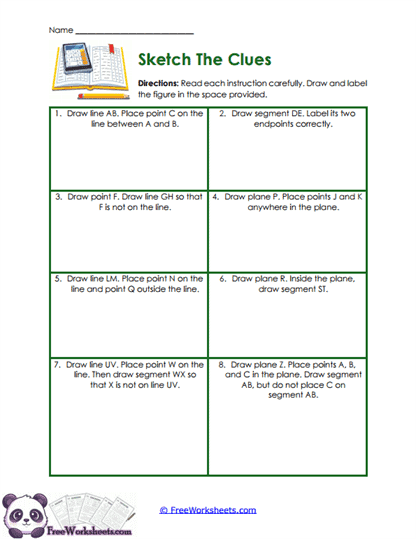
This worksheet helps tenth-grade students draw and label basic geometric figures from written directions. Students work through eight prompts that ask them to create lines, line segments, points, and planes while following specific placement rules. Some directions ask for a point to lie on a line or segment, while others ask for a point to stay off the figure. This gives students practice turning geometric language into an accurate drawing.
For example, one problem asks students to draw line AB and place point C somewhere between A and B. Another asks students to draw a plane and place labeled points inside it. Students must pay close attention to the wording so the final sketch matches every condition given.
What Students Practice
Students practice reading geometric directions carefully and creating a diagram that follows them exactly. They draw points, lines, segments, and planes, then add labels in the correct places. This strengthens both notation and visual reasoning.
The worksheet also reinforces spatial relationships such as “on,” “between,” “inside,” and “outside.” Students must understand what those words mean in geometry and show the relationship correctly in the picture.
Why This Skill Matters
Geometry is not only about reading diagrams; students also need to create them. Drawing from written conditions helps students connect vocabulary with actual geometric structure. This becomes especially useful when they work on constructions, proofs, and word problems.
The skill also encourages precision. A diagram can quickly become misleading if a point is placed in the wrong location or if a line is drawn as a segment. Learning to follow the directions carefully builds better geometric habits.
Common Challenges
Students may draw a segment when the directions ask for a line. Remind them that a line should have arrows showing that it continues in both directions, while a segment has two endpoints. Checking the requested figure type first can prevent this mistake.
Another common issue is putting a point on a figure when the directions say it should be off the figure. Encourage students to underline location words such as “on,” “inside,” or “outside” before drawing.
How To Use It
Teachers can use this worksheet after students have practiced identifying basic geometric figures. It works well for independent practice, partner checking, homework, or a short construction-style activity. Having students compare drawings can show that different sketches can still be correct if all conditions are met.
Parents and homeschool teachers can read each direction aloud and ask, “What must be drawn first?” Then check each location word before adding the next part. This helps students build the picture one step at a time.
Grade Alignment
This worksheet is designed for Grade 10 geometry and supports CCSS HSG-CO.A.1 by reinforcing precise geometric definitions and representations. It also builds the visual communication skills students need for constructions and proof diagrams.
Students should already understand points, lines, segments, and planes. After this practice, they can move into collinear, coplanar, and intersection relationships with more confidence.