
About This Worksheet
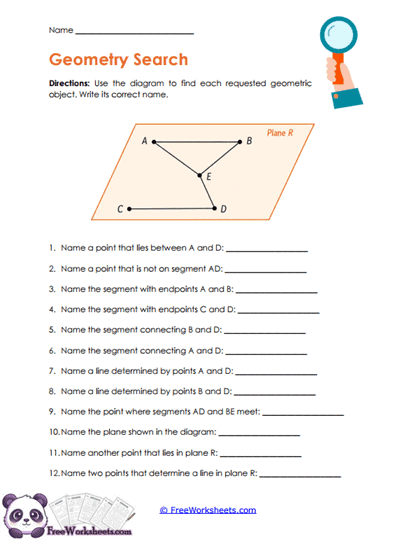
This worksheet helps tenth-grade students find specific points, segments, lines, and planes inside one larger geometric diagram. Instead of looking at isolated pictures, students study a diagram containing plane R and several labeled points connected in different ways. They answer twelve questions by identifying objects and relationships already shown in the figure. This gives students practice reading a diagram as a connected geometric structure.
For example, students may be asked to name the point between A and D, identify the segment connecting B and D, name the line determined by two points, or identify the plane shown. Other questions ask students to find additional points lying in plane R or describe where two segments meet.
What Students Practice
Students practice locating labeled points and using them to name segments and lines correctly. They also identify points that lie between other points and recognize where two segments intersect. This helps students understand how several basic geometric objects can work together in one diagram.
The worksheet also builds familiarity with planes. Students must recognize which labeled points are drawn in plane R and use those points when responding to questions about the plane. This prepares them for later work with coplanar and noncoplanar objects.
Why This Skill Matters
Real geometry problems rarely show only one isolated point or line. Students usually need to interpret several geometric objects at the same time and decide how they relate. This worksheet gives them practice finding useful information inside a larger figure.
The skill also supports proof writing. Before students can explain why two objects have a certain relationship, they need to read the diagram accurately and name the objects involved. Strong diagram-reading skills make later geometric reasoning much easier.
Common Challenges
Students may name a segment when the question asks for a line, or vice versa. Encourage them to read the requested object carefully before writing the answer. A segment is limited to its endpoints, while a line is understood to continue in both directions.
Another common mistake is confusing “between” with simply being nearby. A point between two others must lie on the same straight path with the other two points. Students should use the actual connections in the diagram instead of judging by visual closeness alone.
How To Use It
Teachers can use this worksheet after students know the basic geometric figures but before introducing more formal ideas such as collinearity and coplanarity. It works well for guided practice, independent work, homework, or a diagram-reading warm-up.
Parents and homeschool teachers can encourage students to point to each object before naming it. Ask, “Which two labeled points make this segment?” or “Which points are actually drawn inside the plane?” Physically tracing the diagram can make the relationships easier to understand.
Grade Alignment
This worksheet is intended for Grade 10 geometry and supports CCSS HSG-CO.A.1 by reinforcing precise use of points, lines, segments, and planes. It also develops the diagram-reading skills students need when working with collinear and coplanar relationships.
Students should already know how to identify the four basic geometric objects. After this practice, they can move into constructing diagrams, identifying collinear points, and reasoning about objects that lie in the same plane.