
About This Worksheet
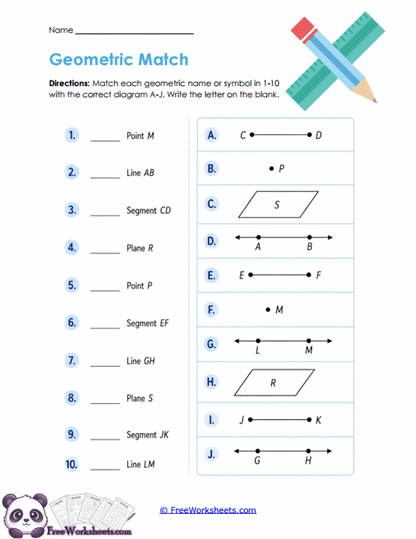
This worksheet helps tenth-grade students match geometric names and notation with the correct diagrams. Students are given ten descriptions on one side of the page, such as Point M, Line AB, Segment CD, and Plane R. They then choose the letter of the picture that correctly represents each object. This matching format gives students a quick way to practice both visual recognition and geometry vocabulary.
The diagrams include dots, two-ended segments, lines with arrows in both directions, and parallelogram-shaped plane models. Students must look closely at labels as well as symbols. A picture may clearly show a line, for example, but it still must contain the correct labeled points to match “Line GH.”
What Students Practice
Students practice distinguishing between several geometric objects that can look similar. They identify whether a drawing shows a point, line, segment, or plane and then check whether its labels match the requested name. This requires more careful thinking than simply identifying the figure type.
The activity also reinforces notation and naming order. A segment with endpoints C and D can be named segment CD or DC, while a line through A and B can be named line AB or BA. Students begin to see that the figure type comes from the symbols and structure rather than the order of the two endpoint letters.
Why This Skill Matters
Geometry depends on accurate visual interpretation. A student who mistakes a segment for a line may misunderstand later problems involving intersections, distances, or constructions. Matching words and symbols with diagrams helps students build a strong connection between written geometry and visual geometry.
The skill is also useful when reading textbooks and proofs. Geometry problems often switch between diagrams, notation, and written descriptions. Students need to understand that all three can describe the same mathematical object.
Common Challenges
Students may match based only on the letters and ignore whether the picture is a line or segment. Remind them to check the geometric object first and the labels second. Both pieces must match.
Another common problem is overlooking arrowheads. A figure with arrows at both ends represents a line, even though two labeled points appear on it. A figure that stops at two endpoints represents a segment. Those small visual details completely change the meaning.
How To Use It
Teachers can use this worksheet as independent review, partner matching, homework, or a quick vocabulary assessment. It can also work well immediately after students learn the notation for points, lines, segments, and planes.
Parents and homeschool teachers can have students first say the object aloud before looking for its match. Ask, “What should a line look like?” or “How would a plane be shown?” Then have the student locate the diagram with the correct labels.
Grade Alignment
This Grade 10 worksheet supports CCSS HSG-CO.A.1 by reinforcing precise geometric vocabulary and the foundational ideas of points, lines, segments, and planes. Matching notation to diagrams helps students communicate geometric relationships accurately.
Students should already recognize the basic symbols for lines and segments. After this practice, they are ready to identify these objects inside more complicated geometric diagrams.