
About This Worksheet
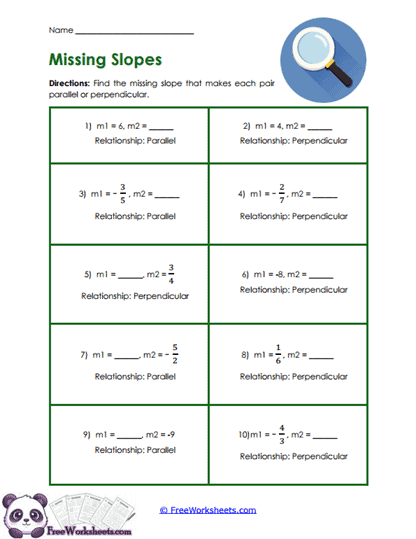
This worksheet helps tenth-grade students practice finding a missing slope when two lines must be parallel or perpendicular. Each of the ten problems gives one slope, leaves the other slope blank, and states the required relationship. Students decide whether the missing slope should match the given slope or become its negative reciprocal. This gives them direct practice with the two main slope rules used in coordinate geometry.
For example, if a line has slope 6 and the second line must be parallel, the missing slope is also 6. If a line has slope 4 and the second line must be perpendicular, the missing slope is -1/4. Students also work with fractional and negative slopes, which helps them get comfortable flipping fractions and changing signs correctly.
What Students Practice
Students practice using the rule that parallel lines have equal slopes and perpendicular lines have negative reciprocal slopes. They work with whole numbers, fractions, and negative values, so they must simplify carefully before writing the missing slope. This strengthens both fraction skills and geometric reasoning.
The worksheet also helps students recognize that taking a negative reciprocal involves two changes: reversing the numerator and denominator and changing the sign. Repeated practice with this pattern helps students avoid common mistakes later when writing equations of perpendicular lines.
Why This Skill Matters
Finding a missing slope is an important step in many geometry problems. Students often need the correct slope before they can write an equation of a line, prove that sides of a figure are parallel, or show that two segments form a right angle. This worksheet focuses on that one skill so students can use it confidently in larger problems.
The activity also strengthens the connection between numbers and geometry. A simple relationship between two slopes tells students whether two lines run in the same direction or meet at 90°. That makes slope much more than just a calculation.
Common Challenges
Students may confuse opposites with negative reciprocals. For instance, the perpendicular slope to 4 is not -4; it is -1/4. Encourage students to rewrite whole numbers as fractions over 1 before flipping them.
Another common mistake is changing only the fraction or only the sign. A true negative reciprocal requires both changes unless the original slope is already a reciprocal-style value. Writing a quick two-step note-flip, then change sign-can help.
How To Use It
Teachers can use this worksheet after students understand how to classify slope relationships. It works well for guided practice, independent classwork, homework, or a quick skill check before equation-writing activities. Asking students to label each answer “same” or “negative reciprocal” can make their reasoning easier to follow.
Parents and homeschool teachers can ask, “Is the line supposed to be parallel or perpendicular?” If it is parallel, keep the slope the same. If it is perpendicular, flip the slope and change the sign.
Grade Alignment
This worksheet is designed for Grade 10 geometry and supports CCSS HSG-GPE.B.5, which asks students to use slope criteria for parallel and perpendicular lines. The focused practice prepares students to apply those criteria when solving coordinate geometry problems.
Students should already understand slope and fraction simplification. After this practice, they can move into writing complete equations of lines with required relationships.