
About This Worksheet
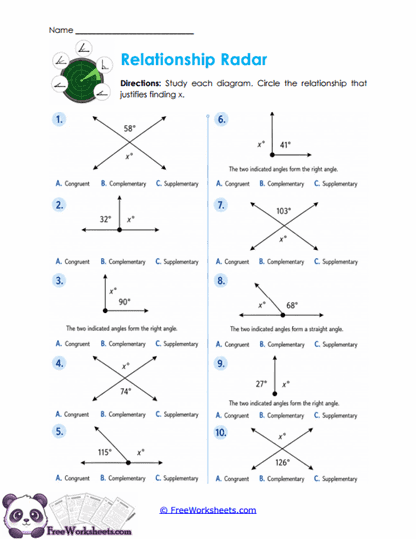
This worksheet helps tenth-grade students identify which angle relationship justifies a missing measure. Students study ten small diagrams and choose whether the relevant relationship is congruent, complementary, or supplementary. The diagrams include vertical angles, right-angle splits, and straight-line pairs. This gives students practice using visual clues to decide which rule applies.
For example, opposite angles formed by intersecting lines are congruent. Two angles that split a right angle are complementary, while adjacent angles on a straight line are supplementary. Students must recognize the structure of the diagram before selecting the relationship.
What Students Practice
Students practice reading small geometry diagrams and deciding how the indicated angles are connected. They focus on whether the angles are equal, total 90°, or total 180°. This strengthens both visual reasoning and vocabulary.
The worksheet also helps students connect diagrams with the rules they have learned. Instead of being told the relationship, they must determine it from the picture. This makes the practice more independent and more like real geometry problem solving.
Why This Skill Matters
Students need to recognize angle relationships quickly when they work with larger diagrams. Often the main challenge is not the arithmetic but deciding which geometric fact applies. This worksheet gives focused practice with that decision.
The skill also supports proof reasoning. In formal geometry, students must justify each statement with a valid relationship or theorem. Being able to identify the correct justification from a diagram is an important early step.
Common Challenges
Students may confuse congruent and supplementary relationships when two angles are near each other. Remind them to look for whether the angles are opposite, form a right angle, or lie on a straight line. The structure of the diagram gives the clue.
Another common mistake is relying on how large an angle looks. Geometry diagrams are not always drawn to scale. Encourage students to use the markings and line relationships instead of visual guessing.
How To Use It
Teachers can use this worksheet as a review after students know the main angle relationships. It works well for independent practice, partner discussion, homework, or a quick formative check. Asking students to explain why one answer is correct can strengthen the reasoning.
Parents and homeschool teachers can ask, “Are these angles across from each other, part of a right angle, or on a straight line?” That question usually points directly to congruent, complementary, or supplementary.
Grade Alignment
This worksheet is intended for Grade 10 geometry and supports CCSS HSG-CO.C.9, which includes reasoning about angle relationships formed by lines. It also reinforces precise geometric vocabulary and diagram interpretation. The activity prepares students for proof-style justification and more advanced angle problems.
Students should already know vertical angles, right angles, and linear pairs. After this practice, they can move into true-false reasoning, algebraic angle expressions, and multi-step geometry challenges.