
About This Worksheet
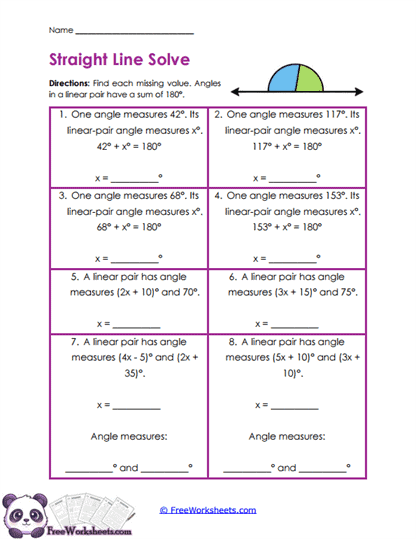
This worksheet helps tenth-grade students practice solving missing angles and algebraic expressions in linear pairs. Students work through eight problems where two adjacent angles form a straight line, so their measures must add to 180°. Some questions provide one numerical measure and ask for the other, while later problems use expressions such as 2x + 10 and 70. This gives students practice using the same linear-pair rule in both simple and algebraic forms.
For example, if one angle measures 42°, the other must measure 138° because 42 + 138 = 180. If the two angles are written as algebraic expressions, students add them together, set the sum equal to 180°, solve for x, and then determine the actual angle measures. This makes the worksheet a strong blend of geometry and algebra.
What Students Practice
Students practice recognizing that a linear pair is supplementary and therefore totals 180°. They use subtraction for simple problems and linear equations for more advanced ones. This helps them understand that the same geometry relationship can be represented in different mathematical forms.
The worksheet also reinforces multi-step problem solving. Students may first solve for x and then substitute that value into both angle expressions. Writing both final measures helps confirm that the pair really totals 180°.
Why This Skill Matters
Linear pairs are one of the most common angle relationships in geometry. They appear whenever two adjacent angles form a straight line and often work together with vertical-angle facts in larger diagrams. Students who understand linear pairs can solve many missing-angle problems quickly.
The skill also prepares students for formal geometric reasoning. Knowing that a straight angle measures 180° gives students a clear reason why the pair is supplementary. This kind of justification is important in proofs and explanations.
Common Challenges
Students may treat a linear pair as if the angles are equal. Remind them that linear-pair angles are supplementary, not necessarily congruent. Their measures must add to 180°, but they can be very different sizes.
Another common mistake is stopping after finding x instead of finding the actual angle measures. Encourage students to substitute x back into both expressions and check that the results sum to 180°. This provides a useful accuracy check.
How To Use It
Teachers can use this worksheet after students understand supplementary angles and straight lines. It works well for guided practice, independent classwork, homework, or review before angle-equation problems. Completing one numeric and one algebraic example together can show students the full range of the skill.
Parents and homeschool teachers can ask, “What do angles on a straight line add to?” Once the student remembers 180°, have them build the equation around that total. This keeps the reasoning simple and consistent.
Grade Alignment
This worksheet is intended for Grade 10 geometry and supports CCSS HSG-CO.C.9, which includes using and proving angle relationships formed by lines. It also reinforces solving linear equations in a geometric setting. The combination of arithmetic and algebra gives students a strong foundation for later geometry work.
Students should already understand supplementary angles and basic equation solving. After this practice, they can move into mixed angle equations involving several relationships at once.