
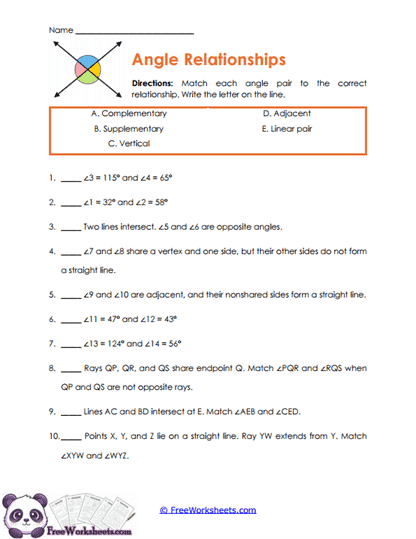
About This Worksheet
This worksheet helps tenth-grade students identify common angle relationships from measures, diagrams, and written descriptions. Students match ten angle pairs to categories such as complementary, supplementary, vertical, adjacent, and linear pair. The problems include both numerical examples and geometry descriptions, so students must think about either the measures or the position of the angles. For example, two angles measuring 32° and 58° are complementary because their measures add to 90°.
The worksheet also includes examples of opposite angles formed by intersecting lines and angles that share a side. This gives students practice distinguishing positional relationships from relationships based on total measure. The mix makes the activity a strong review of core geometry vocabulary.
What Students Practice
Students practice using angle sums, shared sides, opposite positions, and straight-line structures to identify the correct relationship. They must decide which clue matters most in each problem. This builds stronger reasoning than simple definition recall.
The worksheet also reinforces the differences between categories that students often mix up. Adjacent angles share a vertex and side, while a linear pair is a special adjacent pair whose outer sides form a straight line. Complementary and supplementary angles are defined by their total measures.
Why This Skill Matters
Angle relationships are used constantly in geometry. Students need to recognize these relationships before they can solve missing-angle problems, write equations, or justify geometric statements. Strong classification skills make later work much more efficient.
The skill also supports proof and reasoning. When students know why two angles are vertical or supplementary, they can explain why certain measures must be equal or add to a fixed total. That is a major part of high-school geometry.
Common Challenges
Students may confuse vertical angles with adjacent angles because both can be formed at an intersection. Remind them that vertical angles are across from each other, while adjacent angles sit next to each other and share a side. Sketching a quick X can help.
Another common mistake is assuming complementary or supplementary angles must touch. They do not have to be adjacent; their measures are what define them. Encourage students to check the sum before looking at position.
How To Use It
Teachers can use this worksheet as a vocabulary review or prerequisite check before angle-equation work. It works well for guided discussion, independent practice, homework, or a quick assessment. You might ask students to explain the clue they used for each match.
Parents and homeschool teachers can ask, “Do the numbers add to 90 or 180?” and then, “If not, how are the angles positioned?” These two questions can guide students toward the correct relationship.
Grade Alignment
This worksheet is intended for Grade 10 geometry and supports CCSS HSG-CO.C.9, which involves proving and using relationships involving lines and angles. It also reinforces precise angle vocabulary from HSG-CO.A.1. The activity provides a foundation for equation solving and geometric reasoning.
Students should already know basic angle types and notation. After this practice, they can move into finding missing angle measures and writing algebraic equations from angle relationships.