
Making 10 Worksheets
Kindergarten math making 10 worksheets help children build number pairs, complete missing parts, and understand how smaller amounts combine to make 10. Free, ready-to-print worksheets in PDF format are designed for immediate classroom use, centers, guided practice, homework, or homeschool lessons. Students strengthen number sense, addition readiness, and part-part-whole reasoning while developing skills that support curriculum expectations.
About This Collection of Worksheets
Making 10 is an important early number sense skill because it helps kindergarten students see 10 as a whole that can be built from different pairs. Children explore combinations such as 1 and 9, 2 and 8, 4 and 6, and 5 and 5 while learning that the same whole can be decomposed in many ways. This understanding supports addition, subtraction, missing-number reasoning, teen numbers, and later place-value work.
The collection presents make-10 relationships through several visual and symbolic formats. Students complete number bonds, fill ten-frames, solve missing-addend equations, count picture groups, match complementary number pairs, color or draw missing quantities, and complete part-part-whole models. Some activities use pictures and concrete visual support, while others move toward number-only practice to help children build quicker recall of common combinations.
Teachers can use these worksheets during guided math, centers, intervention, fact-fluency practice, homework, or informal assessment. Parents, tutors, and homeschool educators can reinforce the same ideas with fingers, counters, connecting cubes, or homemade ten-frames before moving to the printed pages. Because the collection progresses from visual models to more abstract number relationships, it gives children multiple ways to understand and remember combinations that total 10.
Paul’s Teacher Tip
Begin with a full set of 10 counters so children can physically separate the whole into two parts before working with equations. Ask students to say each relationship as a complete sentence, such as “Six and four make ten,” to connect the quantities with the language of addition. When children are ready, encourage them to count on from the known number rather than recounting every object from one. Use ten-frames to highlight useful structures such as five and five, then connect those visuals to equations like 5 + 5 = 10. As students gain confidence, mix the order of the partners so they recognize that 3 + 7 and 7 + 3 describe the same total.
Worksheet Collection Skill Spotlights
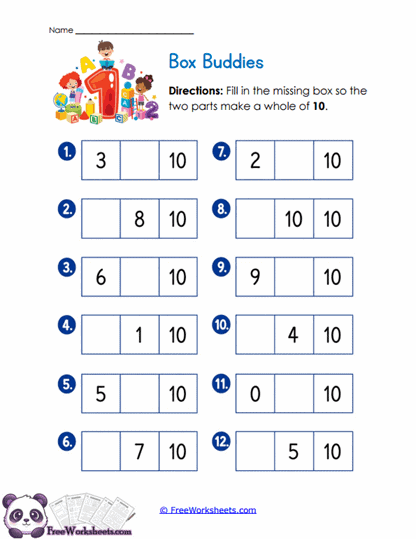
Box Buddies
What Kids Do:
Students complete twelve part-part-whole box models in which 10 is always shown as the whole. One part is provided, and students determine the missing partner and write it in the empty box, even when the known part changes position within the visual model.
Target Skill:
This activity strengthens understanding of 10 as a whole composed of two smaller parts. Kindergarten students practice missing-addend reasoning, number bonds, and flexible recognition of complementary pairs while learning that the underlying relationship stays the same even when the model’s layout changes.
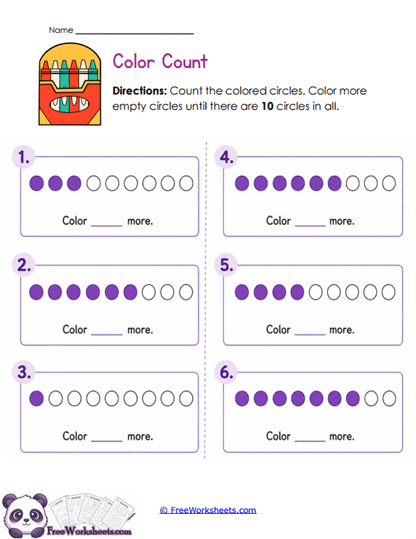
Circle Fill
What Kids Do:
Students examine six rows of circles with some already colored and determine how many additional circles are needed to reach a total of 10. They color the missing amount and record the number they added, giving them a visual and written way to show each make-10 combination.
Target Skill:
The worksheet develops part-part-whole thinking through a repeated visual structure. Kindergarten learners strengthen counting on, missing-number reasoning, and combinations of 10 while connecting a known quantity with the additional amount required to complete the whole.
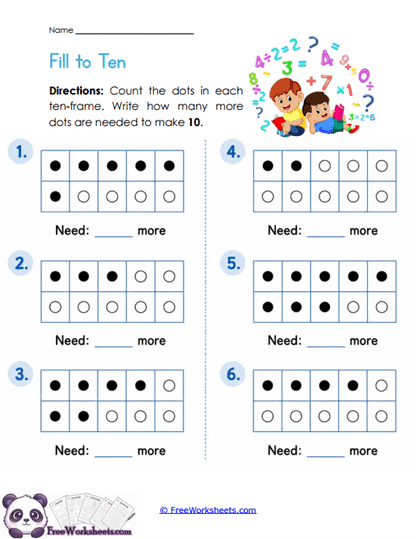
Frame Fill
What Kids Do:
Students study six partial ten-frames containing filled dots and empty spaces. They count or recognize the filled amount, determine how many spaces remain, and write the number needed to complete each frame so that all 10 positions are represented.
Target Skill:
This activity builds strong visual number sense by using the familiar five-and-five structure of a ten-frame. Kindergarten students learn to see 10 as a complete set, identify missing parts efficiently, and connect visual quantities with future equations such as 6 + 4 = 10.
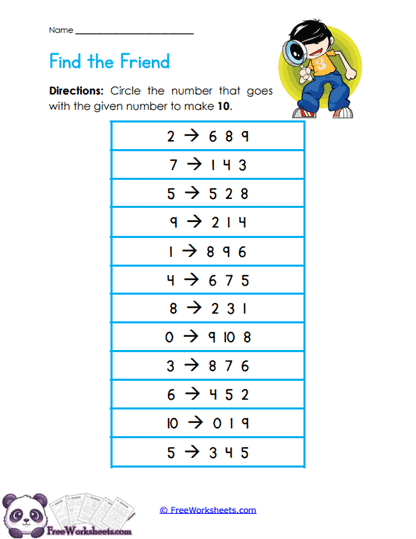
Number Allies
What Kids Do:
Students work through multiple-choice rows that each begin with one number and offer three possible make-10 partners. They decide which choice combines with the starting number to total 10 and circle the correct answer, using repeated practice with values from 0 through 10.
Target Skill:
The multiple-choice format strengthens recognition of complementary number pairs while reducing writing demands. Kindergarten learners build faster recall of make-10 facts, improve number sense, and practice checking whether two numbers form a complete total rather than selecting an answer by appearance.
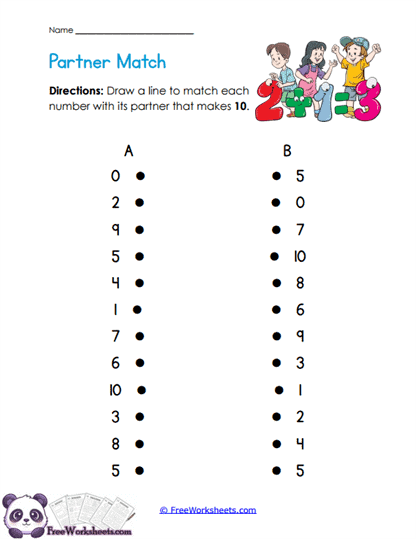
Partner Links
What Kids Do:
Students examine two mixed columns of numbers and draw lines between pairs that combine to make 10. They connect relationships such as 1 and 9, 4 and 6, 5 and 5, and 0 and 10 while scanning across the page to locate each correct partner.
Target Skill:
This matching activity develops make-10 fact fluency and strengthens the connection between complementary numbers. Kindergarten students practice recalling number partners without picture support while recognizing important special relationships such as 5 with 5 and 0 with 10.
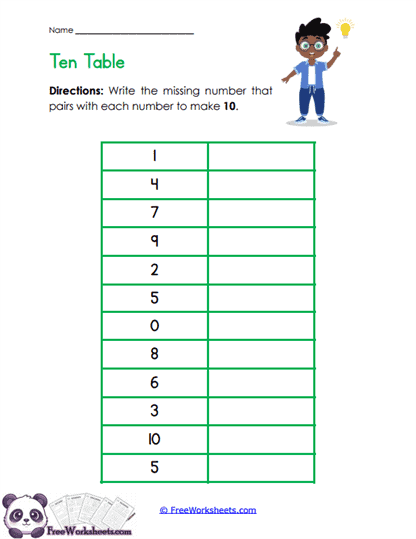
Partner Table
What Kids Do:
Students use a two-column table containing a given number on the left and a blank partner box on the right. For each row, they determine what number combines with the starting value to make 10 and write that complementary number in the table.
Target Skill:
The number-only format helps students transition away from visual models toward mental recall. Kindergarten learners strengthen missing-addend thinking, complementary pair fluency, and early addition readiness by repeatedly retrieving the partner associated with each number from 0 through 10.
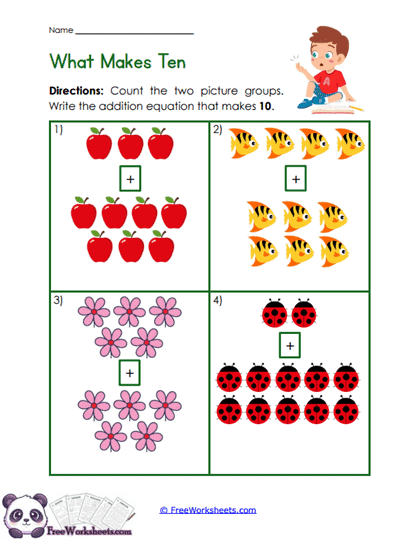
Picture Partners
What Kids Do:
Students count two groups of matching pictures in each of four problems and use those quantities to write an addition equation totaling 10. They work with objects such as apples, fish, flowers, and ladybugs, identifying each part before recording the complete number sentence.
Target Skill:
This activity connects concrete visual groups with symbolic equations. Kindergarten students practice counting separate parts, combining them into a whole, and translating what they see into addition notation, strengthening part-part-whole understanding and early equation-writing skills.
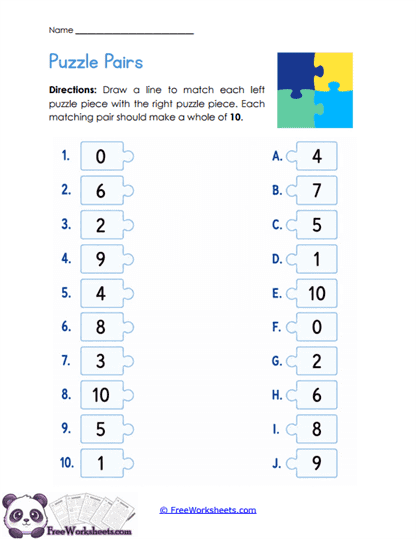
Puzzle Partners
What Kids Do:
Students inspect numbered puzzle pieces arranged in two columns and match pieces whose values combine to make 10. They draw connecting lines between complementary numbers while checking relationships such as 8 and 2, 6 and 4, 5 and 5, and 10 and 0.
Target Skill:
The puzzle format reinforces complementary pair recognition through visual matching. Kindergarten learners develop make-10 fluency, number relationships, and early addition reasoning while learning to identify partners based on their combined total rather than matching identical numbers.
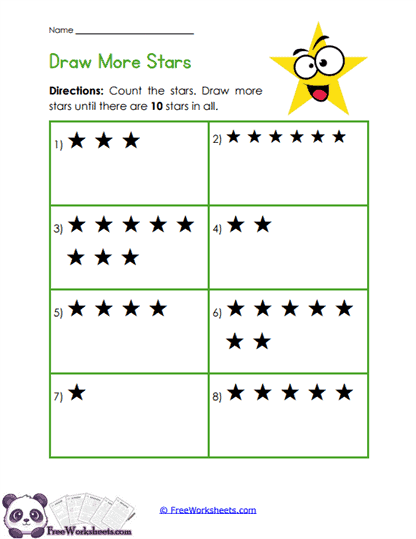
Star Complements
What Kids Do:
Students count the stars already shown inside eight separate boxes and draw enough additional stars to make 10 in each one. Because no empty spaces guide the placement, children must decide how many stars are missing and then recount the finished group to check their work.
Target Skill:
This open drawing activity strengthens missing-part reasoning without the support of a fixed frame. Kindergarten students practice counting on, creating a complete set of 10, checking quantities independently, and connecting a partial group with the number needed to finish the whole.
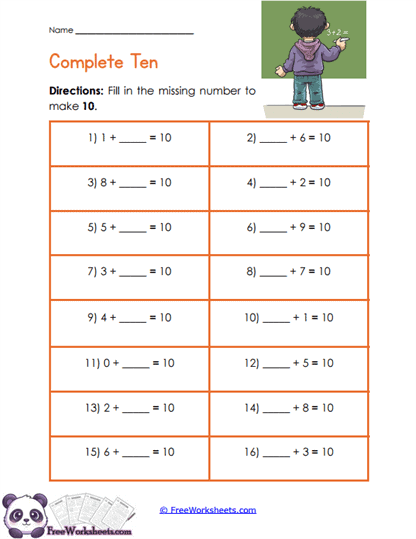
Ten Equations
What Kids Do:
Students complete sixteen addition equations that all have a total of 10. They determine the missing addend and write it in the blank, working with equations where the missing number may appear either before or after the plus sign.
Target Skill:
This worksheet develops symbolic understanding of make-10 relationships and missing-addend equations. Kindergarten learners practice recognizing that the same complementary pair can appear in different equation positions while building fluency with number combinations and addition notation.
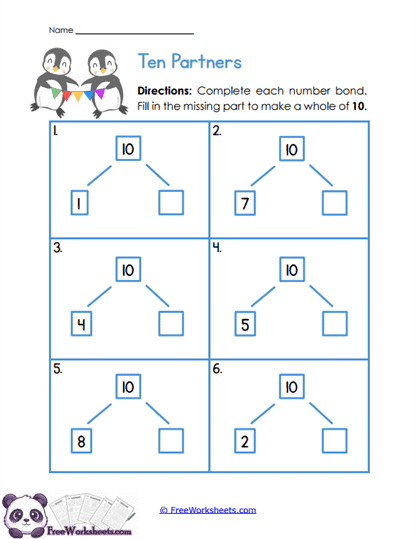
Ten Partners
What Kids Do:
Students complete six number bonds that show 10 as the whole and one known part underneath. They determine the missing part, write it in the empty box, and use the repeated number-bond structure to explore several different ways the whole of 10 can be decomposed.
Target Skill:
The activity builds foundational part-part-whole understanding by showing that 10 can be separated into many number pairs. Kindergarten students strengthen missing-number reasoning, number bonds, and addition readiness while learning to think about how much more is needed to complete a known whole.
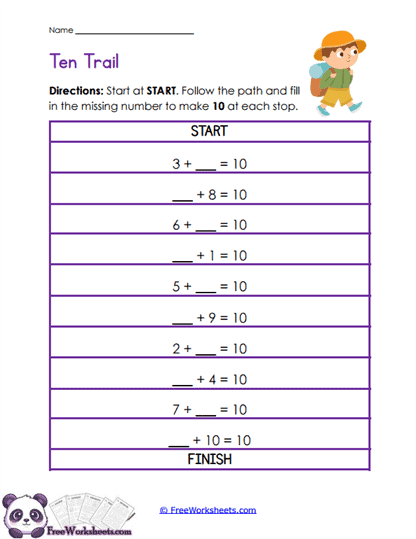
Ten Trail
What Kids Do:
Students follow a start-to-finish path containing ten missing-addend equations. They solve each equation in order, writing the number that combines with the visible addend to make 10, while adjusting to blanks that appear in different positions around the plus sign.
Target Skill:
The trail provides focused fluency practice with complementary pairs and equation reading. Kindergarten learners strengthen quick recall of make-10 facts, flexible missing-addend reasoning, and understanding that an equation represents the same relationship even when the unknown changes position.