
Extending Patterns Worksheets
Kindergarten math extending patterns worksheets help children recognize repeating rules, predict what comes next, and complete visual sequences with confidence. Free, ready-to-print worksheets in PDF format are designed for immediate classroom use, centers, guided practice, homework, or homeschool lessons. Students strengthen pattern recognition, sequencing, and logical reasoning while developing skills that support curriculum expectations.
About This Collection of Worksheets
Extending patterns helps kindergarten students notice repetition, identify what stays consistent, and use a rule to determine what should come next. Children work with visual sequences built from pictures, colors, shapes, and familiar objects while learning common structures such as AB, AAB, ABB, ABC, and ABBA. Recognizing these repeating units encourages students to look beyond individual pictures and focus on the underlying order of a sequence.
The collection provides varied ways to practice pattern thinking rather than relying on one repeated task format. Students draw missing pictures, choose correct endings, color unfinished sequences, match patterns with their next items, repair mistakes, identify missing pieces in the middle, and name pattern rules using letters. Themes involving fruit, animals, school supplies, weather symbols, shapes, balloons, vehicles, and other recognizable objects keep the visual work approachable.
Teachers can use these worksheets during guided math, centers, morning work, intervention, review, or informal assessment. Parents, tutors, and homeschool educators can build similar patterns with toys, blocks, crayons, or household objects before moving to the printed activities. Because the collection ranges from simple AB extensions to identifying and repairing more complex rules, educators can select pages that match each child’s current level of pattern understanding.
Paul’s Teacher Tip
Before students complete a pattern, ask them to say the repeating part aloud instead of immediately guessing what comes next. For an AAB pattern, for example, have children use a rhythm such as “apple, apple, leaf / apple, apple, leaf” so they can hear the repeating unit. When introducing more complex structures, physically separate each complete repeat with a finger, craft stick, or small gap between objects. If students make mistakes, ask them to find another place where the same part of the sequence occurs and check what follows it there. Once children can extend patterns reliably, challenge them to name the rule with letters or create a pattern that a classmate must continue.
Worksheet Collection Skill Spotlights
Color Patterns
What Kids Do:
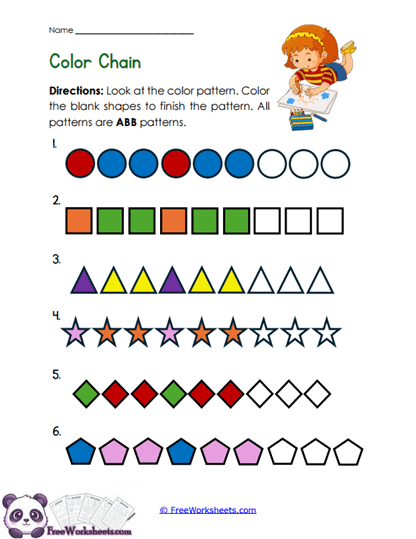
Students study six rows of repeated colors shown inside circles, squares, triangles, stars, diamonds, and pentagons. They identify the AAB color order in each row and use crayons to color the remaining blank shapes so the repeating sequence continues correctly from left to right.
Target Skill:
This activity strengthens recognition of repeating units when color, rather than object type, creates the pattern. Kindergarten students practice identifying AAB structures, maintaining a three-part sequence, and predicting future elements while also developing color recognition and careful visual tracking.
Next Choice
What Kids Do:
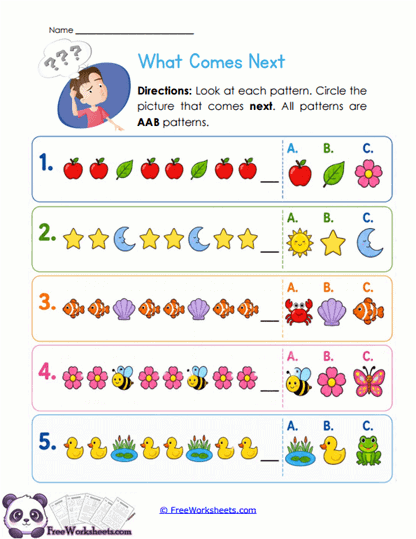
Students examine five picture sequences that follow an AAB structure, such as apple, apple, leaf. After identifying the repeating three-part unit, they compare three labeled picture choices and circle the image that would correctly appear next in each sequence.
Target Skill:
The worksheet develops students’ ability to move beyond basic alternating patterns and recognize when one element repeats twice before another appears. Kindergarten learners strengthen sequencing, prediction, and early algebraic reasoning by applying an AAB rule to determine an unknown next position.
Pattern Frames
What Kids Do:
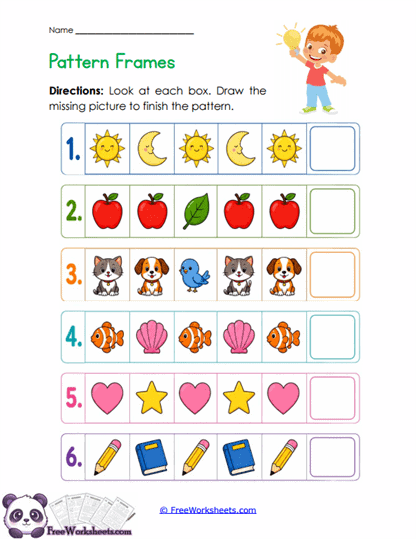
Students read six picture sequences from left to right and examine the repeating order shown before a blank frame. They determine which picture belongs at the end and draw the missing item, using familiar combinations such as suns and moons, apples and leaves, or pencils and books.
Target Skill:
This activity builds the ability to use a repeating rule to predict one missing element at the end of a sequence. Kindergarten students practice identifying repetition, remembering visual order, and extending patterns logically instead of simply copying the picture closest to the blank.
Pattern Links
What Kids Do:
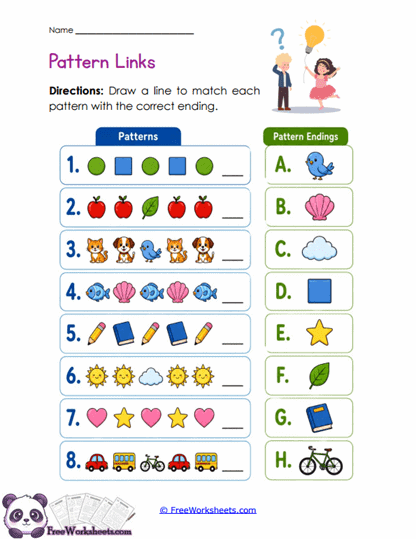
Students study eight repeating picture patterns displayed on one side of the page and predict what should follow each sequence. They then scan the available ending pictures on the opposite side and draw a line connecting every pattern to the image that correctly continues its rule.
Target Skill:
The matching format strengthens pattern recognition and prediction while reducing the drawing demands of the task. Kindergarten students must identify each repeating structure, hold the expected next item in mind, and distinguish the correct choice from other pictures that may also appear somewhere in the sequence.
Pattern Parade
What Kids Do:
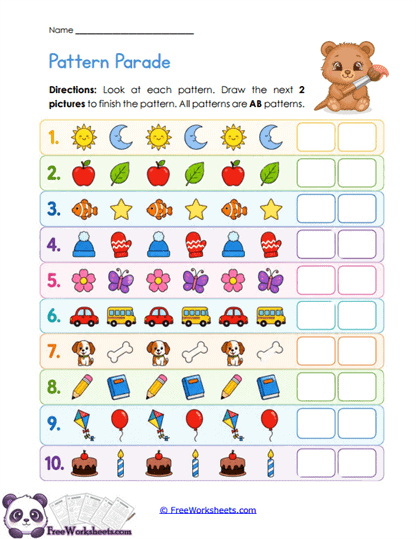
Students work through ten rows of simple AB patterns featuring familiar pictures such as suns and moons, fruit and leaves, fish and stars, vehicles, pets, school supplies, and balloons. They identify the alternating pair and draw the next two pictures in the empty boxes.
Target Skill:
This worksheet develops foundational understanding of AB patterns by teaching students to recognize a two-part unit that repeats in a consistent order. Kindergarten learners strengthen left-to-right sequencing, visual prediction, and rule recognition while showing that they can extend the sequence beyond a single missing item.
Pattern Puzzle
What Kids Do:
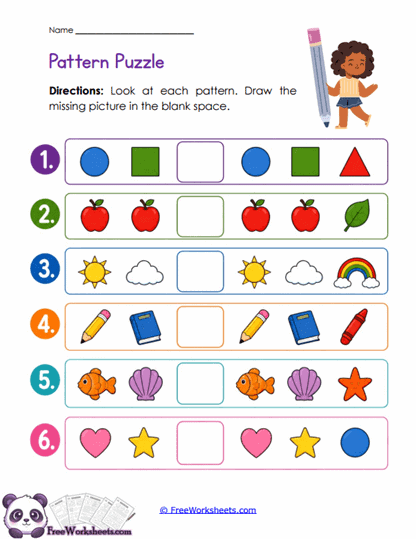
Students inspect six repeating sequences containing a blank space somewhere in the middle rather than at the end. They use the pictures appearing both before and after the gap to determine which item is missing, then draw the correct picture in the open space.
Target Skill:
This activity deepens pattern analysis because students cannot rely only on predicting the next item. Kindergarten learners must understand the full repeating rule, determine where they are within that rule, and use surrounding information to reconstruct a missing part of the sequence accurately.
Pattern Repair
What Kids Do:
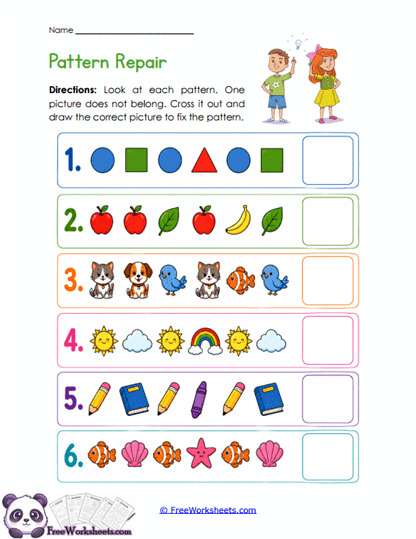
Students act as pattern checkers while examining six sequences that each contain one picture that breaks the repeating rule. They locate and cross out the incorrect item, then determine what belongs in its place and draw the correct replacement in the provided answer area.
Target Skill:
The worksheet develops error detection and logical reasoning in addition to basic pattern recognition. Kindergarten students must identify the intended repeating structure, notice exactly where it fails, and apply the rule to repair the sequence, showing a deeper understanding than simple continuation alone requires.
Pattern Rules
What Kids Do:
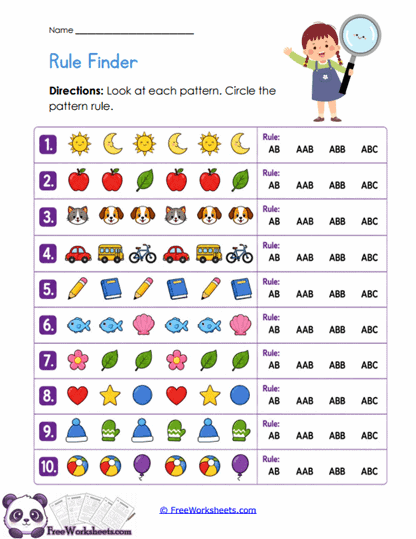
Students examine ten repeating picture sequences and identify how each one is structured. After finding the repeating unit, they compare the sequence with the choices AB, AAB, ABB, and ABC and circle the letter rule that accurately represents the order of the pictured elements.
Target Skill:
This activity introduces symbolic descriptions of visual patterns and helps students connect concrete pictures with abstract pattern labels. Kindergarten learners strengthen early algebraic thinking by identifying repeating units, comparing structures, and representing the organization of a sequence with letters.
Pattern Sketch
What Kids Do:
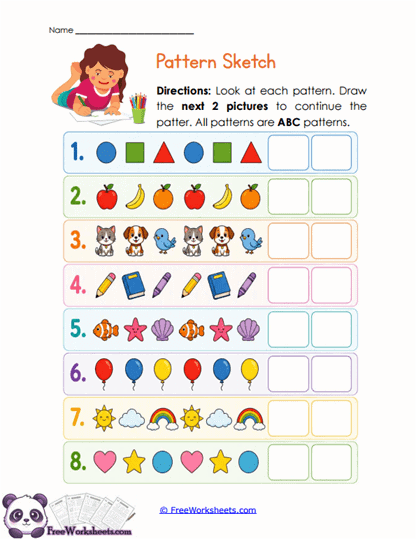
Students study eight sequences made from three different pictures repeating in the same ABC order. After identifying the three-part unit, they draw the next two pictures in the blank spaces using patterns based on shapes, fruit, animals, school supplies, weather symbols, and other familiar images.
Target Skill:
The activity strengthens students’ ability to remember and extend a three-element repeating sequence without changing its order. Kindergarten learners develop visual memory, sequencing, and prediction while progressing from simpler two-part patterns toward more complex repeating structures.
Pattern Strips
What Kids Do:
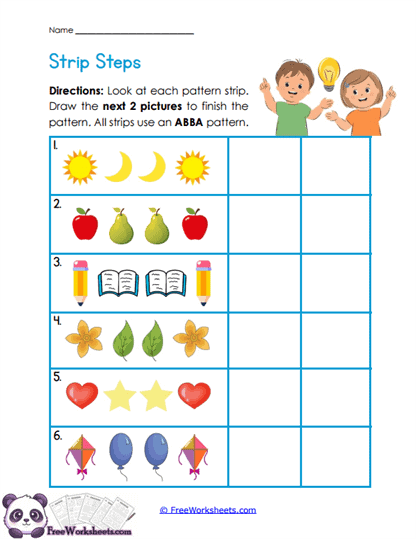
Students examine six picture strips that follow an ABBA arrangement, where the second picture appears twice between repeated examples of the first. They find the complete four-part rule and draw the next two images in the open boxes to continue each strip accurately.
Target Skill:
This worksheet develops understanding of longer repeating units that do not simply alternate one item at a time. Kindergarten students practice grouping sequences into four-part sections, noticing repeated middle elements, and using a more complex rule to predict what should appear next.
Pattern Trail
What Kids Do:
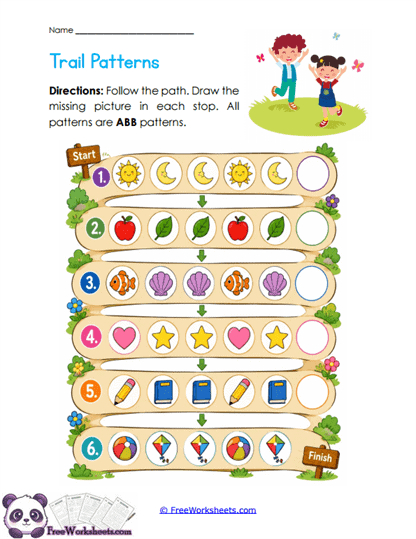
Students follow a start-to-finish path containing six separate pattern stops. At each stop, they examine a short picture sequence, identify the repeating rule, and draw the missing image in the final circle before following the arrows to the next pattern challenge.
Target Skill:
The trail format provides repeated practice with prediction while encouraging careful visual tracking from one problem to the next. Kindergarten students strengthen pattern recognition, sequencing, and rule-following as they analyze each sequence independently rather than assuming every row uses the same structure.
Train Patterns
What Kids Do:
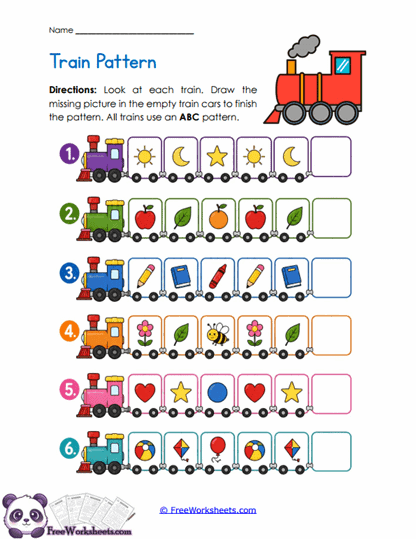
Students examine six colorful trains whose cars contain repeating combinations of pictures such as suns and moons, apples and leaves, pencils and books, flowers and bees, hearts and stars, or balls and kites. They identify each rule and draw the missing picture in the final empty train car.
Target Skill:
This activity reinforces the ability to extend picture patterns by identifying the repeated order before making a prediction. Kindergarten learners practice left-to-right tracking, visual sequencing, and logical reasoning while learning to use earlier parts of a pattern as evidence for what belongs next.