
Measuring Using Nonstandard Units Worksheets
Kindergarten math measuring using nonstandard units worksheets help children count equal units, compare lengths, and record simple measurements with familiar objects. Free, ready-to-print worksheets in PDF format are designed for immediate classroom use, centers, guided practice, homework, or homeschool lessons. Students strengthen measurement understanding, one-to-one counting, and length comparison while developing skills that support curriculum expectations.
About This Collection of Worksheets
Measuring with nonstandard units helps kindergarten students understand that length can be described by repeating the same-size unit from one end of an object to the other. Instead of beginning with inches or centimeters, children use cubes, paper clips, and other familiar units that make the measurement process easy to see. This builds the important idea that a measurement number tells how many equal units fit along an object’s length.
The collection gives students many ways to practice this early measurement concept. Children count cube strips and paper clips, match objects with equal measurements, compare lengths as longer, shorter, or the same, complete missing measurement units, order objects from shortest to longest, use color keys, and record measurements in simple charts. Familiar items such as pencils, shoes, trains, ropes, books, bananas, and paintbrushes keep the activities concrete and approachable.
Teachers can use these worksheets during guided math, centers, measurement units, review, intervention, or informal assessment. Parents, tutors, and homeschool educators can reinforce the ideas by measuring household objects with blocks, paper clips, or other equal-size items before moving to the printed pages. Because the activities progress from counting completed unit strips to building, comparing, ordering, and recording measurements, the collection supports both basic understanding and deeper application.
Paul’s Teacher Tip
Before students work on paper, demonstrate measurement with real cubes or paper clips placed end to end beside an object. Emphasize that units must be the same size, touch without gaps, and avoid overlapping, since changing any of those conditions changes the measurement. Have children point to each unit once as they count and finish with a complete statement such as, “The pencil is 7 cubes long.” When comparing two objects, ask students to say both measurements before deciding which is longer or shorter. For extension, let students measure several classroom objects with the same nonstandard unit, record the results, and arrange the objects from shortest to longest.
Worksheet Collection Skill Spotlights
Clip Measures
What Kids Do:
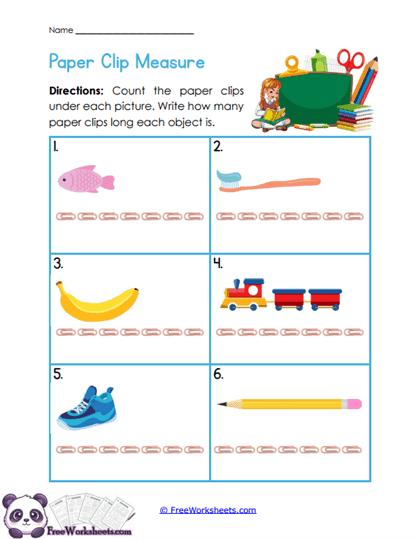
Students examine six everyday objects with rows of paper clips placed underneath them. They count each complete paper clip as one measuring unit and write how many paper clips long the fish, toothbrush, banana, toy train, shoe, and pencil are.
Target Skill:
This activity develops understanding that length can be measured with repeated equal-size units other than a ruler. Kindergarten students strengthen one-to-one counting, measurement vocabulary, and visual tracking while learning that units should be placed consistently from one end of an object to the other.
Cube Choices
What Kids Do:
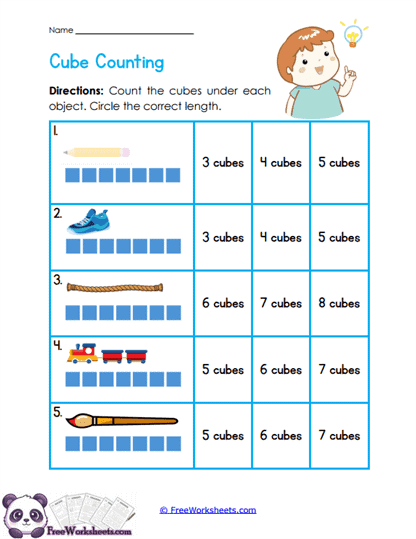
Students study five familiar objects with blue cube strips beneath them and count the units representing each length. They then compare three numerical answer choices and circle the measurement that matches the pencil, shoe, rope, train, or paintbrush.
Target Skill:
The multiple-choice format strengthens the connection between a counted nonstandard measurement and its written numerical label. Kindergarten learners practice cube counting, numeral recognition, measurement language, and careful answer checking without relying on the apparent size of the picture.
Cube Lengths
What Kids Do:
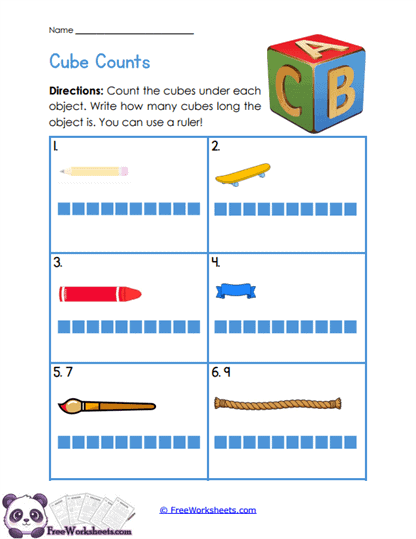
Students look at six familiar pictures, including a pencil, skateboard, crayon, ribbon, paintbrush, and rope, with equal-size cubes lined up below each one. They point to and count the cubes, then record the total as the object’s length.
Target Skill:
This worksheet builds foundational understanding that measurement describes how many equal units span an object’s length. Kindergarten students connect counting with measurement while strengthening one-to-one correspondence, left-to-right tracking, and accurate use of unit language such as cubes long.
Length Builder
What Kids Do:
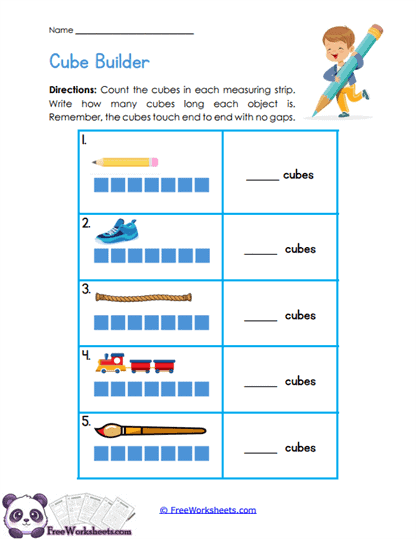
Students count complete blue cube strips shown beneath five objects and write each total on an answer line. They measure a pencil, shoe, rope, train, and paintbrush, then complete the measurement using the word cubes to describe the unit.
Target Skill:
The activity reinforces accurate reading and recording of nonstandard measurements. Kindergarten learners practice counting equal units, writing numerals, and expressing a length with both a number and unit name, preparing them for later work with formal measurement notation.
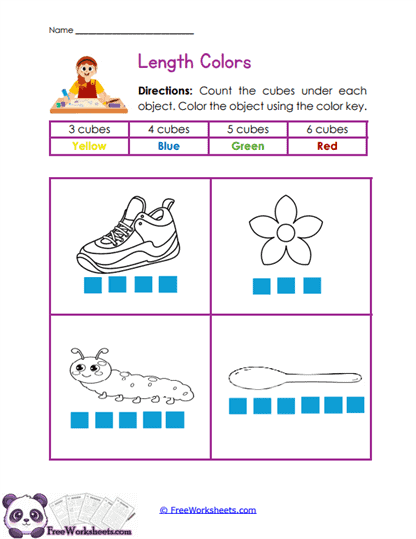
Length Colors
What Kids Do:
Students count the cube units beneath a shoe, flower, caterpillar, and spoon, then use a measurement color key to determine how each picture should be colored. They complete the two-step task by finding the length first and matching that number to the correct color.
Target Skill:
This worksheet combines nonstandard measurement with number matching and direction-following. Kindergarten students strengthen cube counting and measurement recognition while learning to transfer a numerical result to a second representation using a simple key.
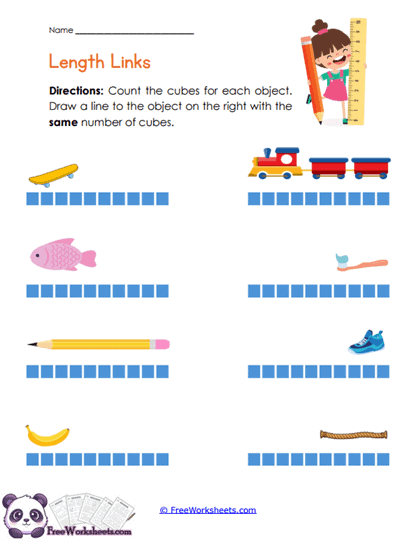
Length Connections
What Kids Do:
Students count cube units beneath objects on both sides of the page and search for pairs with equal measurements. After determining each length, they draw lines between different objects that have the same number of cubes, such as matching two items that both measure 7 cubes.
Target Skill:
The matching activity develops understanding of equal length through numerical measurement rather than visual appearance. Kindergarten learners practice counting, remembering measurements, comparing values, and recognizing that very different objects can share exactly the same measured length.
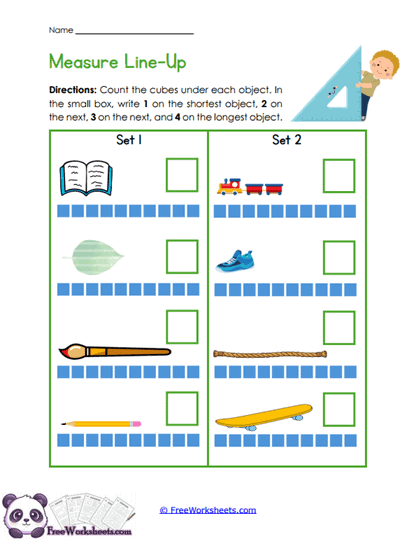
Length Lineup
What Kids Do:
Students work with two groups of four objects, count the cube strips beneath each item, and compare the resulting measurements. They then write 1 through 4 to rank each group from shortest to longest using the measured values rather than the picture sizes.
Target Skill:
This activity extends measurement into ordering and sequencing. Kindergarten students strengthen comparison reasoning by using numerical lengths to arrange several objects, helping them connect smaller measurements with shorter objects and larger measurements with longer ones.
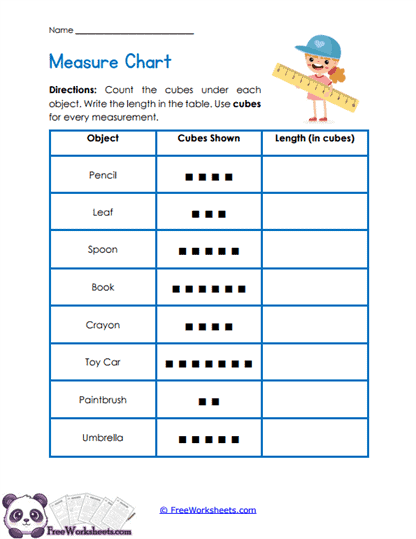
Measure Chart
What Kids Do:
Students read across an eight-row measurement table containing object names, cube strips, and blank recording spaces. They count the cubes beside items such as a pencil, leaf, spoon, book, crayon, toy car, paintbrush, and umbrella and write each length in the correct row.
Target Skill:
The chart format strengthens measurement recording and simple data organization. Kindergarten learners practice counting equal units, matching information across a row, and recording numerical lengths accurately while becoming familiar with an organized table structure.
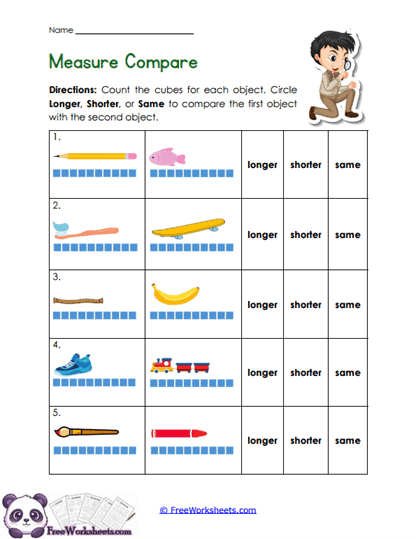
Measure Compare
What Kids Do:
Students examine five pairs of objects with cube strips shown underneath each picture. They count or compare the two measured lengths and circle longer, shorter, or same to describe how the first object relates to the second in each row.
Target Skill:
This worksheet builds comparison vocabulary by connecting words such as longer, shorter, and same with actual measured quantities. Kindergarten students learn to use cube counts as evidence when comparing lengths instead of relying on picture size or position on the page.
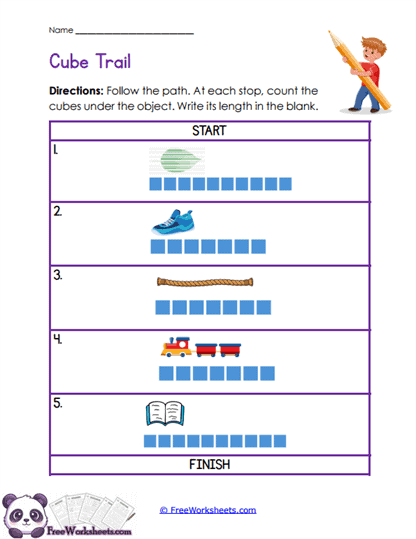
Measurement Trail
What Kids Do:
Students follow a start-to-finish path containing five measurement stops. At each stop, they count the blue cubes beneath a familiar object such as a leaf, shoe, rope, toy train, or book and write the measured length before continuing along the trail.
Target Skill:
The repeated trail format reinforces accurate nonstandard measurement and written recording. Kindergarten learners strengthen one-to-one counting, visual sequencing, numeral writing, and measurement vocabulary while maintaining focus across several similar measurement tasks.
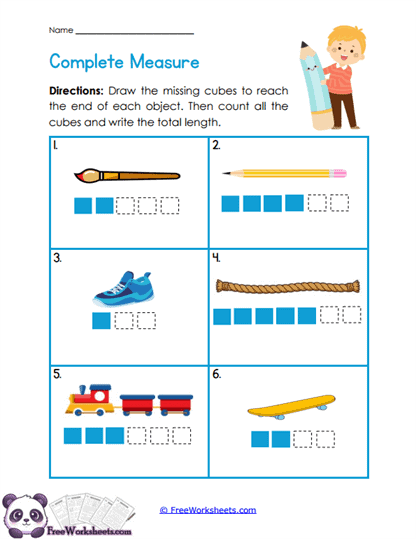
Missing Units
What Kids Do:
Students inspect six objects with partially completed cube strips and dotted spaces showing where additional units belong. They draw the missing cubes so the strip reaches the object’s full length, then count both the printed and added units and write the total measurement.
Target Skill:
This activity develops a deeper understanding of how measurement units must cover an entire length without gaps or overlaps. Kindergarten students practice equal-unit placement, counting, and total-length reasoning instead of simply reading a finished measuring strip.
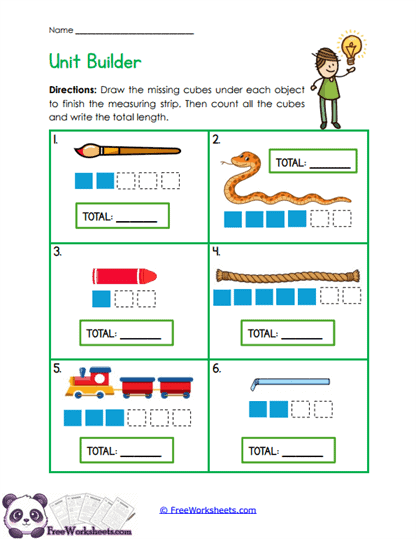
Unit Builder
What Kids Do:
Students complete six incomplete cube measuring strips beneath familiar objects by drawing units into the dotted spaces. After making each unit row continuous from one end of the object to the other, they count the complete strip and record the final length.
Target Skill:
The worksheet strengthens construction of a valid measurement model. Kindergarten learners practice keeping units equal in size, placing them side by side, covering the full length, and counting every unit accurately, preparing them to measure real objects more independently.