
About This Worksheet
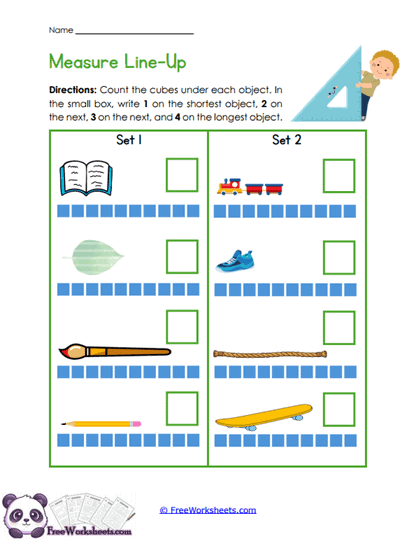
Length Lineup is a kindergarten measurement activity that helps children put objects in order from shortest to longest by counting cube units. The page is split into two sets, and each object has a row of blue cubes underneath it to show its length. Children count the cubes and then write 1 for the shortest object, 2 for the next, 3 for the next, and 4 for the longest. For example, if one object measures 4 cubes and another measures 7 cubes, the 4-cube object comes earlier in the order. This helps children connect measurement numbers with the idea of putting lengths in sequence.
Curriculum and Grade Alignment
This worksheet is made for kindergarten learners who are ready to compare several measured objects at once. The main goal is to help children use nonstandard cube measurements to order objects from shortest to longest. Before using this page, your child should be able to count cube units and compare two lengths as longer or shorter. The next step is measuring real objects independently and arranging them in order by length. This activity supports early measurement learning by combining counting, comparison, and sequencing.
Student Tasks
On this worksheet, students will work with two groups of four objects. They will count the blue cubes beneath each object and compare the measurements within that set. Children then write the numbers 1 through 4 in the small boxes to show the order from shortest to longest. The objects include familiar pictures such as a book, leaf, paintbrush, pencil, train, shoe, rope, and skateboard. This builds measurement, number ordering, and comparison skills.
Common Challenges and Misconceptions
Some children may number the objects from top to bottom instead of using the cube measurements. Others may correctly find the shortest and longest but mix up the two middle lengths. A child may also rely on the picture size rather than counting the cubes. Encourage your child to say each measurement aloud before ordering anything. Finding the shortest first and the longest second can make the two middle choices easier to place.
Implementation Guidance
Teachers can use this worksheet after students have practiced comparing pairs of objects by cube length. It works well in guided math because children can explain why one object comes before another in the lineup. Parents can measure four household objects with blocks and write down the totals before asking the child to put them in order. Then use the same strategy on the worksheet. This makes the sequencing idea much more concrete.
Details and Features
This worksheet includes two measurement sets with four objects in each group. Every object has a clear cube strip underneath and a small box for writing its place in the order. The repeated 1-to-4 ranking system gives children a simple way to show shortest through longest. Familiar pictures keep the task easy to understand. The printable supports nonstandard measurement, ordering, comparison, and number writing.