
Writing Numerals 0 To 10 Worksheets
Kindergarten math writing numerals 0 to 10 worksheets help children form numbers, record quantities, and connect written symbols with counting and number words. Free, ready-to-print worksheets in PDF format are designed for immediate classroom use, centers, handwriting practice, homework, or homeschool lessons. Students strengthen numeral formation, counting, and number recognition while developing skills that support curriculum expectations.
About This Collection of Worksheets
Writing numerals from 0 to 10 helps kindergarten students connect the numbers they count and say with the symbols they put on paper. Children need to recognize numeral shapes, remember how each one is formed, and understand that a written number represents a specific quantity. Repeated practice with tracing, copying, counting, and independent writing helps these skills become more comfortable and automatic.
The collection provides a gradual mix of supported and independent number-writing activities. Students trace model numerals, copy printed numbers, complete partially drawn numerals, count picture groups and ten-frames, fill in missing numbers, write numerals from number words, and follow counting paths that require written responses. Some activities emphasize handwriting, while others ask children to use numeral writing as part of counting, sequencing, or number recognition.
Teachers can use these worksheets for handwriting centers, number-sense lessons, morning work, intervention, review, or informal assessment. Parents, tutors, and homeschool educators can reinforce difficult numerals with finger tracing, air writing, number cards, or small groups of counters before using the printed pages. Because the collection moves from tracing and copying toward writing numerals from quantities, words, and memory, it supports increasing independence with numbers from 0 through 10.
Paul’s Teacher Tip
Have students say the number name aloud while tracing or writing so the spoken number stays connected to its written symbol. When a numeral is difficult, model its starting point and movement rather than asking children to repeatedly erase an incorrect version. Use larger motions such as air writing or finger tracing before returning to pencil work, especially for numerals that are often reversed. During count-and-write activities, ask students to count the quantity, say the total, and only then write the numeral. As children become more confident, gradually remove nearby models so they practice recalling numeral shapes independently.
Worksheet Collection Skill Spotlights
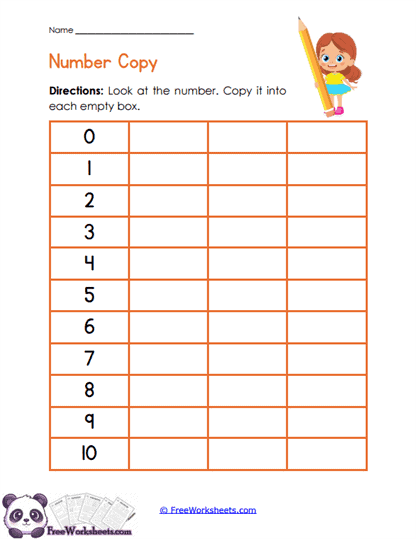
Copy Rows
What Kids Do:
Students work through model numerals from 0 through 10 and copy each one into three blank boxes. Unlike tracing practice, they must look at the printed example, remember its shape, and reproduce it independently several times across the row.
Target Skill:
This activity bridges tracing and writing from memory by strengthening visual copying, numeral formation, and pencil control. Kindergarten students practice holding a numeral’s shape in mind long enough to reproduce it accurately while becoming less dependent on dotted guides.
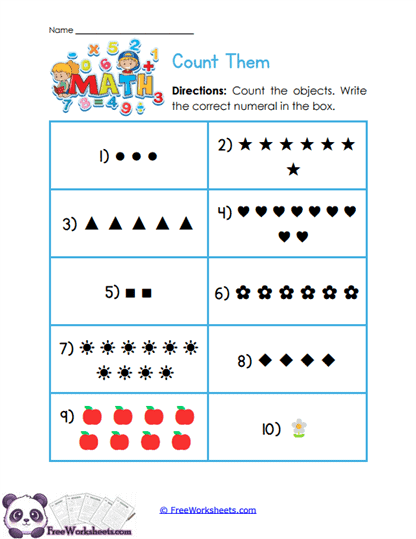
Count Records
What Kids Do:
Students count ten groups of simple pictures, including dots, stars, triangles, hearts, squares, flowers, suns, diamonds, and apples. After determining each quantity, they write the numeral that represents the total in the matching answer space.
Target Skill:
The worksheet connects one-to-one counting with written number recording. Kindergarten learners strengthen quantity recognition and numeral formation while learning that the number they write communicates how many objects are in a group regardless of the picture type.
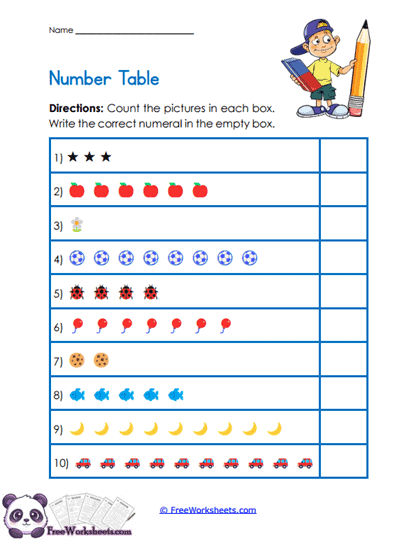
Count Table
What Kids Do:
Students move down a simple table containing rows of familiar picture groups such as stars, apples, flowers, balls, ladybugs, balloons, cookies, fish, moons, and cars. They count each row carefully and write the matching numeral in the answer box beside it.
Target Skill:
This activity develops counting accuracy and organized numeral recording. Kindergarten students practice keeping information aligned across rows, connecting quantities with written symbols, and using a chart format while strengthening one-to-one correspondence and number-writing fluency.
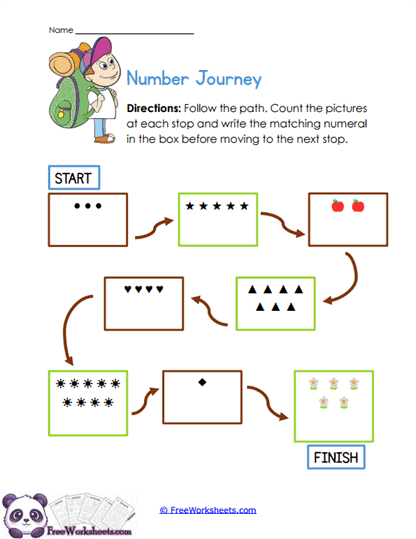
Counting Journey
What Kids Do:
Students follow a winding start-to-finish picture path containing groups of dots, stars, apples, triangles, hearts, flowers, suns, diamonds, and other symbols. At each stop, they count the pictures, write the corresponding numeral, and follow the arrow to the next group.
Target Skill:
The journey format combines numeral writing with counting and visual sequencing. Kindergarten learners strengthen one-to-one correspondence, number recognition, and written recording while practicing how to maintain attention and follow an ordered path through several changing quantities.
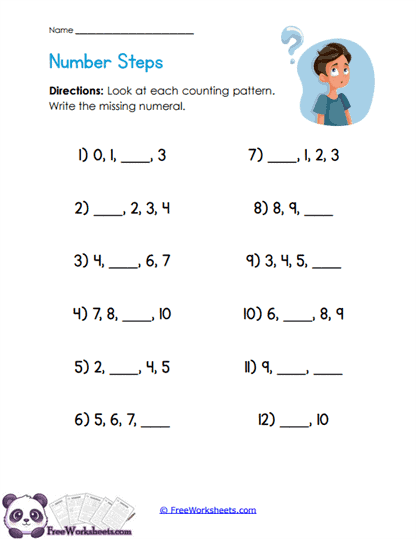
Counting Steps
What Kids Do:
Students complete twelve short counting sequences containing one or more blank spaces. They examine nearby numerals, say the sequence aloud, and write the missing numbers whether the blanks appear before, after, or between the given values.
Target Skill:
This worksheet strengthens number order and numeral writing within 0 through 10. Kindergarten students practice using surrounding numbers as clues, identifying before-and-after relationships, and recalling the correct written form of a missing numeral rather than simply copying a nearby model.
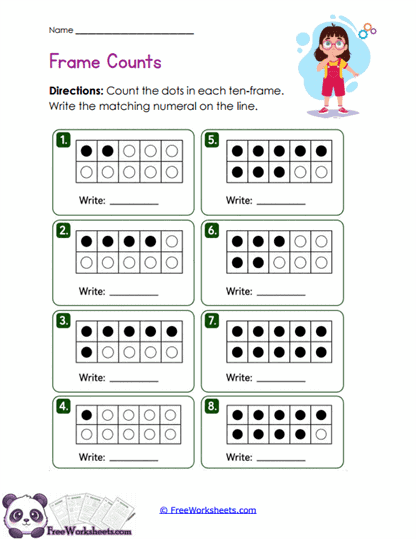
Frame Writing
What Kids Do:
Students examine eight ten-frames containing filled black dots and empty spaces. They count the filled dots in each frame, determine the quantity represented, and write the matching numeral on the line provided below the visual model.
Target Skill:
The activity connects structured visual quantities with written numerals. Kindergarten learners strengthen ten-frame understanding, counting within 10, and number writing while beginning to recognize familiar groups such as a full row of five without recounting every dot.
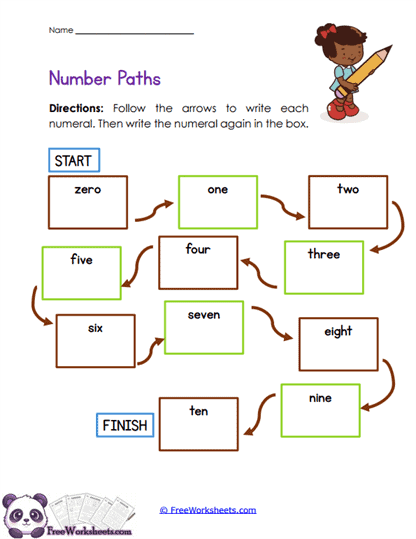
Number Route
What Kids Do:
Students follow arrows through a path of number words from zero through ten. At each stop, they read or listen to the word, identify the numeral it names, and write that number in the matching box before continuing along the route.
Target Skill:
This worksheet links number words, counting order, and numeral formation. Kindergarten students practice translating written number names into symbols while strengthening sequencing, early reading, visual tracking, and independent recall of numerals from 0 through 10.
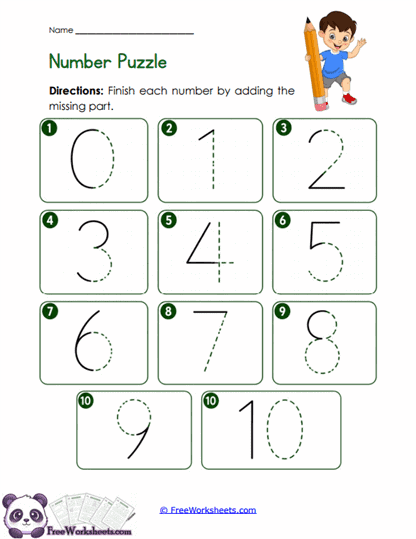
Numeral Puzzle
What Kids Do:
Students inspect partially drawn numerals from 0 through 10 and complete each one by tracing or drawing its missing line or curve. They use the solid section as a clue and add the dotted portion needed to finish the correct numeral shape.
Target Skill:
This puzzle-style activity focuses attention on the individual strokes and curves that make up written numerals. Kindergarten learners strengthen visual discrimination, formation awareness, fine-motor control, and understanding of how separate parts combine to create a complete number symbol.
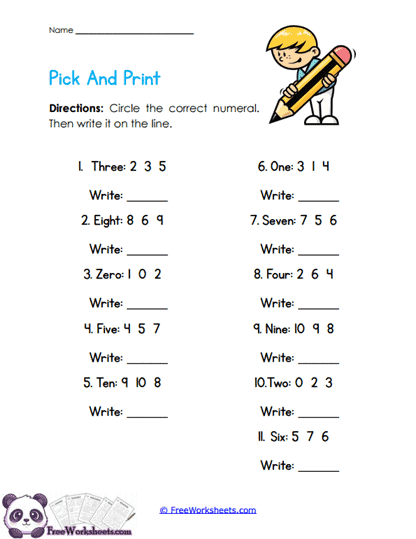
Pick Print
What Kids Do:
Students read or listen to eleven number words and compare three numeral choices for each one. They circle the correct symbol and then copy that same numeral onto the writing line, completing both a recognition task and an independent writing task.
Target Skill:
The two-step format strengthens the connection among number words, numeral recognition, and handwriting. Kindergarten students practice identifying the correct symbol from distractors and then forming it independently, preparing them to write numerals directly from spoken or written number names.
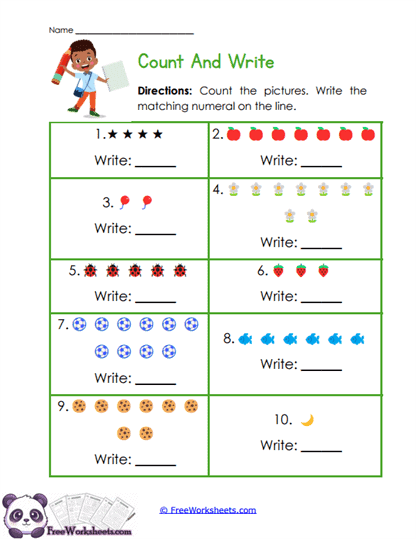
Picture Totals
What Kids Do:
Students count ten groups of colorful objects such as stars, apples, balloons, flowers, ladybugs, strawberries, balls, fish, cookies, and a moon. They determine each total and write the matching numeral on the answer line beside or beneath the group.
Target Skill:
This worksheet reinforces the relationship between quantity and written number symbols. Kindergarten learners practice accurate one-to-one counting, numeral recall, and independent number formation while seeing that different kinds of objects can represent the same numerical amount.
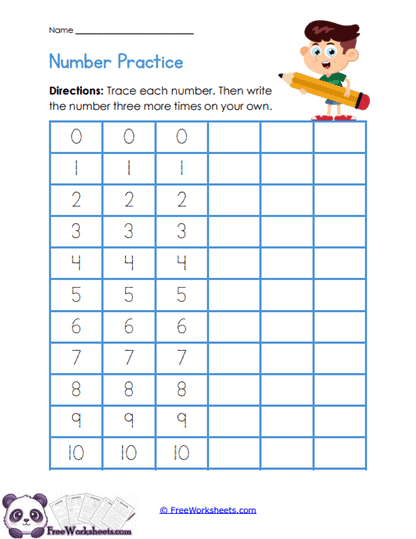
Trace Then
What Kids Do:
Students practice every numeral from 0 through 10 by tracing three light examples in each row and then writing the same number independently in three blank boxes. The repeated routine gradually shifts the work from supported tracing to unaided formation.
Target Skill:
This activity develops numeral handwriting through a clear progression from guided movement to independent writing. Kindergarten students strengthen pencil control, visual memory, numeral formation, and confidence while practicing each number enough times to begin remembering its shape.
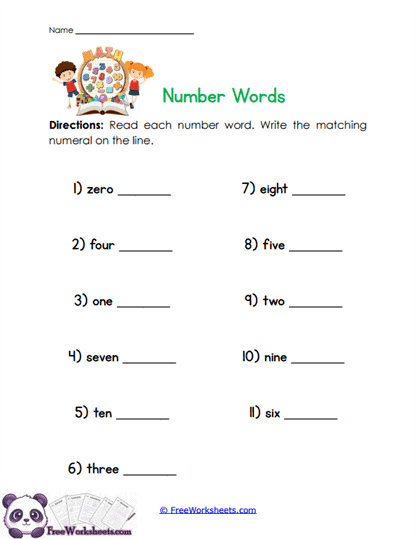
Word Numbers
What Kids Do:
Students read or listen to eleven number words presented in mixed order and write the numeral that matches each one. They work with all numbers from zero through ten, translating written language such as four, seven, or ten into the correct numerical symbol.
Target Skill:
The worksheet connects early literacy with mathematical notation. Kindergarten learners strengthen number-word recognition, numeral recall, and handwriting while learning that the same number can be represented by a spoken name, a written word, or a numerical symbol.