
Recognizing And Naming Numerals Worksheets
Kindergarten math recognizing and naming numerals worksheets help children identify numbers, connect symbols with quantities, and practice number words and writing. Free, ready-to-print worksheets in PDF format are designed for immediate classroom use, centers, guided practice, homework, or homeschool lessons. Students strengthen numeral recognition, counting, and number order while developing skills that support curriculum expectations.
About This Collection of Worksheets
Recognizing and naming numerals helps kindergarten students connect written number symbols with spoken names, quantities, and positions in the counting sequence. Children work with numerals from 0 through 10 and learn that a number keeps the same meaning whether it appears in a search grid, a ten-frame match, a number sequence, or a written word. Building this flexibility gives students a strong foundation for later number sense and operations.
The collection includes several types of numeral practice so children encounter numbers in varied ways. Students search for target numerals, match numbers with picture quantities and ten-frames, trace and write numerals, connect numerals with number words, complete missing-number sequences, sort values into number ranges, and follow simple numeral trails. These different formats help children move beyond memorizing one activity routine and apply number knowledge in new settings.
Teachers can use these worksheets during number-sense lessons, math centers, morning work, intervention, handwriting practice, or informal assessment. Parents, tutors, and homeschool educators can pair the pages with number cards, counters, ten-frames, or simple oral counting games. Because the collection combines recognition, quantity matching, writing, sequencing, and number-word practice, it provides a well-rounded way to build confidence with numerals from 0 through 10.
Paul’s Teacher Tip
When introducing a numeral, connect three ideas together: how the numeral looks, how its name sounds, and how many objects it represents. Ask students to say the number aloud whenever they circle, trace, write, or match it so the visual symbol stays connected to the spoken name. For quantity activities, have children count the objects first and say the total before looking for the numeral choice. When practicing number order, encourage students to use nearby numbers as clues instead of always restarting the count from 0. As students become more confident, mix numeral cards, number words, and small object groups and have them build matching sets.
Worksheet Collection Skill Spotlights
Frame Match
What Kids Do:
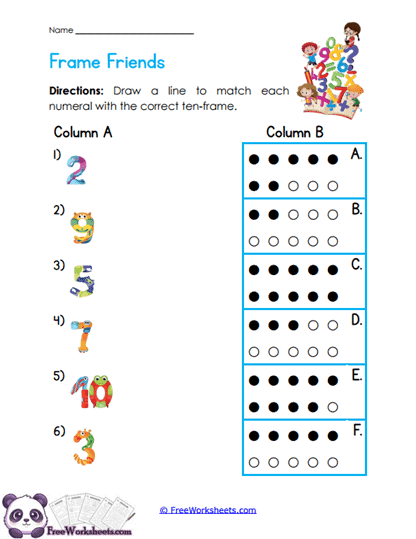
Students examine six numerals and six ten-frames showing different quantities of filled dots. They count the filled spaces in each frame, decide which numeral represents that amount, and draw a line between each visual quantity and its matching written number.
Target Skill:
This activity strengthens the connection between written numerals and structured quantities. Kindergarten students practice counting within 10, recognizing numerals, and interpreting ten-frames while beginning to see familiar quantities as organized groups rather than unrelated individual dots.
Missing Spots
What Kids Do:
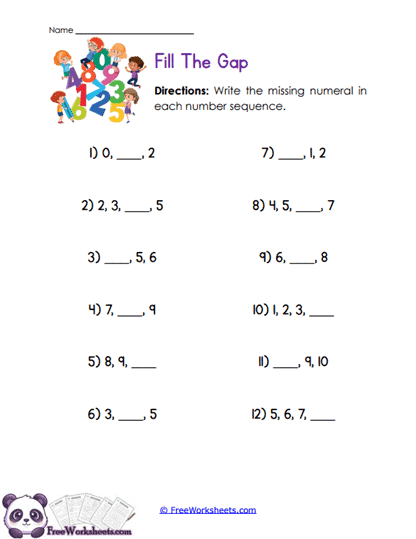
Students complete twelve short number sequences containing one missing numeral. They examine what comes before and after each blank, decide which number belongs there, and write the missing value whether the gap appears at the beginning, middle, or end of the sequence.
Target Skill:
The worksheet develops number-order understanding and flexible sequencing. Kindergarten learners practice identifying numbers that come before, after, or between other values while strengthening numeral recognition and writing within the familiar counting range through 10.
Nine Search
What Kids Do:
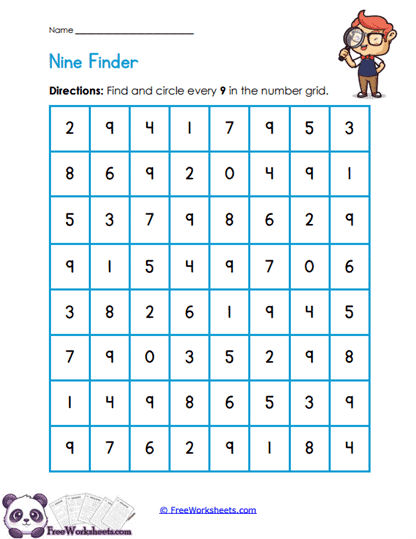
Students scan a large grid filled with mixed numerals from 0 through 9 and circle every 9 they find. They work carefully from row to row, ignoring distractor numbers and marking each occurrence of the target numeral wherever it appears.
Target Skill:
This focused search strengthens rapid visual recognition of the numeral 9. Kindergarten students develop numeral discrimination, attention, and scanning skills while learning to identify a number symbol confidently without needing a picture quantity or counting cue.
Number Sort
What Kids Do:
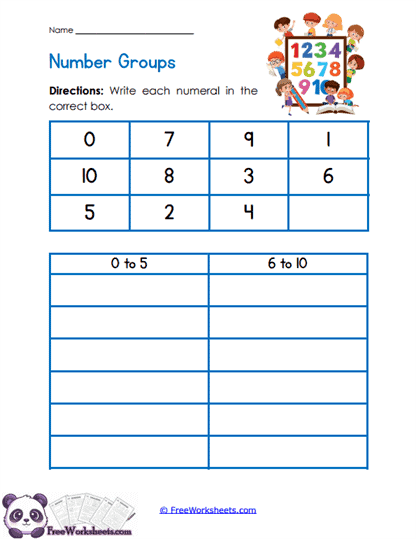
Students examine a mixed set of numerals from 0 through 10 and decide whether each belongs in the 0-to-5 group or the 6-to-10 group. They write every numeral in the appropriate sorting box and track which values have already been classified.
Target Skill:
This activity extends numeral recognition into early classification and comparison. Kindergarten learners practice identifying numbers by value, understanding where they fall within the counting sequence, and separating smaller and larger number ranges in an organized way.
Number Trail
What Kids Do:
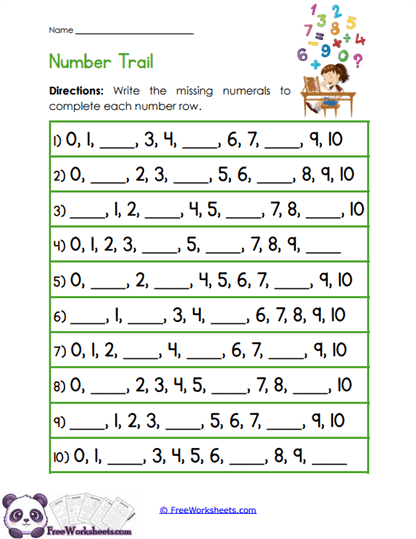
Students work through ten rows of number sequences from 0 through 10 that contain several missing values. They read each row from left to right, determine which numerals are absent, and write the correct numbers in the blank spaces.
Target Skill:
The worksheet strengthens counting order, numeral recognition, and number writing. Kindergarten students practice using surrounding numbers as clues, maintaining a sequence across several positions, and connecting spoken counting patterns with their written numerical forms.
Number Writing
What Kids Do:
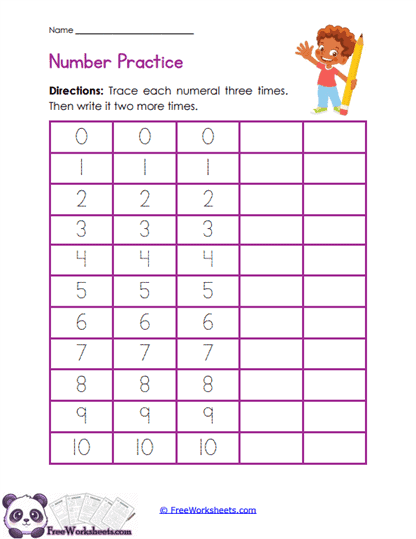
Students practice every numeral from 0 through 10 by tracing three dotted examples and then writing the same numeral independently in two blank boxes. Each row focuses on one number so children can pay close attention to its shape and formation.
Target Skill:
This activity develops correct numeral formation, fine-motor control, and visual memory for number symbols. Kindergarten learners move from supported tracing to independent writing while reinforcing the connection between a numeral’s appearance, spoken name, and written form.
Numeral Links
What Kids Do:
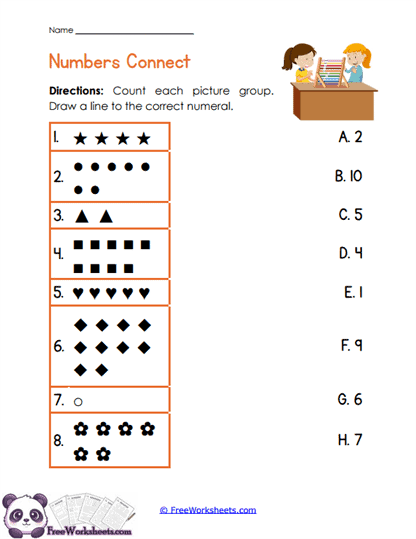
Students count eight groups made from shapes such as stars, dots, triangles, squares, hearts, diamonds, circles, and flowers. They determine the quantity in each box and draw a line to the numeral on the opposite side that represents the same amount.
Target Skill:
The matching format strengthens the relationship between quantity and symbol across different visual representations. Kindergarten students practice accurate one-to-one counting and numeral recognition while learning that a number represents the same quantity regardless of what objects are being counted.
Quantity Match
What Kids Do:
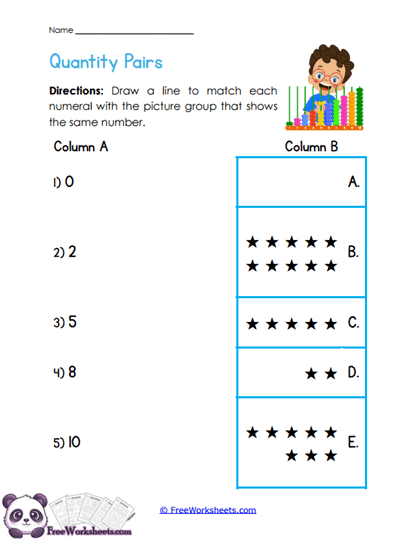
Students compare numerals such as 0, 2, 5, 8, and 10 with groups of stars showing those quantities. They count each picture group, identify its total, and connect it with the written numeral that represents the same number.
Target Skill:
This activity builds foundational number sense by linking counted quantities with written symbols. Kindergarten learners strengthen one-to-one counting, numeral recognition, and understanding of zero while practicing how a numerical symbol communicates the size of a set.
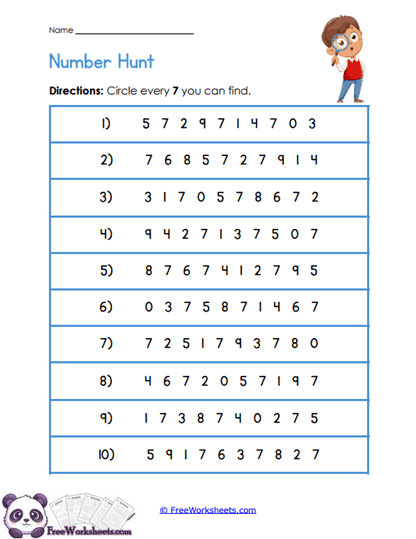
Seven Search
What Kids Do:
Students scan ten rows filled with mixed single-digit numerals and circle every 7 they see. Because the target appears in different positions and may occur more than once in a row, children must check each symbol carefully before moving on.
Target Skill:
The worksheet provides concentrated practice recognizing the numeral 7 by shape. Kindergarten students strengthen visual discrimination, scanning, attention, and automatic numeral identification without relying on object groups or number-order clues.
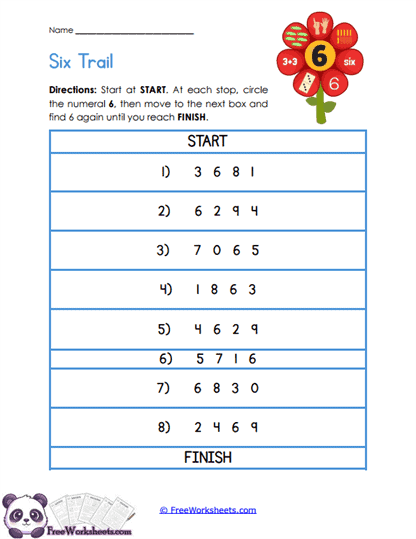
Six Search
What Kids Do:
Students follow a simple start-to-finish trail made from eight rows of four numerals. At each stop, they inspect the choices, locate the numeral 6, circle it, and then move down to the next row until they reach the finish.
Target Skill:
This activity builds quick recognition of the numeral 6 through repeated visual searches. Kindergarten learners practice identifying a target number among distractors while strengthening attention, left-to-right scanning, and confidence with written numeral forms.
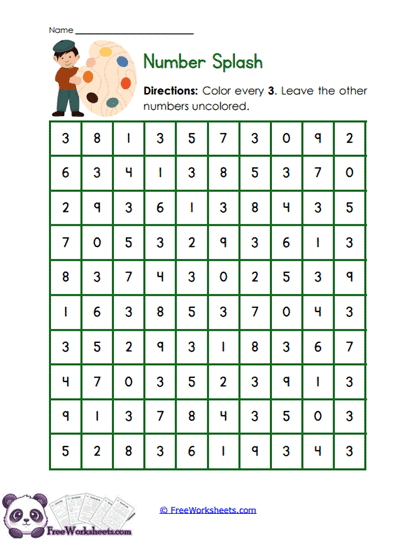
Three Splash
What Kids Do:
Students search a large grid of numerals from 0 through 9 and color every box containing the numeral 3. They work row by row, distinguish 3 from the surrounding numbers, and leave all non-target numerals uncolored.
Target Skill:
The coloring format reinforces rapid recognition of the numeral 3 while adding fine-motor practice. Kindergarten students strengthen visual discrimination and scanning as they learn to identify one written number consistently within a crowded field of other symbols.
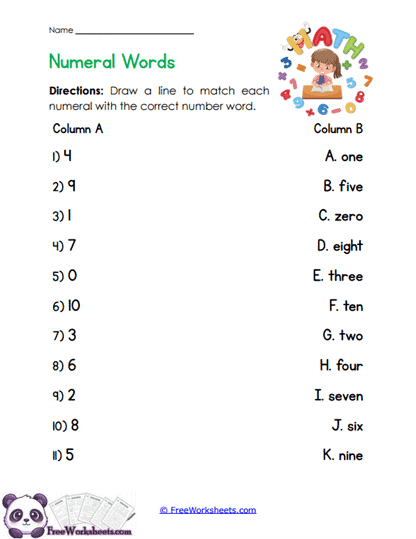
Word Partners
What Kids Do:
Students match numerals from 0 through 10 with their corresponding written number words. They say each numeral, scan a mixed list of words such as zero, four, seven, and ten, and draw a line connecting each symbol with the word that names it.
Target Skill:
This worksheet connects mathematical symbols with early reading and vocabulary. Kindergarten learners strengthen numeral recognition, number-word knowledge, and visual matching while learning that numbers can be represented both by symbols and by written language.