
Short Vowels Worksheets
Short vowels in kindergarten language arts help children hear, identify, compare, and write vowel sounds inside simple CVC words. These free, ready-to-print PDF worksheets are prepared for immediate classroom use, literacy centers, homeschool lessons, intervention, homework, or independent practice. Children strengthen vowel discrimination, phonemic awareness, and CVC decoding while working toward important kindergarten curriculum goals.
About This Collection of Worksheets
Short vowel practice helps kindergarten children understand how the middle sound in a CVC word changes the word they read and spell. Learning to distinguish short a, e, i, o, and u gives beginning readers an important foundation for sounding out unfamiliar words, building spelling accuracy, and recognizing common word patterns. Repeated listening and comparison also help children become more confident using phonics instead of guessing.
This collection approaches short vowels through several different activity types. Children fill in missing vowels, build words in sound boxes, find odd vowel sounds, match words with meanings, complete sentences, choose words from picture clues, focus on short a and short i, match words with the same vowel sound, hunt for vowels in sentences, and compare groups of similar words. Pasted text
Teachers can use these worksheets during kindergarten phonics lessons, literacy centers, small groups, intervention, homework, or informal assessment. Parents and homeschool educators can choose pages based on whether a child needs more help hearing individual vowels, segmenting CVC words, comparing sounds, or applying phonics inside sentences. The mix of listening, reading, writing, matching, and sorting provides repeated practice without relying on only one type of exercise.
Paul’s Teacher Tip
When short vowels are confusing, have children say the entire word aloud before looking at the spelling. Ask them to stretch the word and listen closely to the middle sound, especially with commonly confused pairs such as short e and short i. Tapping one finger for each sound can help children isolate the vowel instead of blending the word too quickly. For comparison activities, say both words back to back so the contrast is easier to hear. Once a child chooses a vowel, have them read the complete word again to check whether it sounds right.
Worksheet Collection Skill Spotlights
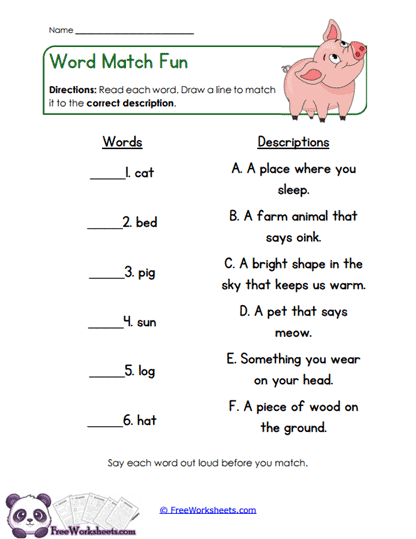
Meaning Match
What Kids Do:
Children read six familiar short-vowel words such as cat, bed, pig, sun, log, and hat and connect each one with the description that explains its meaning. They draw a line or write a matching letter, then reread the completed word-and-definition pairs.
Target Skill:
This activity combines decoding with vocabulary and comprehension. Students practice reading CVC words accurately, identifying their short vowel sounds, and connecting the printed word with its meaning instead of treating phonics as an isolated sound exercise.
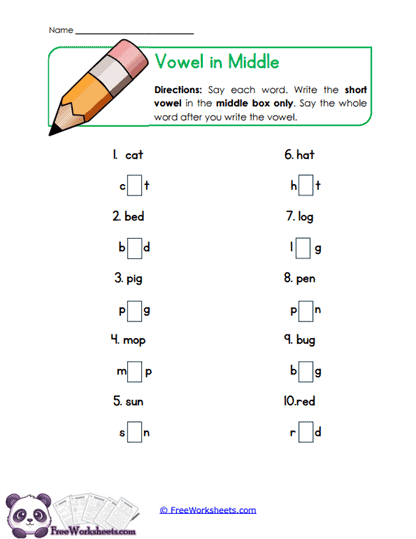
Middle Vowels
What Kids Do:
Children work with 10 familiar CVC words that already show the beginning and ending consonants. They say each word, listen carefully for the middle sound, write the correct short vowel in the blank, and then read the completed word aloud.
Target Skill:
The worksheet develops short-vowel identification across a, e, i, o, and u. Students strengthen phonemic awareness, sound-to-letter matching, spelling accuracy, and the understanding that changing the middle vowel can create an entirely different word.
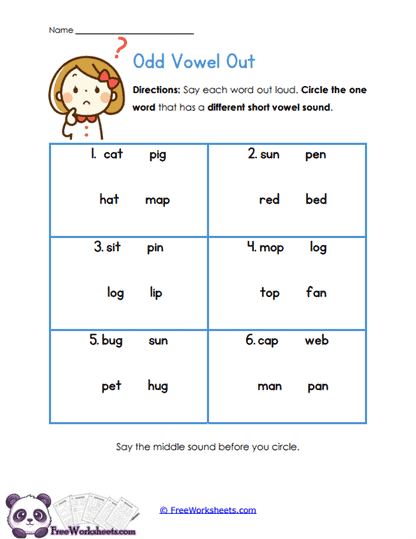
Odd Vowel
What Kids Do:
Children read six groups of four words and listen for the vowel sound in the middle of each one. Three words share the same short vowel, while one word is different, and students circle the word that does not belong.
Target Skill:
This activity strengthens vowel discrimination by requiring students to compare several words at once. Children practice ignoring beginning and ending consonants and focusing specifically on the medial vowel sound, which supports decoding, spelling, and phonemic awareness.
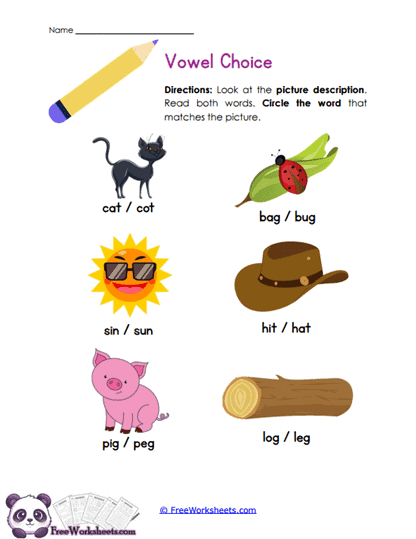
Picture Vowels
What Kids Do:
Children look at six familiar pictures and choose between two similar-looking words, such as cat and cot or pig and peg. They say the picture name, compare the two spellings, and circle the option with the correct short vowel.
Target Skill:
The worksheet helps students hear and visually distinguish short vowels within similar CVC patterns. Children practice using picture meaning, spoken sounds, and printed letters together rather than relying only on matching first and last consonants.
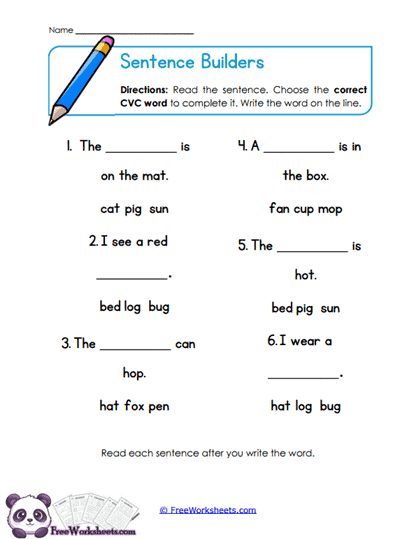
Sentence Choices
What Kids Do:
Children read six simple sentences and choose the correct CVC word from three answer options to complete each blank. They write the best word on the line and reread the full sentence to make sure the answer fits both the sound pattern and meaning.
Target Skill:
This activity applies short-vowel decoding inside connected reading. Students strengthen phonics, vocabulary, and sentence comprehension by evaluating several CVC choices and using context to determine which accurately completes the idea.
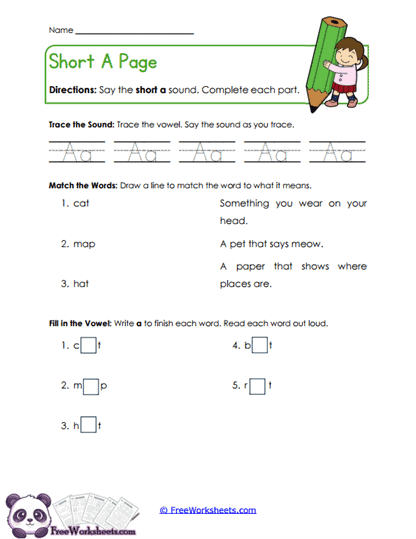
Short A
What Kids Do:
Children trace the letter a, match short-a words such as cat, map, and hat with their meanings, and fill in missing vowels to complete additional words. The page gives them several different ways to practice the same target sound.
Target Skill:
This focused activity develops recognition and production of short a in CVC words. Students strengthen vowel-sound awareness, letter formation, decoding, spelling, and vocabulary while repeatedly connecting the written letter a with its short sound.
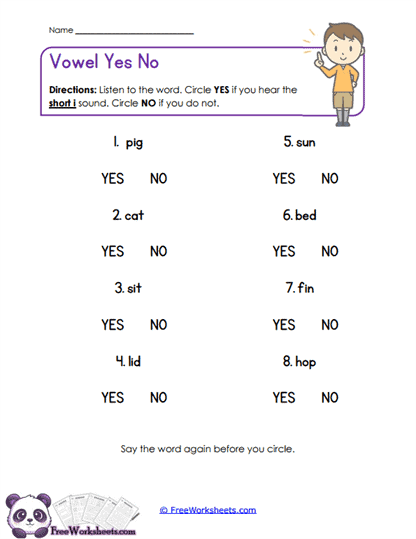
Short I
What Kids Do:
Children read eight familiar words such as pig, cat, sit, lid, sun, bed, fin, and hop and decide whether each contains the short i sound. They circle Yes or No and then repeat the word to check the vowel sound.
Target Skill:
The worksheet strengthens auditory recognition of short i and helps children distinguish it from other short vowels. Students practice listening carefully to the medial sound, making a sound-based decision, and developing more accurate decoding and spelling habits.
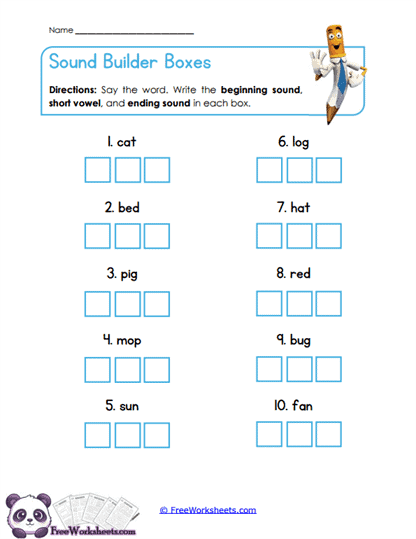
Sound Boxes
What Kids Do:
Children say 10 CVC words slowly and write one letter in each of three boxes. They place the beginning consonant first, the short vowel in the middle, and the ending consonant last before blending all three sounds to read the word.
Target Skill:
This activity strengthens phoneme segmentation and sound-to-letter correspondence. The three-box structure reinforces beginning, middle, and ending positions while helping students hear every sound, record letters in order, and avoid omitting the medial vowel.
Sound Pairs
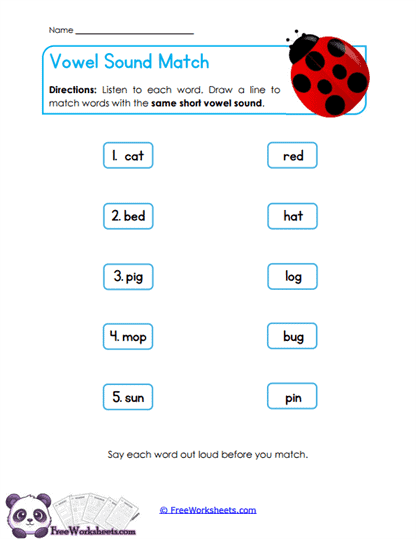
What Kids Do:
Children read words such as cat, bed, pig, mop, and sun and match each one with another word that has the same short vowel sound. They draw connecting lines and then read the completed pairs aloud to hear the shared middle sound.
Target Skill:
The worksheet builds awareness that different CVC words can share the same medial vowel pattern. Students practice comparing sounds across words, sorting by pronunciation, and paying attention to the vowel instead of matching by first or final consonants.
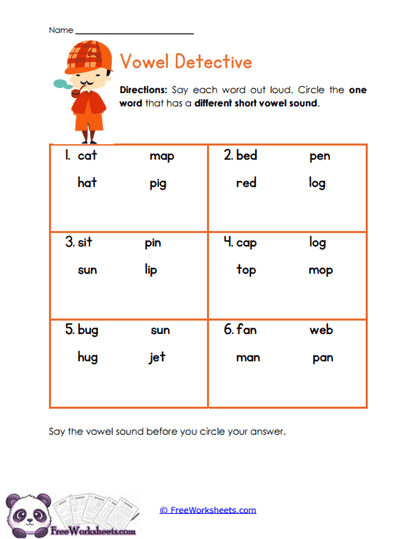
Vowel Detective
What Kids Do:
Children work through six groups containing four short-vowel words each. They say every word aloud, listen closely to the middle sound, and circle the one word whose vowel does not match the other three in the group.
Target Skill:
This activity develops careful auditory comparison across all five short vowels. Students strengthen phonemic awareness, sound categorization, decoding, and spelling-pattern recognition by identifying which word differs specifically in its medial vowel.
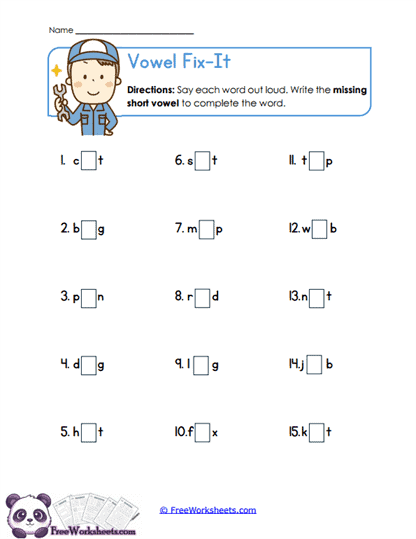
Vowel Fix
What Kids Do:
Children complete 15 CVC words by writing the missing middle vowel between the consonants already shown. They work across examples with short a, e, i, o, and u, then read each finished word aloud to check whether the spelling sounds correct.
Target Skill:
The worksheet gives broad practice identifying all five short vowel sounds in the medial position. Students strengthen listening, spelling, decoding, and sound-to-letter mapping while learning to use the completed word as a self-check for vowel accuracy.
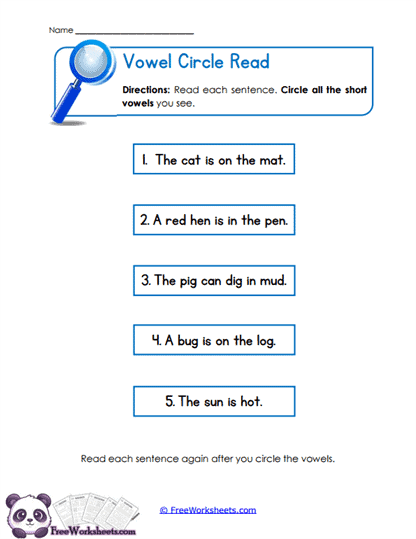
Vowel Hunt
What Kids Do:
Children read five simple sentences containing familiar CVC words and circle the short vowels they find. They move through each sentence word by word and then reread the text after marking the vowel sounds.
Target Skill:
This activity helps students transfer short-vowel knowledge from isolated words into connected reading. Children strengthen visual scanning, phonics awareness, sentence reading, and the ability to recognize vowel sounds while maintaining meaning across a full sentence.