
Kindergarten Mixed Math Review Worksheets
Kindergarten math kindergarten mixed math review worksheets help children practice numbers, operations, shapes, patterns, measurement, and problem solving together. Free, ready-to-print worksheets in PDF format are designed for immediate classroom use, centers, homework, guided practice, or homeschool lessons. Students strengthen number sense, flexible problem solving, and early operations while developing skills that support curriculum expectations.
About This Collection of Worksheets
Mixed math review helps kindergarten students revisit several important skills on the same page instead of practicing only one topic at a time. Children may move from counting to addition, then switch to shapes, patterns, comparison, measurement, number order, or a simple word problem. This variety encourages students to pay attention to each direction and decide which math idea fits the problem.
The collection includes a wide range of activity formats to keep review engaging and useful. Students count objects, compare numbers and quantities, solve addition and subtraction problems, identify shapes, extend patterns, work with position and measurement words, complete number sequences, match related ideas, draw mathematical representations, and solve short real-world problems. Some pages use multiple-choice or matching formats, while others require students to write, draw, circle, cross out, or color.
Teachers can use these worksheets for morning work, centers, spiral review, intervention, homework, or informal assessment. Parents, tutors, and homeschool educators can use individual pages to see which skills a child remembers confidently and which ones may need additional practice. Because each worksheet combines several topics, the collection also helps students become comfortable switching strategies and applying different kinds of math thinking within one activity.
Paul’s Teacher Tip
Before students begin a mixed review page, remind them that every box may ask for a different kind of math. Have children pause and say what the problem is asking before solving, such as “I need to count,” “I need to subtract,” or “I need to find the shape.” If students become overwhelmed by the variety, cover part of the page and work through one section at a time. Use mistakes diagnostically: a missed comparison problem may call for different follow-up practice than a missed pattern or addition problem. For extension, ask students to explain how they solved one problem from each major skill area instead of simply checking the answers.
Worksheet Collection Skill Spotlights
Choice Challenge
What Kids Do:
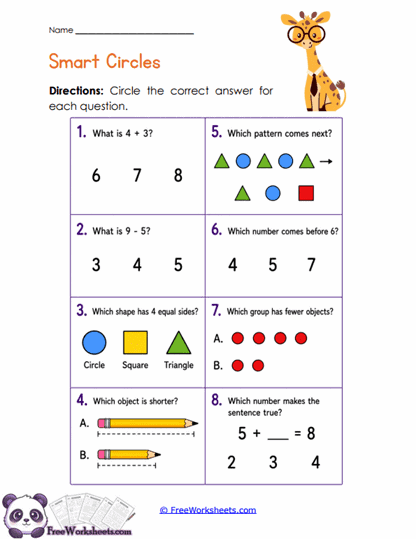
Students solve eight multiple-choice questions covering addition, subtraction, shape features, measurement, patterns, number order, comparing quantities, and a missing addend. They work out each problem, compare the available choices, and circle the answer that makes the statement or picture correct.
Target Skill:
This activity strengthens mixed-skill recall while giving kindergarten students the support of limited answer choices. Children practice calculation, geometry, sequencing, comparison, and number relationships while learning to solve first and use the choices as a way to check their reasoning rather than guess.
Color Quest
What Kids Do:
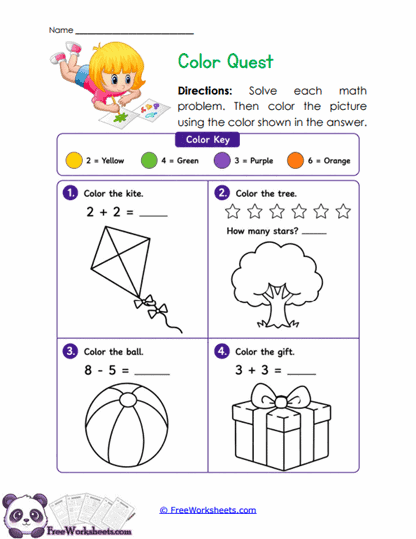
Students solve four short math problems involving addition, subtraction, and counting, then use a number-based color key to determine how each picture should be colored. They complete a two-step process by finding the numerical answer first and then matching that answer with the correct color.
Target Skill:
The worksheet reinforces basic computation and number recognition while adding careful direction-following. Kindergarten students practice connecting an answer with a second representation, helping them strengthen operations, attention, number matching, and the ability to complete a simple sequence of mathematical steps.
Matching Mission
What Kids Do:
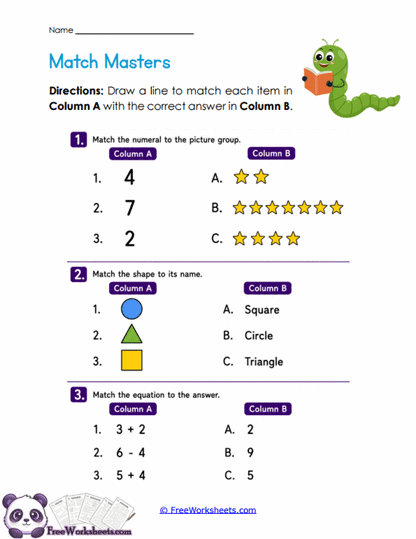
Students complete three matching activities on one page. They connect written numerals with equal groups of stars, match common shapes with their names, and solve basic addition or subtraction equations before drawing lines to the corresponding numerical answers.
Target Skill:
This activity strengthens connections between different mathematical representations. Kindergarten learners practice linking numerals to quantities, shapes to vocabulary, and equations to solutions, reinforcing number sense, geometry language, early computation, and careful visual comparison across several skill areas.
Math Medley
What Kids Do:
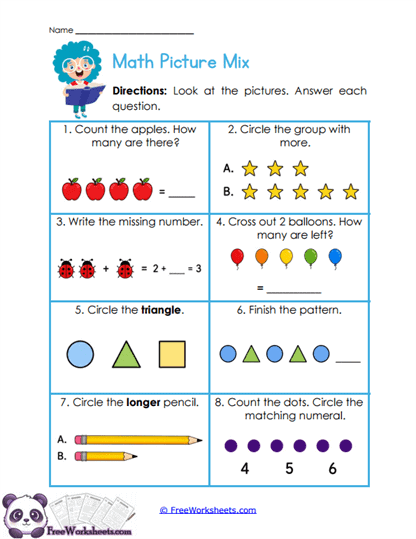
Students work through eight picture-supported problems that include counting apples, comparing star groups, completing addition, modeling subtraction by crossing out balloons, identifying a triangle, extending a pattern, comparing pencil lengths, and matching a dot quantity with the correct numeral.
Target Skill:
The varied tasks build flexible kindergarten math thinking by requiring students to move among number sense, operations, geometry, patterning, and measurement. Children learn to identify what each problem is asking and select an appropriate strategy rather than repeating one procedure across the entire page.
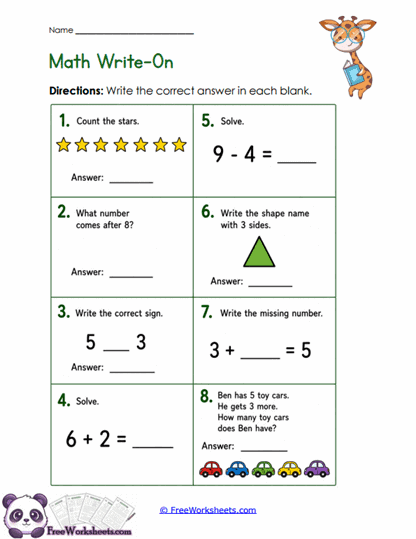
Math Writeup
What Kids Do:
Students answer eight mixed math questions primarily by writing responses rather than choosing from prepared options. They count objects, identify the number after 8, compare numbers, solve addition and subtraction, name a triangle, complete a missing-number problem, and answer a short toy-car story problem.
Target Skill:
This worksheet develops independent recall and written mathematical response. Kindergarten students must produce answers without relying heavily on multiple-choice clues, strengthening number writing, operations, comparison, geometry vocabulary, number order, and simple problem-solving confidence.
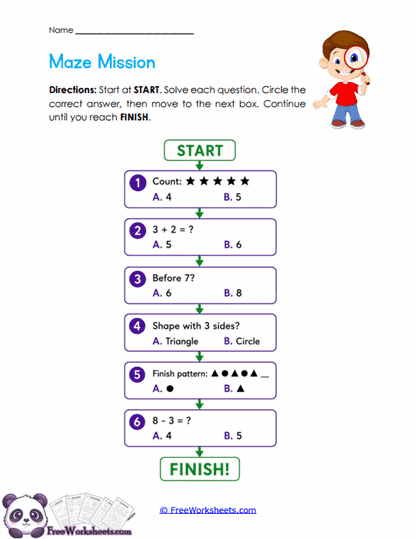
Maze Mission
What Kids Do:
Students follow a start-to-finish path containing six connected math stations. They count stars, solve addition, identify the number before 7, choose a three-sided shape, complete a repeating pattern, and solve subtraction, circling one of two choices before moving to the next station.
Target Skill:
The activity supports rapid recall of several foundational kindergarten concepts while maintaining a clear sequence of work. Students strengthen counting, operations, number order, geometry, and pattern recognition while practicing attention and switching from one type of math problem to another.
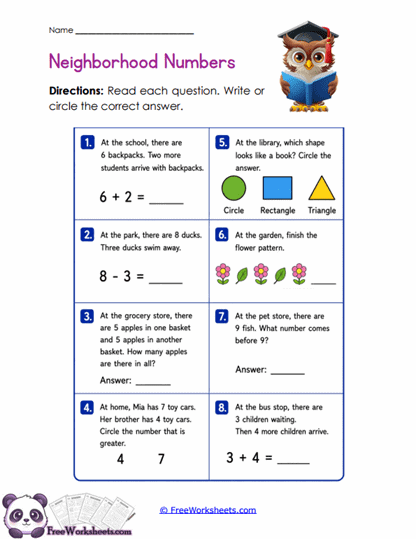
Neighborhood Math
What Kids Do:
Students solve eight questions placed in familiar settings such as school, the park, a grocery store, library, garden, pet store, home, and bus stop. They use addition, subtraction, shapes, patterns, counting, and number order to solve short real-world situations and record or circle answers.
Target Skill:
This worksheet strengthens mathematical application by connecting classroom skills with everyday contexts. Kindergarten learners practice identifying whether a situation requires adding, subtracting, recognizing a shape, completing a sequence, or using number order, building early problem-solving and reading-for-meaning skills.
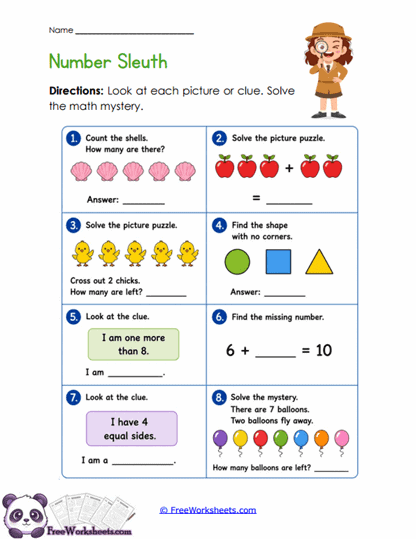
Number Sleuth
What Kids Do:
Students solve eight mystery-style problems involving counting shells, picture addition, picture subtraction, shape clues, number clues, a missing addend, shape properties, and a balloon story problem. They use visual information and short written hints to determine each answer and record it on the provided line.
Target Skill:
The clue-based format builds flexible number sense and reasoning. Kindergarten students practice interpreting phrases such as one more, solving equations, connecting shapes with attributes, and using pictures to model operations, supporting careful reading and mathematical thinking across several early concepts.
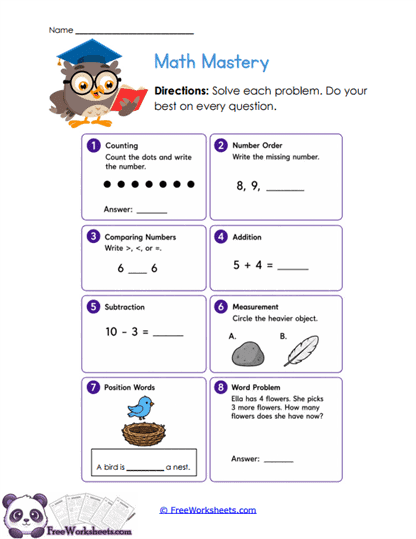
Owl Challenge
What Kids Do:
Students complete eight boxed problems that include counting dots, finding the number after 9, comparing equal numbers, solving addition and subtraction, identifying the heavier object, completing a position-word sentence, and solving a short flower word problem.
Target Skill:
This broad review develops independent recall across number sense, operations, comparison, measurement, positional language, and problem solving. Kindergarten learners must recognize which skill applies in each box and use the correct mathematical language or operation without relying on one repeated task structure.
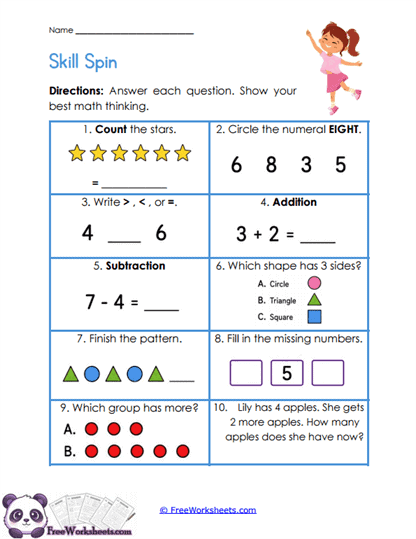
Skill Sampler
What Kids Do:
Students complete ten short problems that move through counting, numeral recognition, number comparison, addition, subtraction, shape identification, pattern extension, number sequencing, quantity comparison, and a simple apple word problem. Responses include writing numbers, circling choices, and completing blanks.
Target Skill:
This activity provides a broad check of foundational kindergarten mathematics and helps students practice shifting between different concepts. Children strengthen number sense, operations, geometry, patterns, comparisons, and problem solving while learning to read each direction carefully before choosing a strategy.
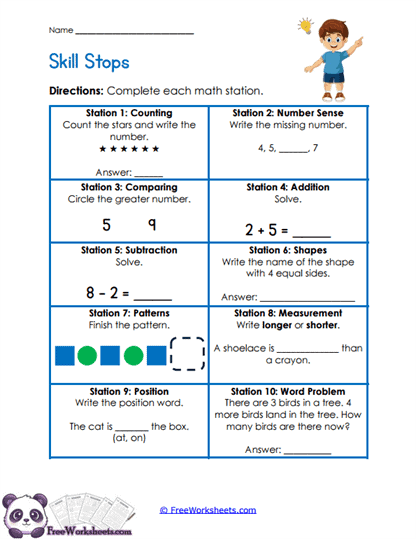
Skill Stations
What Kids Do:
Students rotate through ten labeled sections covering counting, missing numbers, greater-number comparison, addition, subtraction, shape naming, pattern completion, length vocabulary, position words, and a short bird story problem. Each station uses a slightly different type of response.
Target Skill:
The station format reinforces broad kindergarten math knowledge while emphasizing flexible strategy use and mathematical vocabulary. Students practice selecting the correct approach for numbers, operations, geometry, measurement, patterns, and spatial relationships as they move from one independent task to the next.
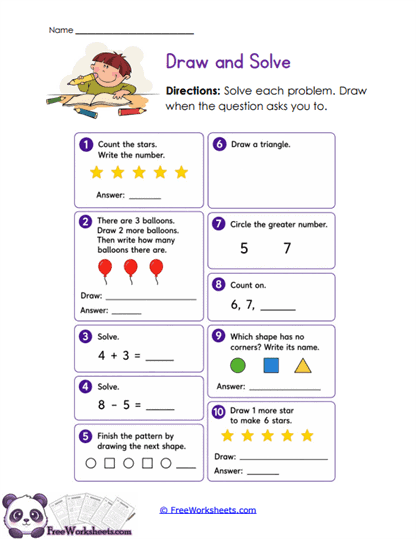
Sketch Solver
What Kids Do:
Students complete ten mixed questions that require both solving and drawing. They count stars, add balloons to a pictured group, solve equations, continue a shape pattern, draw a triangle, compare numbers, complete a number sequence, identify a shape with no corners, and add another star to a group.
Target Skill:
This worksheet strengthens visual representation alongside computation and number sense. Kindergarten students show mathematical ideas through drawings as well as numerals, building understanding of quantities, operations, geometry, patterns, comparison, and number order without depending on multiple-choice answers.