
Identifying And Creating Repeating Patterns Worksheets
Kindergarten math identifying and creating repeating patterns worksheets help children recognize pattern rules, continue sequences, and build repeating designs independently. Free, ready-to-print worksheets in PDF format are designed for immediate classroom use, centers, guided practice, homework, or homeschool lessons. Students strengthen sequencing, prediction, and logical reasoning while developing skills that support curriculum expectations.
About This Collection of Worksheets
Identifying and creating repeating patterns helps kindergarten students understand that a pattern follows a predictable rule. Children learn to notice the small unit that repeats, determine what should come next, identify when a sequence is incorrect, and describe simple structures such as AB, AAB, and ABC. These visual activities encourage students to focus on order and repetition rather than memorizing individual pictures.
The collection gives children many ways to practice the same core ideas without relying on one task style. Students identify repeating units, circle the next picture, draw missing items, repair broken patterns, match sequences with correct endings, create AB patterns from picture pairs, extend longer pattern strips, and label sequences with letter rules. Familiar images such as fruit, animals, weather symbols, school supplies, toys, and shapes keep the activities approachable and easy to discuss.
Teachers can use these worksheets during guided math, centers, morning work, intervention, review, or informal assessment. Parents, tutors, and homeschool educators can reinforce the same concepts with blocks, crayons, toys, or household objects before moving to the printed pages. Because the collection includes both pattern identification and original pattern creation, students have opportunities to show that they understand the rule rather than simply copying what they see.
Paul’s Teacher Tip
Have students say a pattern aloud before they circle, draw, or write an answer. For an AAB pattern, use a clear rhythm such as “apple, apple, leaf / apple, apple, leaf” so children can hear where the repeating unit begins again. When introducing letter labels, assign A to the first picture type, B to the next different picture, and C only when a third new picture appears. If a student makes an error, ask them to point to one complete repeating unit and rebuild the pattern from that point. Once students can extend patterns confidently, challenge them to create a pattern for a partner to identify and label.
Worksheet Collection Skill Spotlights
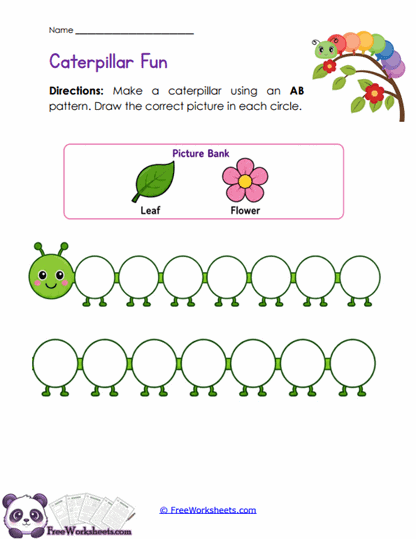
Caterpillar Chain
What Kids Do:
Students use a picture bank containing a leaf and flower to create one long AB pattern across the circles that make up a caterpillar’s body. They choose a starting picture, alternate the two images from one circle to the next, and continue the same repeating rule across both rows.
Target Skill:
This activity strengthens independent pattern creation by requiring kindergarten students to maintain an AB rule across a longer sequence. Children build visual memory, sequencing, and consistency while learning that a repeating pattern must continue in the same order even when it stretches across many spaces.
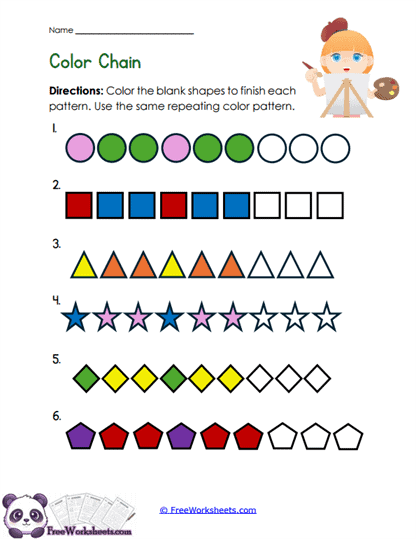
Color Patterns
What Kids Do:
Students examine six rows of matching shapes whose colors follow a repeating rule. They identify the color sequence already shown and use crayons to fill the remaining circles, squares, triangles, stars, diamonds, or pentagons so each pattern continues correctly from left to right.
Target Skill:
The worksheet develops pattern recognition when color, rather than object type, creates the repeating structure. Kindergarten students practice identifying repeating units, maintaining the correct color order, and predicting future elements while also strengthening visual tracking and fine-motor control.
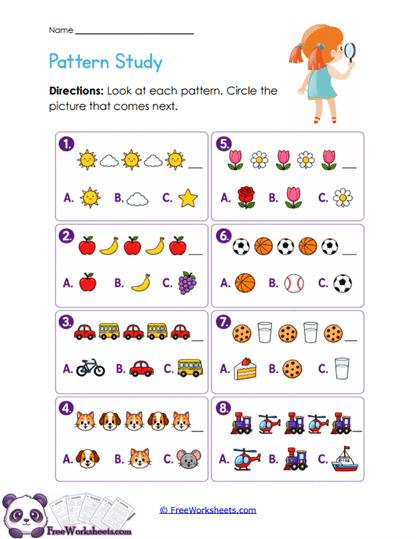
Pattern Choice
What Kids Do:
Students study eight picture patterns and decide which image should come next in each sequence. After identifying the repeating order, they compare choices A, B, and C and circle the picture that correctly continues patterns made from familiar objects such as weather symbols, fruit, vehicles, pets, and classroom items.
Target Skill:
This activity builds prediction and rule recognition by asking students to use an established repeating sequence as evidence for the next item. Kindergarten learners strengthen visual memory, left-to-right sequencing, and logical reasoning while learning not to choose an answer based on preference or appearance alone.
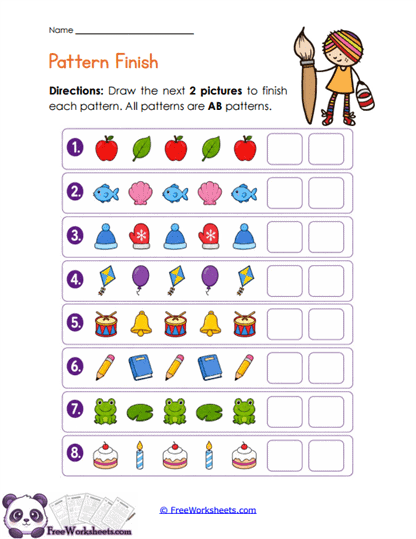
Pattern Finish
What Kids Do:
Students work through eight AB picture patterns and draw the next two items in the blank boxes at the end of each row. They use sequences featuring apples and leaves, fish and shells, hats and mittens, kites and balloons, drums and bells, books and pencils, and other familiar pairs.
Target Skill:
This worksheet strengthens students’ ability to extend a simple two-part repeating rule for more than one position. Kindergarten learners practice holding an AB sequence in mind, predicting consecutive items, and maintaining the correct order rather than repeating the same answer twice.
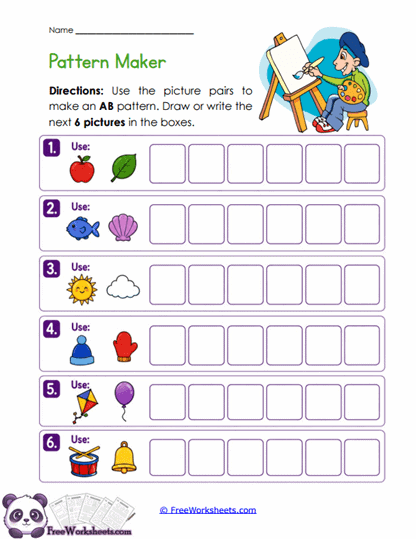
Pattern Maker
What Kids Do:
Students receive two pictures at the beginning of each row and use those images to build an AB sequence across six blank boxes. They alternate picture pairs such as apples and leaves, fish and shells, suns and clouds, hats and mittens, kites and balloons, or drums and bells.
Target Skill:
The activity moves students from recognizing patterns to creating them independently. Kindergarten learners must apply the AB structure consistently, strengthening early algebraic reasoning, visual sequencing, and understanding that two elements take turns in the same repeating order.
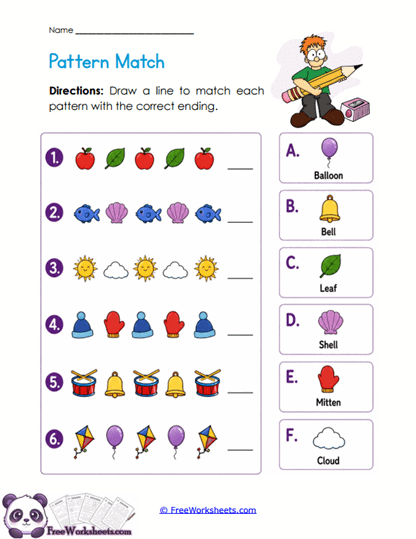
Pattern Matches
What Kids Do:
Students examine six AB picture patterns on the left side of the page, predict what should come next, and draw a line to the correct ending picture on the right. They work with familiar pairs including apples and leaves, fish and shells, weather pictures, clothing, instruments, and outdoor objects.
Target Skill:
This matching task strengthens pattern extension while reducing the drawing demands of the activity. Kindergarten students practice identifying a two-part repeating unit, predicting the missing next element, and distinguishing the correct ending from other pictures that may also appear somewhere in the sequence.
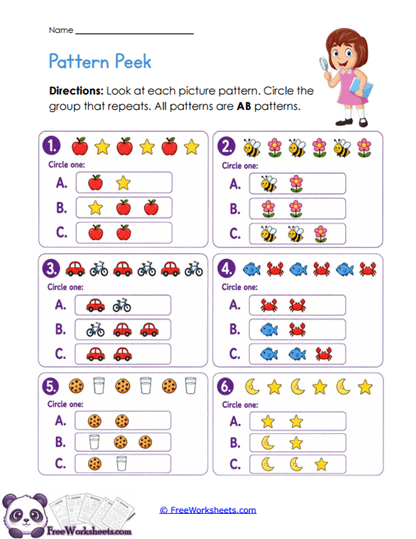
Pattern Parts
What Kids Do:
Students study six complete AB picture patterns and decide which two-picture group forms the repeating unit. They compare three answer choices for each sequence and circle the pair that accurately shows the small section repeated across the entire row.
Target Skill:
This activity develops a deeper understanding of how patterns are built by focusing on the repeating unit instead of only the next picture. Kindergarten students strengthen rule recognition and early algebraic thinking by identifying the core two-part structure that generates the full sequence.
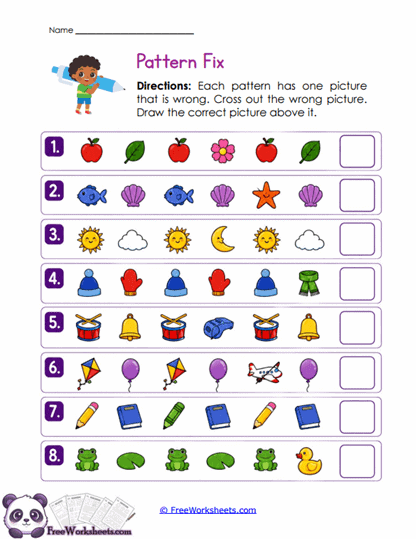
Pattern Repair
What Kids Do:
Students inspect eight AB picture patterns containing one item that breaks the repeating rule. They find and cross out the incorrect picture, determine what should appear in that position, and draw the correct replacement in the provided blank box.
Target Skill:
The worksheet develops error detection, pattern analysis, and correction. Kindergarten learners must understand the intended AB structure well enough to recognize when the sequence fails, explain what belongs instead, and restore the repeating order rather than simply extending a correct pattern.
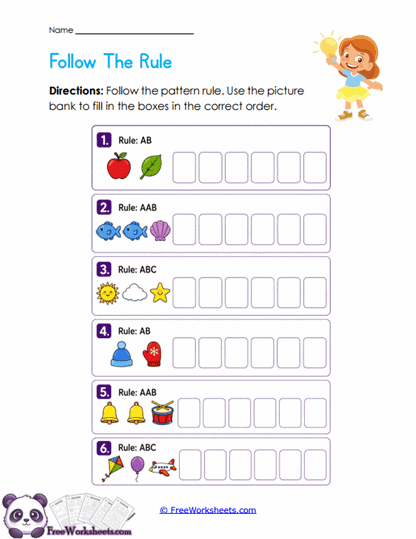
Pattern Rules
What Kids Do:
Students follow six named pattern rules, including AB, AAB, and ABC, and use the starter pictures to complete each sequence. They study both the letter label and the pictured examples before filling the remaining boxes in the correct repeated order.
Target Skill:
This activity connects visual patterns with symbolic letter rules. Kindergarten students learn that letters describe positions and relationships rather than specific pictures, strengthening early algebraic thinking as they translate structures such as AB, AAB, and ABC into complete visual sequences.
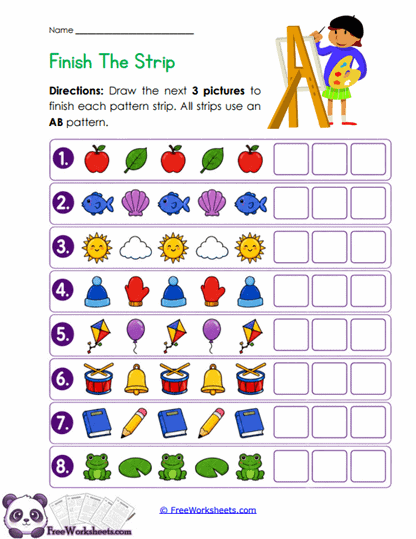
Pattern Strips
What Kids Do:
Students examine eight AB picture strips and extend each one through three additional blank boxes. They identify the alternating pair, say or track the sequence, and draw the next three items in order using familiar themes such as fruit, weather, clothing, instruments, school supplies, and animals.
Target Skill:
The longer response format strengthens pattern fluency by requiring students to apply the same rule repeatedly without losing their place. Kindergarten learners develop sequencing, visual memory, and prediction while demonstrating that they can continue an AB pattern beyond a single missing item.
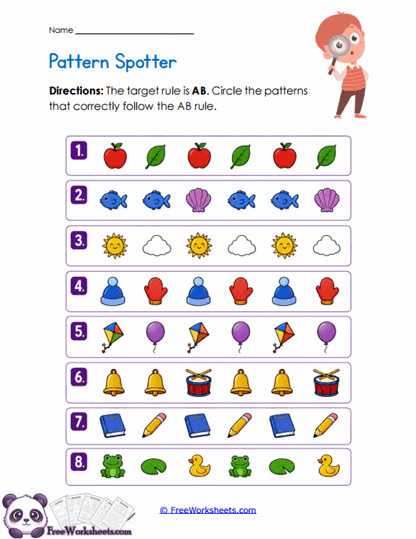
Rule Spotter
What Kids Do:
Students inspect eight complete picture rows and decide which ones truly follow an AB rule. They circle only the sequences in which two different pictures alternate consistently from beginning to end and leave rows with other structures or broken alternation unmarked.
Target Skill:
This activity develops pattern classification and careful rule checking. Kindergarten students learn that repeated pictures alone do not automatically make an AB pattern, strengthening their ability to distinguish steady alternation from AAB, other repeating structures, or incorrectly formed sequences.
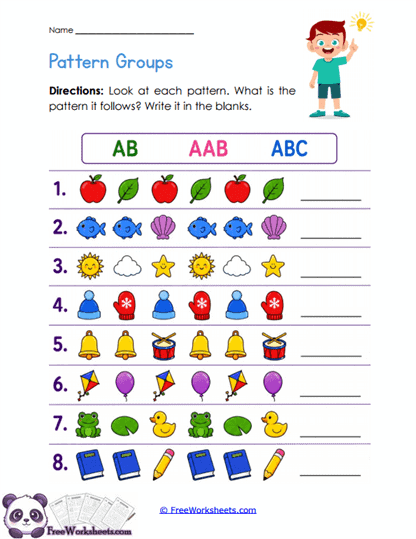
Sequence Labels
What Kids Do:
Students study eight complete picture patterns and determine whether each one follows an AB, AAB, or ABC structure. They identify the repeating unit, compare the positions of the pictures, and write the appropriate letter label on the answer line for each sequence.
Target Skill:
The worksheet strengthens symbolic reasoning by asking students to describe visual patterns with abstract letter rules. Kindergarten learners practice comparing common repeating structures, identifying how many distinct positions appear in a unit, and translating picture sequences into simple algebraic language.