
Comparing Length, Weight, And Capacity Worksheets
Kindergarten math comparing length, weight, and capacity worksheets help children describe measurable differences between familiar objects using simple comparison words. Free, ready-to-print worksheets in PDF format are designed for immediate classroom use, guided practice, centers, homework, or homeschool lessons. Students strengthen measurement vocabulary, visual comparison, and early reasoning while developing skills that support curriculum expectations.
About This Collection of Worksheets
Comparing length, weight, and capacity gives kindergarten students an important foundation for later measurement work. Children learn that objects can be compared in different ways, using words such as longer, shorter, heavier, lighter, holds more, and holds less. These visual activities help students focus on one measurable feature at a time before they begin using rulers, balance scales, or other measurement tools.
The collection includes a wide range of practice formats so children can work with comparison ideas in different ways. Students circle longer or shorter objects, compare heavier and lighter items, decide which containers hold more or less, sort objects by weight, order several objects by length, complete comparison sentences, and create their own examples through drawing. Mixed review pages also ask students to switch between length, weight, and capacity so they learn to recognize which type of measurement a problem is asking about.
Teachers can use these worksheets during whole-class instruction, guided math, centers, review, or informal assessment. Parents, tutors, and homeschool educators can reinforce the concepts with simple hands-on activities using pencils, containers, toys, or household objects before moving to the printed pages. Because the worksheets progress from straightforward picture comparisons to ordering, sorting, language use, and drawing, they offer multiple ways to build confidence with early measurement concepts.
Paul’s Teacher Tip
Start with real objects whenever possible so children can see, hold, line up, or compare items before working from pictures. For length, line up one end of two objects and ask which stretches farther; for weight, let students gently lift or balance objects; and for capacity, use containers that can be filled with water, rice, or counters. Watch for students who confuse overall size with the specific feature being measured, such as assuming the tallest container must always hold more. Ask children to name the measurement idea before answering by saying, “Are we comparing length, weight, or how much it holds?” Once students are comfortable with pairs, move to ordering several objects or asking them to create their own examples of longer, lighter, or heavier items.
Worksheet Collection Skill Spotlights
Capacity Check
What Kids Do:
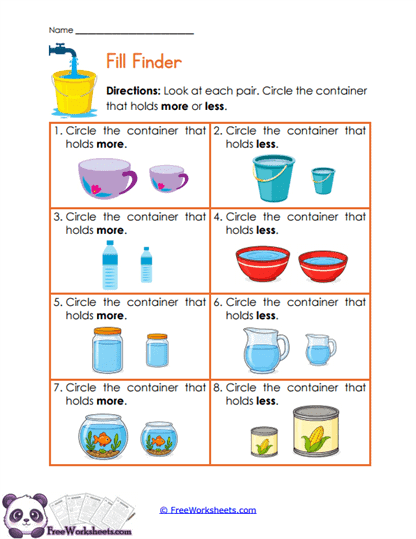
Students examine eight pairs of familiar containers, including cups, buckets, bottles, bowls, jars, pitchers, fishbowls, and cans. For each pair, they determine which container holds more or holds less and circle the picture that matches the direction, using visual clues to reason about the amount each container could contain.
Target Skill:
This activity develops an early understanding of capacity as the amount a container can hold. Kindergarten students practice distinguishing capacity from height or general size while building vocabulary such as holds more and holds less, which prepares them for later hands-on comparisons and measurement with real containers.
Compare Pairs
What Kids Do:
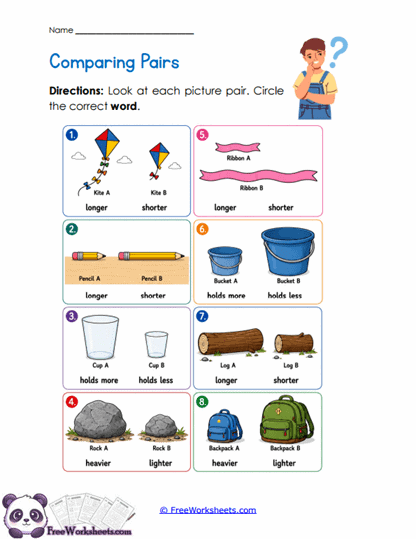
Students work through eight picture comparisons involving objects such as kites, pencils, cups, rocks, ribbons, buckets, logs, and backpacks. They study each pair, identify whether the comparison involves length, weight, or capacity, and circle the word that correctly describes the relationship between the two objects.
Target Skill:
This mixed review strengthens students’ ability to select the correct comparison language for different measurable features. Kindergarten learners practice distinguishing longer from heavier and holds more from looks bigger, helping them connect measurement vocabulary with the specific attribute being compared.
Equal Length
What Kids Do:
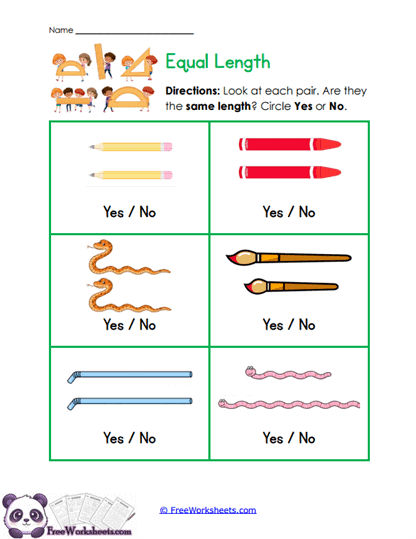
Students look closely at six pairs of matching objects such as pencils, crayons, snakes, paintbrushes, straws, and worms. They compare how far each object extends and circle Yes when the two objects have the same length or No when one extends farther than the other.
Target Skill:
The worksheet builds understanding of equal length and direct comparison. Kindergarten students learn that objects can be the same type yet have different lengths, and they practice judging whether two objects would reach the same endpoint if their starting points were lined up.
Length Order
What Kids Do:
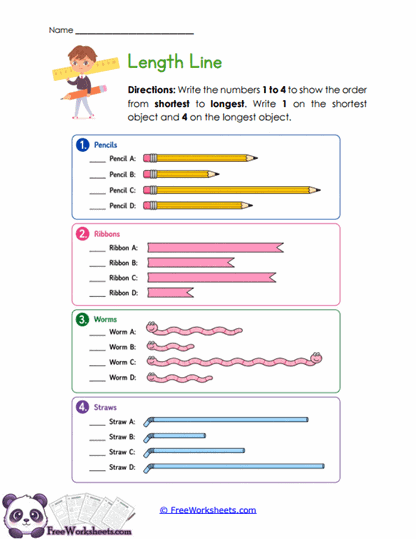
Students examine groups of four pencils, ribbons, worms, or straws that vary in length. They compare all four items and write the numbers 1 through 4 to place them in order from shortest to longest, requiring them to identify both extreme and middle lengths.
Target Skill:
This activity extends length comparison beyond simple pairs by asking students to sequence several objects. Kindergarten learners strengthen shortest and longest vocabulary, visual ordering, comparison reasoning, and number-writing while preparing for later work arranging measured lengths by value.
Length Scout
What Kids Do:
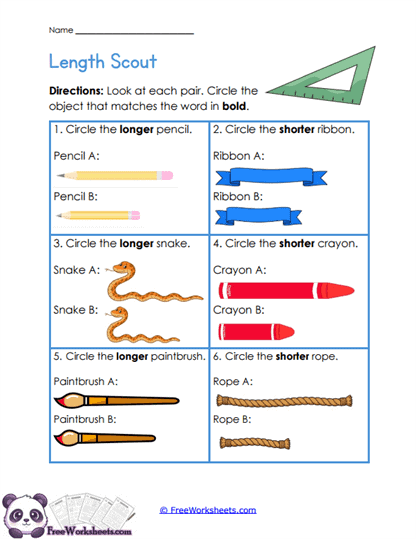
Students study six pairs of familiar objects, including pencils, ribbons, snakes, crayons, paintbrushes, and ropes. Each direction asks them to find either the longer or shorter item, and students circle the object that matches the requested comparison word after visually checking the full length of both pictures.
Target Skill:
The worksheet develops direct length comparison and accurate use of longer and shorter. Kindergarten students learn to focus on how far an object stretches from one end to the other rather than being distracted by width, color, or overall picture size.
Length Words
What Kids Do:
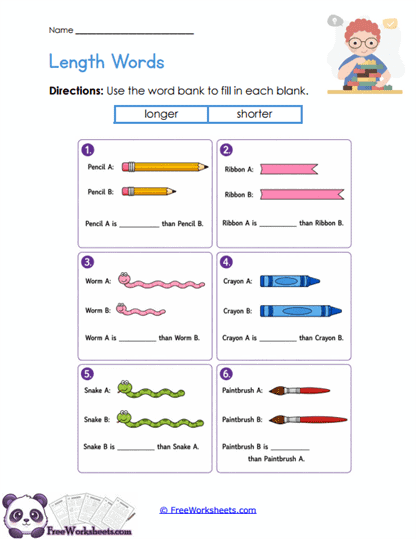
Students compare six pairs of matching objects and complete simple sentences using the words longer or shorter from a word bank. They study pencils, ribbons, worms, crayons, snakes, and paintbrushes, then write the comparison word that makes each sentence accurately describe the pictured relationship.
Target Skill:
This activity connects visual measurement with mathematical language. Kindergarten students practice describing length comparisons in complete statements, strengthening both measurement vocabulary and early reading skills while learning to identify which object a sentence is asking them to compare.
Longer Draw
What Kids Do:
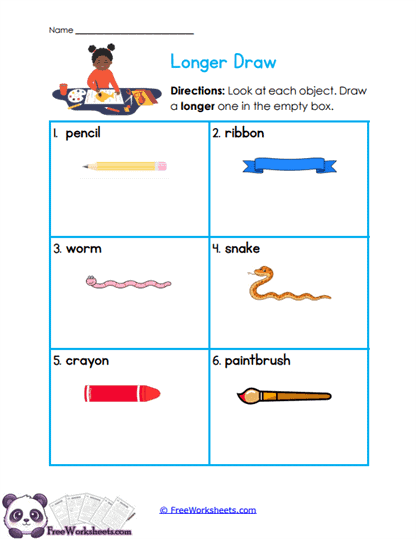
Students look at one pictured object in each of six large boxes and create a longer version in the open space. Using examples such as pencils, ribbons, worms, snakes, crayons, and paintbrushes, they draw an item that clearly stretches farther than the model shown.
Target Skill:
Rather than choosing from prepared answers, students demonstrate their understanding of longer by creating an original example. This strengthens kindergarten length concepts, visual planning, and fine-motor skills while revealing whether children truly understand that longer refers to distance from one end to the other.
Mixed Measures
What Kids Do:
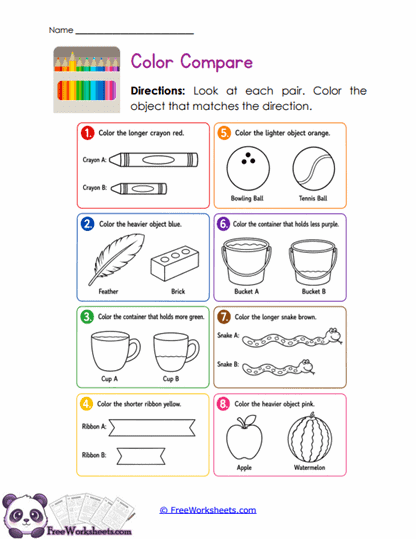
Students complete eight picture-based problems that alternate among length, weight, and capacity. They listen to or read directions such as finding the longer crayon, heavier object, lighter item, or container that holds less, then color the picture that correctly matches each comparison.
Target Skill:
The mixed format helps kindergarten students decide which measurable feature matters before making a comparison. By switching among length, weight, and capacity, children strengthen flexible reasoning and learn to connect words such as longer, heavier, lighter, more, and less with the correct measurement concept.
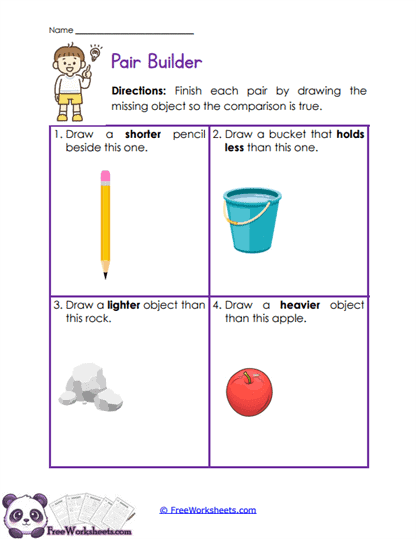
Pair Builder
What Kids Do:
Students begin with one pictured object and draw another object that makes a stated comparison true. The four prompts ask them to create examples such as a shorter pencil, a bucket that holds less, something lighter than rocks, and something heavier than an apple.
Target Skill:
This worksheet asks students to apply measurement vocabulary independently rather than recognize an answer from choices. Kindergarten learners must understand shorter, lighter, heavier, and holds less well enough to invent a reasonable example, strengthening conceptual understanding and explanation skills.
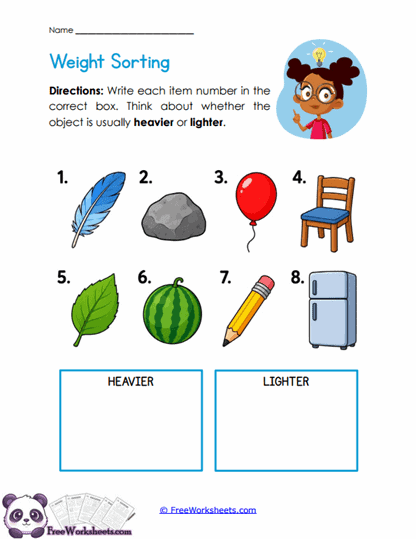
Weight Sort
What Kids Do:
Students examine eight numbered objects, including a feather, rock, balloon, chair, leaf, watermelon, pencil, and refrigerator. They decide whether each item belongs in the heavier or lighter group and write its number in the appropriate sorting box at the bottom of the page.
Target Skill:
The activity develops classification using weight as the sorting rule. Kindergarten students practice making broad real-world judgments about how objects would feel to lift while learning that weight is a measurable attribute that can be used to organize and compare familiar items.
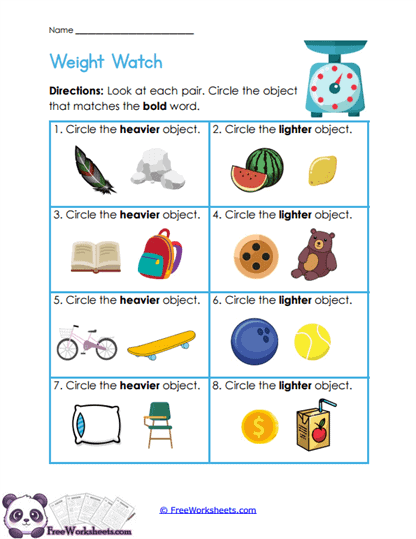
Weight Watch
What Kids Do:
Students compare eight pairs of familiar objects and determine which one is heavier or lighter according to each direction. Examples include feathers and rocks, fruit, books, backpacks, bicycles, balls, chairs, coins, and boxes, giving children repeated practice making realistic weight comparisons.
Target Skill:
This worksheet builds practical understanding of heavier and lighter through familiar real-world examples. Kindergarten learners strengthen measurement vocabulary and reasoning by thinking about how objects would feel to lift rather than relying only on how large their pictures appear.
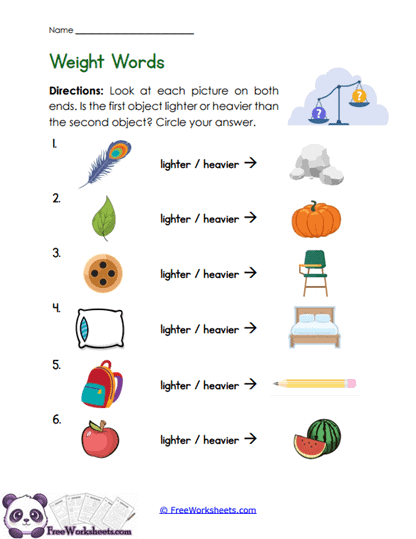
Weight Words
What Kids Do:
Students examine six pairs of everyday objects and decide whether the first object is lighter or heavier than the second. They then circle the word that correctly completes each comparison, using examples such as a feather and rocks, a leaf and pumpkin, or a backpack and pencil.
Target Skill:
The activity develops precise use of weight comparison language within a complete relationship. Kindergarten students practice keeping track of which object is being described while applying lighter and heavier correctly, helping connect hands-on weight experiences with spoken and written measurement vocabulary.