
About This Worksheet
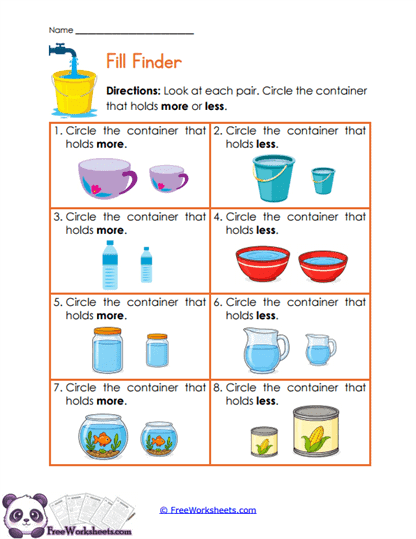
Capacity Check is a kindergarten measurement activity that helps children decide which container can hold more or less. Each problem shows two similar containers in different sizes, including cups, buckets, bottles, bowls, jars, pitchers, fishbowls, and cans. Children compare the space inside each one and circle the container named in the direction. For example, a large bucket can usually hold more than a small bucket. This helps young learners understand that capacity tells how much a container can hold.
Curriculum and Grade Alignment
This worksheet is made for kindergarten learners who are beginning to compare the capacity of familiar containers. The main goal is to help children correctly use the ideas of holds more and holds less. Before using this page, your child should understand that containers can hold different amounts of water, sand, or other materials. The next step is testing containers with real materials and comparing capacity more directly. This activity supports early measurement learning by helping children compare an important measurable feature without using standard units yet.
Student Tasks
On this worksheet, students will look at eight pairs of containers. They will decide whether the direction asks for the container that holds more or the one that holds less. Children then circle the correct cup, bucket, bottle, bowl, jar, pitcher, fishbowl, or can. The repeated pair format gives them several chances to use the same capacity idea with different objects. This builds measurement vocabulary, observation, and real-world reasoning.
Common Challenges and Misconceptions
Some children may focus only on how tall a container is and assume the taller one always holds more. Others may confuse holds less with simply looking smaller. A child may also have difficulty understanding capacity because it describes the empty space inside an object rather than the outside shape alone. Encourage your child to imagine filling both containers with water. Asking, “Which one would need more water before it was full?” can make the comparison clearer.
Implementation Guidance
Teachers can use this worksheet after a simple pouring activity with cups, bowls, or containers of different sizes. It works well when children can first see that one container may take more scoops or cups to fill. Parents can try a similar activity at a sink, water table, or with dry rice if appropriate. Let your child predict which container holds more before testing it. Then return to the worksheet and use the same thinking with the pictures.
Details and Features
This worksheet includes eight capacity comparisons using familiar household containers. Directions alternate between finding the container that holds more and the one that holds less. Large colorful pictures make the size differences easy for kindergarten children to see. The two-column layout keeps each comparison clear and organized. The printable supports capacity vocabulary, visual comparison, reasoning, and early measurement understanding.