
About This Worksheet
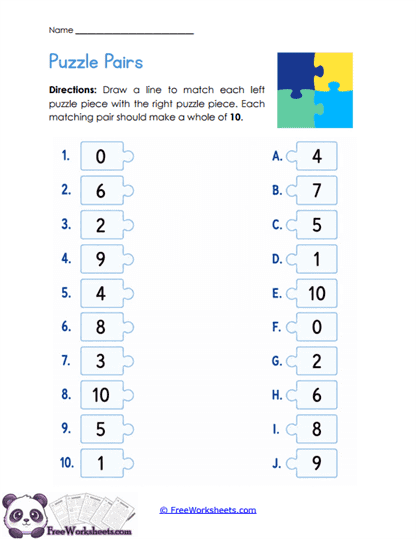
Puzzle Partners is a kindergarten matching activity that helps children connect two numbers that combine to make 10. Each number appears on a puzzle-piece shape, with one set on the left and another set on the right. Children think about the partner for each number and draw a line to the matching puzzle piece. For example, 6 connects to 4 because 6 + 4 = 10. This makes number-pair practice feel like solving a puzzle while still focusing on an important addition skill.
Curriculum and Grade Alignment
This worksheet is made for kindergarten learners who are building fluency with number partners of 10. The main goal is to help children recognize complementary pairs without relying on picture groups. Before using this page, your child should have practiced making 10 with counters, ten-frames, number bonds, or equations. The next step is recalling these combinations quickly during addition and subtraction work. This activity supports early number fluency by strengthening the relationship between numbers that make a total of 10.
Student Tasks
On this worksheet, students will look at each numbered puzzle piece on the left side. They will decide which number on the right joins with it to make 10 and draw a line between the pair. The page includes numbers from 0 through 10, giving practice with many make-10 combinations. Children need to scan carefully because the partners are mixed rather than lined up directly across from each other. This builds number recall, matching, visual tracking, and early addition fluency.
Common Challenges and Misconceptions
Some children may match identical numbers instead of looking for the number that completes 10. Others may forget the special pairs 0 and 10 or 5 and 5. A child may also lose track once several lines cross the page. Encourage your child to say a full equation before drawing each line, such as, “Eight plus two makes ten.” Lightly marking each finished pair can help keep the page organized.
Implementation Guidance
Teachers can use this worksheet after children have practiced make-10 pairs with cards or manipulatives. It works well as a center activity because the puzzle-piece theme gives the matching task a playful feel. Parents can cut simple paper number cards and ask the child to pair numbers that make 10 before starting the worksheet. If a pair is not remembered, use fingers or counters to check it. This helps children build accuracy before speed.
Details and Features
This worksheet includes ten numbered puzzle pieces on the left and ten matching choices on the right. The numbers are mixed so children must rely on the make-10 relationship rather than position. Large puzzle-piece shapes make the activity visually clear for kindergarten learners. Open space leaves room for connecting lines. The printable supports complementary pairs, number matching, addition fluency, and visual reasoning.