
About This Worksheet
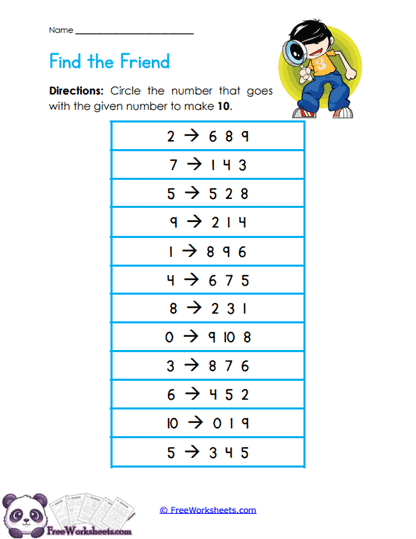
Number Allies is a kindergarten multiple-choice activity that helps children find the number that joins with a given number to make 10. Each row begins with one number and then gives three possible partners to choose from. Children think about the missing part and circle the correct choice. For example, when the starting number is 2, the child circles 8 because 2 + 8 = 10. This helps young learners practice make-10 facts while also checking their thinking against a small set of answers.
Curriculum and Grade Alignment
This worksheet is made for kindergarten learners who are building fluency with combinations of 10. The main goal is to help children recognize the correct number partner from several choices. Before using this page, your child should have experience making 10 with pictures, ten-frames, or number bonds. The next step is recalling these partners without multiple-choice support and using them in addition and subtraction problems. This activity supports early number fluency by strengthening quick recognition of complementary pairs.
Student Tasks
On this worksheet, students will look at the starting number in each row and decide what number is needed to reach 10. They then compare the three choices and circle the correct partner. The rows include starting numbers such as 2, 7, 5, 9, 1, 4, 8, 0, 3, 6, and 10. Some starting values appear again, giving children repeated practice with the same relationship. This builds number-partner recall, multiple-choice reasoning, and confidence with make-10 facts.
Common Challenges and Misconceptions
Some children may circle the choice that is closest to the starting number instead of thinking about the total of 10. Others may choose 10 simply because it appears in the choices. A child may also guess without checking the pair. Encourage your child to say, “___ plus what makes 10?” before looking closely at the choices. If needed, fingers or counters can help verify the answer.
Implementation Guidance
Teachers can use this worksheet after children have practiced make-10 combinations in more visual formats. It works well as a transition toward faster fact recognition because students no longer have picture groups to count. Parents can cover the answer choices at first and ask the child to name the partner from memory. Then uncover the choices so the child can find and circle the number they already said. This reduces guessing and encourages stronger recall.
Details and Features
This worksheet includes twelve make-10 questions with three number choices in each row. The vertical format keeps each problem easy to follow and gives children repeated practice without extra distractions. Several number partners appear more than once, reinforcing important combinations. The simple circling response keeps the focus on number relationships rather than writing. The printable supports make-10 fluency, complementary pairs, number sense, and early addition.