
Use Units In Real Life
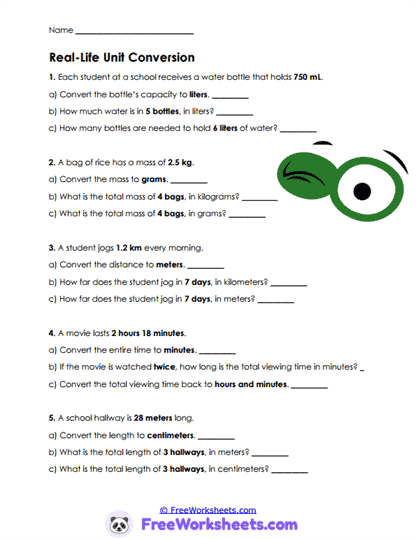
This worksheet teaches students how to apply unit conversions to practical real-world situations involving capacity, mass, distance, and time. Learners solve multi-step measurement problems connected to daily activities such as jogging, movies, and carrying water bottles. The activity strengthens understanding of metric relationships and helps students see how conversions support real-life decision making. For example, students may convert liters to milliliters or determine total jogging distance over several days. The worksheet also reinforces reasoning with multiple measurement units in the same problem.
Standards Connection
This worksheet supports Grade 8 concepts involving metric conversions, proportional reasoning, and practical measurement applications. Students strengthen skills needed for science, geometry, and quantitative reasoning in everyday situations. Learners should already understand basic metric units and operations before beginning this activity. The worksheet aligns with Common Core standards involving measurement and proportional relationships. It also supports TEKS 8.4A and 8.5C through solving contextual problems using unit conversions.
Work Through The Situations
On this worksheet, students will solve real-world conversion problems involving liters, milliliters, kilograms, grams, kilometers, meters, hours, and minutes. Learners convert measurements into different units before solving follow-up questions. Some problems involve calculating totals after repeated actions, such as multiple jogging days or repeated viewing times. Students also practice switching between larger and smaller metric units depending on the situation. The activity strengthens conversion fluency and practical reasoning skills.
Student Challenges
Many students make errors because they forget whether to multiply or divide during metric conversions. Some learners lose track of units during multi-step problems involving repeated calculations. Others confuse time conversions between hours and minutes when solving elapsed-time situations. Students may also forget to label answers with the correct units. Teachers can improve understanding by encouraging learners to write conversion relationships clearly before solving.
Teaching Ideas
Teachers can use this worksheet during measurement units, proportional reasoning lessons, or real-world problem-solving practice. Parents and homeschool educators may support students by discussing examples involving grocery shopping, travel distances, and water usage at home. The activity also works well for partner discussions where learners explain how they chose conversion strategies. Students benefit from repeated multi-step conversion practice because it strengthens accuracy and confidence. Real-world examples help learners understand why unit conversions are important in everyday life.
Worksheet Features
The worksheet includes practical scenarios involving water bottles, jogging distances, movies, and hallway measurements for engaging practice. Organized answer spaces help students keep calculations neat and easy to follow. Problems gradually increase in complexity to support skill growth and flexibility. Student-friendly directions support classroom instruction and independent completion. The printable format works well for middle school classrooms, tutoring sessions, and homeschool math lessons.