
About This Worksheet
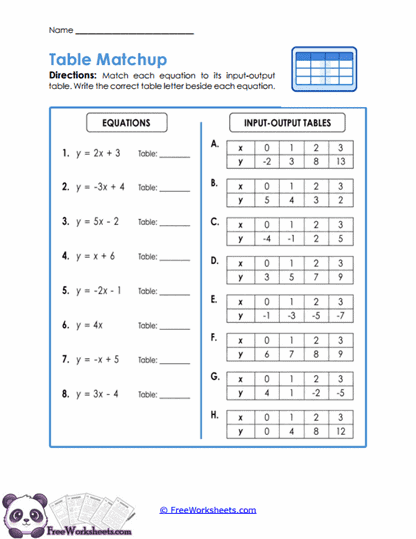
This worksheet helps eighth-grade students match linear equations with input-output tables that follow the same rule. Students compare equations such as y = 2x + 3, y = -3x + 4, and y = 5x – 2 with tables of x- and y-values. Their job is to determine which table was generated by each equation and then record the matching letter. This helps students see that a linear equation and a table are simply two different ways of showing the same relationship. It is a useful bridge between symbolic algebra and numerical patterns.
What Students Practice
Students substitute x-values into each equation and compare the resulting y-values with the tables. They may also work backward from a table by looking for a constant rate of change and an initial value. Some equations have positive slopes, while others have negative or zero intercepts, so students must read the signs carefully. This gives them practice with substitution, pattern recognition, slope, and y-intercept at the same time. The matching format also encourages them to verify more than one row before making a final choice.
Why This Matters
Students need to be able to recognize the same linear relationship whether it is shown as an equation, table, graph, or story. Matching equations with tables strengthens that flexibility. It also helps them see how the slope controls the change between rows and how the intercept determines the value when x = 0. This understanding becomes important when students compare functions or write equations from data. It also helps build confidence with substitution and checking.
Teaching Tips
Encourage students to start with x = 0 whenever that row is available because it reveals the y-intercept immediately. Then check how y changes as x increases by one to confirm the slope. If the table and equation still seem similar, substitute another x-value to verify the match. Remind students that one matching point is not always enough to prove two relationships are the same. Checking two or more values makes the reasoning stronger.
Curriculum Standards
This worksheet supports CCSS.MATH.CONTENT.8.F.A.2, which asks students to compare properties of functions represented in different ways. It also reinforces CCSS.MATH.CONTENT.8.F.B.4 by helping students connect linear equations with rates of change and initial values. The substitution work strengthens students’ ability to interpret and verify function rules. The activity works well for class practice, homework, review, or a formative assessment.