
About This Worksheet
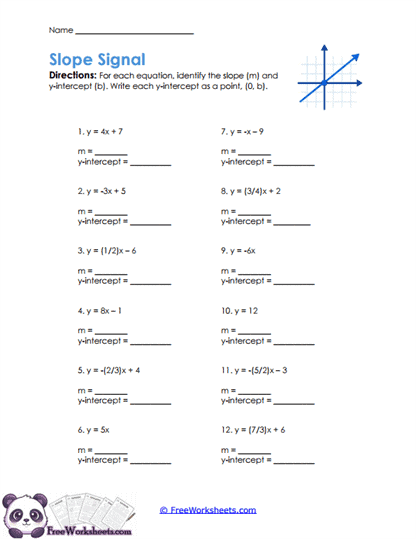
This worksheet helps eighth-grade students identify the two most important parts of a linear equation written in slope-intercept form. Students look at equations such as y = 4x + 7 or y = -3x + 5 and determine the slope, m, and the y-intercept, b. The activity also includes equations with positive slopes, negative slopes, fractions, zero slope, and equations where the y-intercept is zero. This gives students practice reading the structure of y = mx + b without having to graph every equation first. It is a strong foundation for understanding how an equation describes the direction and starting point of a line.
What Students Practice
Students examine each linear equation and identify the coefficient of x as the slope. They also identify the constant term as the y-intercept, paying attention to the sign attached to each value. Some equations do not show an added constant, so students must recognize that the y-intercept is zero. A horizontal equation such as y = 12 gives them practice recognizing a slope of zero as well. By working through these different forms, students learn to read slope-intercept equations quickly and accurately.
Why This Matters
Students need to understand that every part of y = mx + b tells them something about the graph. The slope explains how the line changes as x increases, while the y-intercept tells where the line crosses the y-axis. If students can identify those pieces directly from an equation, graphing and comparing linear relationships becomes much easier. This skill is also important when students later write equations from tables, graphs, and real-world situations. Building fluency here gives them a dependable way to analyze linear equations without guessing.
Teaching Tips
Start by reminding students that the number multiplying x is m and the number added or subtracted at the end is b. Encourage them to keep the sign with each number, since a negative slope or intercept changes the graph. When an equation looks like y = 5x, ask what number is missing after the x-term and help them see that b = 0. For a constant equation such as y = 12, explain that the line never rises or falls, so the slope is zero. Having students say “slope” and “starting value” aloud can make the two parts easier to remember.
Curriculum Standards
This worksheet supports CCSS.MATH.CONTENT.8.F.B.4, which asks eighth-grade students to construct and interpret linear functions and understand the meaning of their rate of change and initial value. It also supports CCSS.MATH.CONTENT.8.EE.B.6 by reinforcing slope as a defining feature of a line. Students are learning to connect the symbolic form of a linear equation with graphical features. The activity works well for direct instruction, independent practice, homework, intervention, or review before graphing lines.