
Grade 3 Vocabulary Worksheets
A stronger vocabulary allows third graders to express differences between words such as happy, delighted, and thrilled instead of treating them as interchangeable. These grade 3 vocabulary worksheets explore word meanings through synonym comparisons, context-clue exercises, and activities involving prefixes and suffixes. Children also replace ordinary words with more precise choices and practice academic terms used in classroom directions. The free printable PDFs support both word recognition and independent vocabulary application. Encourage learners to explain their choices and use new words in meaningful sentences.
About This Collection of Worksheets
Vocabulary development becomes increasingly important in 3rd grade as children encounter more challenging reading passages, express complex ideas, and begin choosing words more deliberately in their writing. Understanding vocabulary involves more than memorizing definitions; students must recognize how words relate to one another, how their meanings change in different contexts, and how word parts contribute to overall meaning. This collection introduces those concepts through accessible activities involving synonyms, antonyms, prefixes, suffixes, context clues, academic vocabulary, and shades of meaning. Children also explore the difference between recognizing a word and using it correctly, an essential step toward developing stronger reading comprehension and more confident written expression.
The worksheets provide several approaches to understanding and applying vocabulary. Some activities ask students to match words with definitions, identify opposite meanings, or choose stronger synonyms to improve ordinary sentences. Others introduce word-building strategies by adding prefixes such as re-, un-, and dis- or suffixes such as -ful, -less, and -ment to familiar base words. Reading-based exercises encourage children to use contextual clues from a playground story to interpret unfamiliar language, while word-strength activities help them distinguish differences in intensity among related terms. Students also practice evaluating whether vocabulary is used correctly, writing original sentences with assigned words, and learning important classroom direction words such as describe, compare, explain, predict, and summarize. Together, these varied formats encourage children to explore language rather than simply memorize isolated word lists.
Teachers can incorporate these printable resources into vocabulary lessons, reading groups, literacy centers, writing workshops, or informal assessments. Activities focusing on context clues and word meanings work particularly well alongside classroom reading selections, while synonym and word-choice exercises provide useful opportunities for sentence revision. Parents and homeschool educators can use individual pages to introduce new vocabulary, reinforce familiar words, or encourage more descriptive everyday communication. Tutors may find the mixed-review and meaning-check activities helpful for identifying whether a student struggles with word definitions, word relationships, or applying vocabulary in context. By combining direct word study with meaningful reading and writing practice, this collection helps children expand their working vocabulary and use language more accurately, thoughtfully, and independently.

Paul’s Teacher Tip
When teaching new vocabulary, I recommend moving through three stages: first helping students understand a word’s meaning, then showing how it works in context, and finally asking them to use it independently. For activities involving synonyms and shades of meaning, have children compare two or three related words aloud and discuss how each one changes the picture or feeling a sentence creates. When introducing prefixes and suffixes, highlight the base word in one color and the added word part in another so students can clearly see how the meaning changes. During context clue exercises, require students to identify the specific words or actions that helped them determine a definition before selecting an answer. As an extension, encourage children to collect interesting vocabulary from their independent reading and use those words in original sentences, gradually building a personal word bank they can draw from during writing assignments.
Worksheet Collection Skill Spotlights
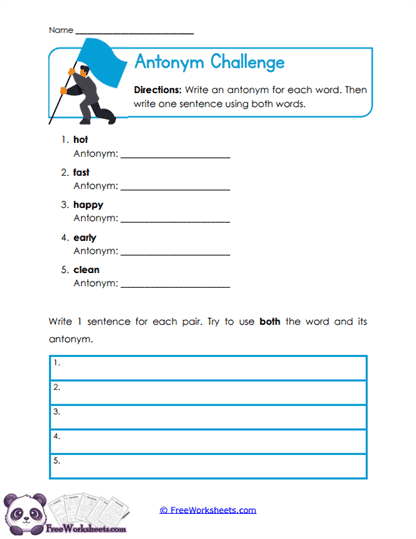
Antonym Pair Challenge
What Kids Do:
Students explore opposite meanings by working with five familiar vocabulary words, including hot, fast, happy, early, and clean. For each word, they independently write an appropriate antonym without selecting from a word bank. After completing the opposite pairs, children move into a sentence-writing section where they create one original sentence using both the starting word and its antonym. For example, they might contrast something hot with something cold or describe arriving early rather than late. The two-part format requires students to recognize opposites and demonstrate their understanding through meaningful written examples.
Target Skill:
This activity strengthens understanding of antonyms, contrasting meanings, and the use of descriptive vocabulary in complete sentences. Students learn to distinguish true opposites from words that are merely different or loosely related, developing greater precision in word choice. Incorporating both terms into an original sentence reinforces comprehension and encourages children to express contrasting ideas clearly. These abilities support 3rd grade language arts curriculum goals involving word relationships, vocabulary development, sentence construction, and accurate use of descriptive language in reading and writing.
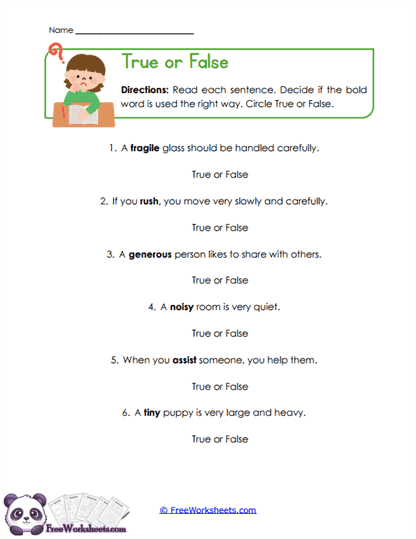
Meaning Check
What Kids Do:
Children read six sentences containing bold vocabulary words and determine whether each word is used in a way that matches its actual meaning. The examples feature terms such as fragile, rush, generous, noisy, assist, and tiny. After reading a statement, students circle True if the usage makes sense or False if the sentence contradicts the word’s meaning. For instance, describing a fragile glass as something that should be handled carefully is appropriate, while saying that rushing means moving very slowly is not. Students repeat the process across all six examples, evaluating meaning instead of simply recognizing familiar vocabulary.
Target Skill:
The exercise develops semantic accuracy and the ability to evaluate vocabulary usage within meaningful sentence contexts. Students practice connecting a word’s definition to the surrounding information and identifying contradictions when the intended meaning does not fit. This moves vocabulary learning beyond simple recognition and encourages deeper understanding of descriptive and action words. These skills reinforce 3rd grade language arts expectations involving word meanings, contextual interpretation, reading comprehension, and precise vocabulary usage when students construct and revise their own sentences.
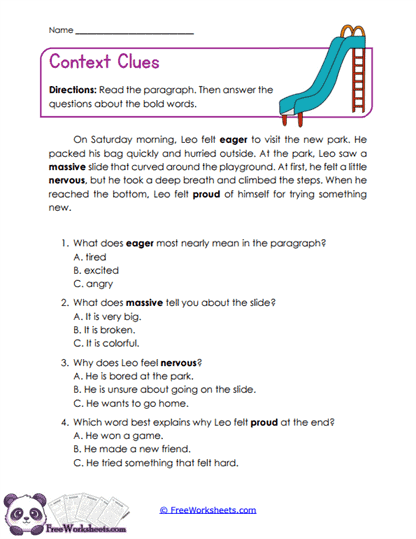
Playground Context Hunt
What Kids Do:
Students read a short narrative about Leo visiting a new playground and encounter highlighted vocabulary words embedded naturally in the story. The passage introduces terms such as eager, massive, nervous, and proud, each supported by surrounding details about Leo’s experiences and feelings. After reading, children answer four multiple-choice questions asking them to determine the most appropriate meaning of each word. They consider clues involving Leo’s actions, the size of playground equipment, and his emotional reactions. Each answer requires students to connect the vocabulary with the passage rather than choosing a definition based on guesswork.
Target Skill:
This activity strengthens contextual vocabulary strategies by teaching students to infer unfamiliar word meanings from surrounding sentences and story events. Children learn to recognize that actions, descriptions, emotional responses, and nearby information can reveal what a word means. The reading format also encourages them to justify vocabulary choices with evidence from the passage. These abilities support 3rd grade reading and language curriculum expectations involving context clues, vocabulary interpretation, inference, and independent comprehension of increasingly challenging narrative texts.
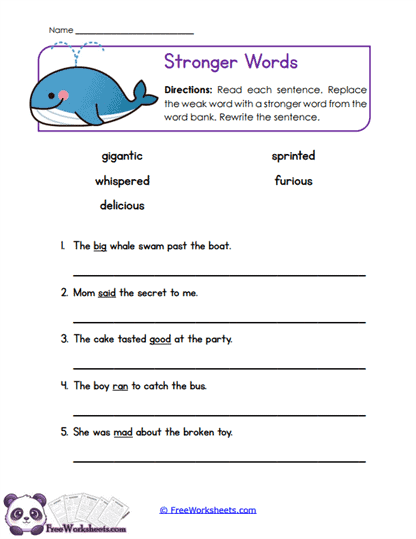
Powerful Word Upgrade
What Kids Do:
Children improve five sentences by replacing ordinary words with stronger, more descriptive vocabulary from a provided word bank. The starting sentences contain simple terms such as big, said, good, ran, and mad, while the replacement choices include gigantic, whispered, delicious, sprinted, and furious. Students examine the underlined word in each sentence, select a more precise option that fits the surrounding meaning, and rewrite the entire sentence with the replacement. The task encourages them to notice how changing a single word can create a clearer description, communicate stronger emotion, or explain an action more specifically.
Target Skill:
The focus is developing precise word choice, descriptive language, and revision skills through meaningful vocabulary substitutions. Students learn that words with related meanings often communicate different levels of intensity, specificity, or emotion, making some choices more effective than others in particular contexts. Rewriting sentences reinforces the connection between vocabulary knowledge and clear written expression. These skills support 3rd grade language arts expectations involving shades of meaning, sentence revision, vocabulary application, and the ability to select words that communicate ideas accurately.
Prefix Meaning Builder
What Kids Do:
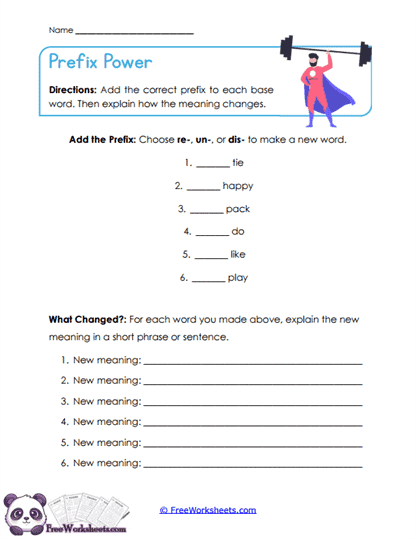
Students build new vocabulary by adding one of three prefixes, re-, un-, or dis-, to six familiar base words. Examples include tie, happy, pack, do, like, and play. In the first section, children choose a suitable prefix and write the complete new word. They then move to the What Changed? section, where they explain the meaning of each constructed word in a short phrase or sentence. For example, a student might recognize that replay means to play again. The activity requires students to consider both how the word is formed and how the prefix changes its meaning.
Target Skill:
This word-building exercise develops morphological awareness by helping students recognize prefixes as meaningful units that modify base words. Children learn that re- often indicates repetition, while un- and dis- can communicate negation, reversal, or an opposite meaning depending on the word. Explaining each new vocabulary term reinforces the relationship between word structure and meaning. These skills support 3rd grade language arts curriculum expectations involving common prefixes, word analysis, vocabulary expansion, and strategies for interpreting unfamiliar words during reading.
School Task Words
What Kids Do:
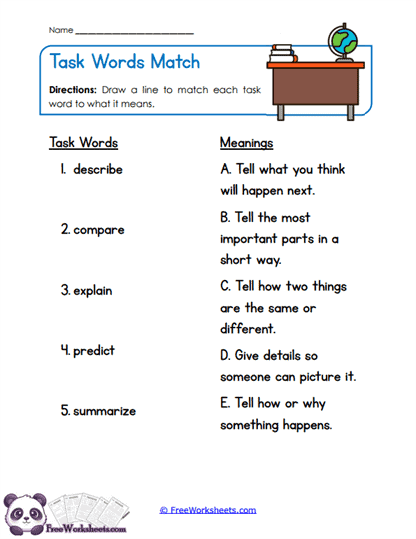
Children work with five frequently used academic direction words: describe, compare, explain, predict, and summarize. The activity presents these words in one column and five student-friendly definitions in another. Students read each term, consider what action it asks them to perform, and draw a line connecting it to the correct meaning. For example, they identify that predict involves telling what might happen next, while summarize means communicating the most important information briefly. The matching format introduces essential classroom vocabulary without requiring lengthy written responses.
Target Skill:
This activity strengthens academic vocabulary comprehension and the ability to interpret common instructional language accurately. Students learn to distinguish directions that ask them to provide descriptions, explain reasoning, make comparisons, anticipate outcomes, or summarize key information. Understanding these distinctions helps children respond more appropriately to assignments across multiple subjects. These abilities support 3rd grade language arts expectations while improving independent task completion, comprehension of written directions, and confidence when approaching classroom questions and assessments.
Stronger Synonym Swap
What Kids Do:
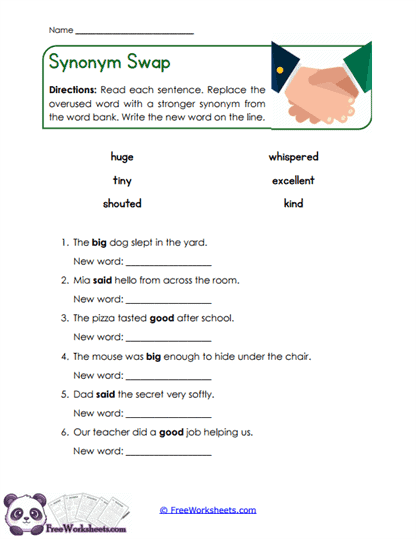
Students examine six sentences containing ordinary or overused vocabulary and replace the underlined words with more expressive alternatives. A six-word bank provides options such as huge, shouted, whispered, excellent, tiny, and kind, which children must match to the appropriate sentence contexts. Rather than selecting any word with a similar meaning, they consider the situation described and decide which replacement makes the sentence more specific. For instance, a sentence about someone speaking softly calls for whispered rather than shouted. Students record their chosen words on the answer lines.
Target Skill:
The exercise develops understanding of synonyms, contextual appropriateness, and precise vocabulary selection. Students discover that words with related meanings are not always interchangeable because they may communicate different actions, degrees of intensity, or descriptive qualities. Choosing suitable replacements strengthens semantic awareness and encourages more effective writing decisions. These skills reinforce 3rd grade language arts expectations involving word relationships, vocabulary interpretation, and the ability to improve sentence clarity through thoughtful word choice.
Suffix Word Builder
What Kids Do:
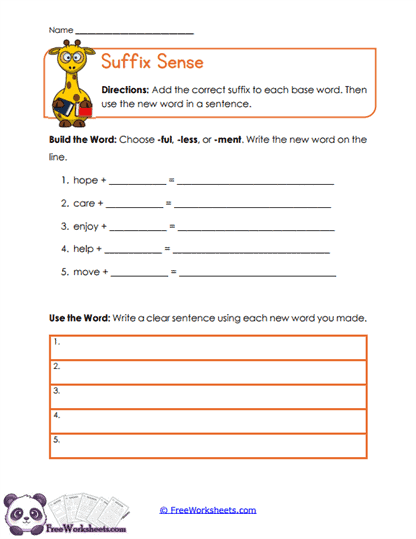
Children create new vocabulary by adding the suffixes -ful, -less, or -ment to five familiar base words, including hope, care, enjoy, help, and move. In the first section, they select an appropriate ending and write the completed word on the line provided. After building all five words, students compose an original sentence using each new term. Their sentences must demonstrate the meaning of the completed word while following basic capitalization and punctuation conventions. The two-stage activity encourages children to connect changes in word structure with practical use in writing.
Target Skill:
This activity develops understanding of suffixes and how word endings influence meaning, grammatical function, and word formation. Students explore how -ful can indicate having a quality, -less can indicate lacking something, and -ment can create nouns associated with actions or results. Using the constructed words in complete sentences reinforces both vocabulary comprehension and accurate grammatical application. These abilities support 3rd grade language arts curriculum goals involving morphology, word analysis, spelling patterns, and meaningful application of new vocabulary.
Vocabulary in Action
What Kids Do:
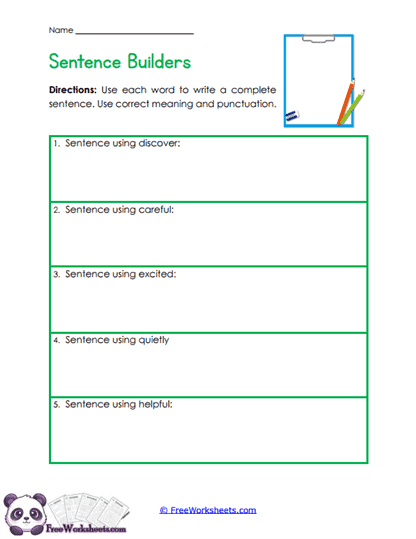
Students use five assigned vocabulary words to construct original sentences that clearly demonstrate their meanings. The target words are discover, careful, excited, quietly, and helpful. Each term appears above a large writing space where children create a complete sentence using the word naturally. Rather than simply mentioning the vocabulary, students must provide enough context to show what it means. For example, a sentence containing discover might describe finding something previously unknown, while one using quietly should explain how an action is performed. Children also check their writing for capitalization, punctuation, and completeness.
Target Skill:
The activity strengthens productive vocabulary knowledge by requiring students to move from recognizing word meanings to applying them accurately in original writing. Children practice selecting appropriate contexts, constructing complete sentences, and communicating meaning through descriptive details. This deeper application helps vocabulary become part of their everyday written and spoken language rather than remaining isolated memorized definitions. These abilities support 3rd grade language arts expectations involving vocabulary usage, sentence development, grammatical accuracy, and increasingly precise written expression.
Vocabulary Match
What Kids Do:
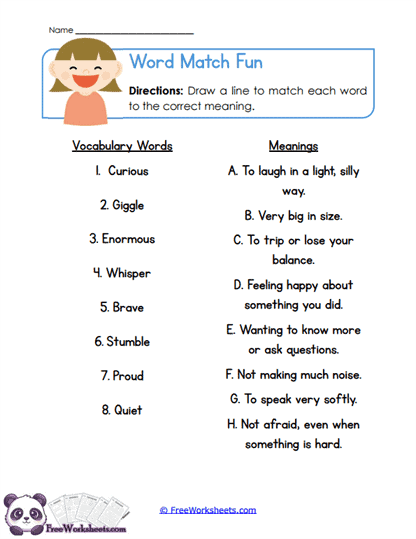
Children work with eight vocabulary words, including curious, giggle, enormous, whisper, brave, stumble, proud, and quiet. The page presents the target words alongside eight definitions labeled A through H. Students read each word, consider its meaning, and draw a line connecting it to the most appropriate definition. The activity includes related terms that require careful attention to distinctions, such as the difference between being quiet and whispering. Students continue until every word has been matched, creating a straightforward but meaningful introduction to common vocabulary.
Target Skill:
This matching exercise reinforces receptive vocabulary knowledge, word-definition relationships, and accurate understanding of frequently encountered descriptive and action words. Students practice distinguishing closely related meanings and associating familiar vocabulary with clear verbal explanations. Recognizing these differences supports stronger interpretation of language in stories, classroom conversations, and informational passages. These skills align with 3rd grade language arts curriculum goals involving vocabulary acquisition, comprehension of word meanings, and the ability to explain or recognize language accurately.
Vocabulary Skill Check
What Kids Do:
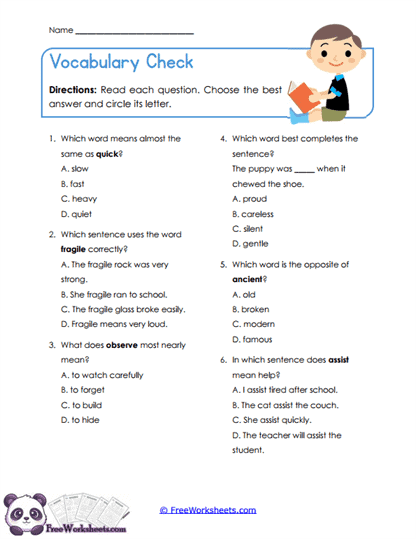
Students complete six multiple-choice questions covering several vocabulary concepts in a single review. They identify a synonym for quick, evaluate whether fragile is used correctly, choose the meaning of observe, and select a word that fits a sentence about a puppy. Additional questions ask them to find an antonym for ancient and recognize a sentence in which assist correctly means help. Each question introduces a different task, requiring children to read the options carefully and apply the appropriate vocabulary strategy before circling their answers.
Target Skill:
This mixed assessment strengthens vocabulary comprehension across multiple word relationships and contextual applications. Students demonstrate understanding of synonyms, antonyms, definitions, sentence meaning, and correct vocabulary usage rather than relying on a single repeated question format. Switching between tasks reinforces flexible thinking and helps educators identify which concepts students understand independently. These skills support 3rd grade language arts curriculum expectations involving word knowledge, contextual reasoning, vocabulary accuracy, and readiness to apply different strategies when encountering unfamiliar language.
Word Strength Ladder
What Kids Do:
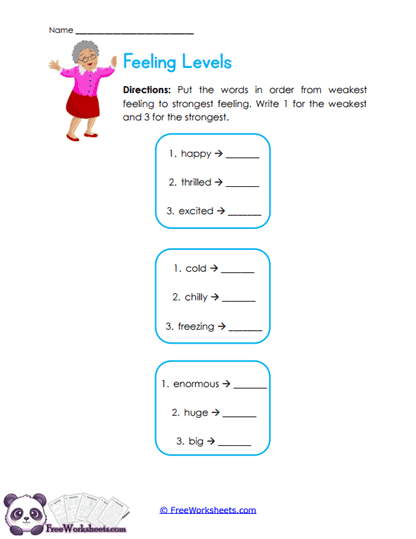
Children compare three groups of related vocabulary words and arrange each group according to intensity. The examples include happy, excited, and thrilled; cold, chilly, and freezing; and big, huge, and enormous. Students write the number 1 beside the weakest or mildest meaning, 2 beside the middle level, and 3 beside the strongest. The exercise requires them to think about the degree of emotion or description each word communicates rather than merely recognizing the words as synonyms. Comparing these relationships helps children develop a more detailed understanding of familiar vocabulary.
Target Skill:
The activity develops awareness of shades of meaning among closely related words and encourages increasingly precise descriptive language. Students learn that words sharing a general meaning can communicate different levels of strength, emotion, size, or intensity. Recognizing these differences improves reading comprehension and gives children more options when selecting vocabulary for their own writing. These skills support 3rd grade language arts expectations involving word relationships, semantic distinctions, descriptive accuracy, and thoughtful choices that make communication clearer and more expressive.