
Grade 3 Language Arts Review Worksheets
Reviewing several language arts skills together helps third graders apply what they know without being prompted to use one particular rule. These grade 3 language arts review worksheets have children correct punctuation and grammar errors, combine short sentences, and determine an author's purpose from brief passages. The free printable PDFs also include vocabulary and reading comprehension exercises for broader skill assessment. Adults can begin with a mixed-review page to identify difficulties, then select more focused activities targeting grammar, sentence structure, or reading understanding.
About This Collection of Worksheets
A well-rounded language arts review gives students opportunities to connect the reading, writing, vocabulary, and grammar skills they have been developing throughout the school year. This collection brings those areas together through engaging, manageable activities designed for 3rd grade learners. Instead of concentrating on a single language arts concept, children practice identifying parts of speech, choosing correct verb forms, recognizing sentence types, using pronouns, interpreting unfamiliar vocabulary, and improving sentence structure. These foundational skills help students become more independent readers and more confident writers as classroom expectations grow.
The worksheets offer a thoughtful mix of reading passages, sentence-level exercises, vocabulary challenges, and longer writing tasks. Some activities ask students to correct capitalization, punctuation, and grammatical errors, while others encourage them to combine sentences or revise an entire paragraph. Reading selections introduce both narrative and informational texts, giving children practice identifying main ideas, recalling important details, understanding character actions, and recognizing an author’s purpose. Students also encounter context clue exercises, subject-verb agreement questions, and activities that require them to classify words or replace repeated nouns with appropriate pronouns. This variety allows educators to review several interconnected language arts skills without relying on repetitive drills.
Teachers can use these printable resources for morning work, literacy centers, small-group instruction, weekly reviews, or informal assessments before introducing more advanced concepts. Because individual activities focus on different skills, the collection also makes it easier to identify learning gaps and provide targeted support. Parents and homeschool educators can select specific pages to reinforce classroom lessons or use several together for a broader skills check. Tutors may find the materials especially useful for determining whether a child needs additional practice with grammar conventions, reading comprehension, or written expression. The overall goal is to make language arts review purposeful, approachable, and genuinely helpful as children strengthen the skills needed for future academic success.
Paul’s Teacher Tip
When reviewing several language arts skills at once, I recommend starting with a short mixed-skills activity to see what students already understand before assigning more focused practice. If children consistently miss questions involving verbs, punctuation, or sentence structure, use those results to create small instructional groups and model the skill with two or three examples before moving into independent work. For reading comprehension activities, encourage students to underline supporting details in the passage rather than relying entirely on memory, especially when identifying main ideas or explaining character traits. During editing exercises, teach students to make separate passes for capitalization and punctuation, grammar and word choice, and overall sentence clarity so they do not overlook multiple mistakes. As an extension, have students apply one skill from the review to their own writing, such as combining choppy sentences or replacing repeated nouns with pronouns, because transferring a skill into original work is one of the best indicators of understanding.
Worksheet Collection Skill Spotlights
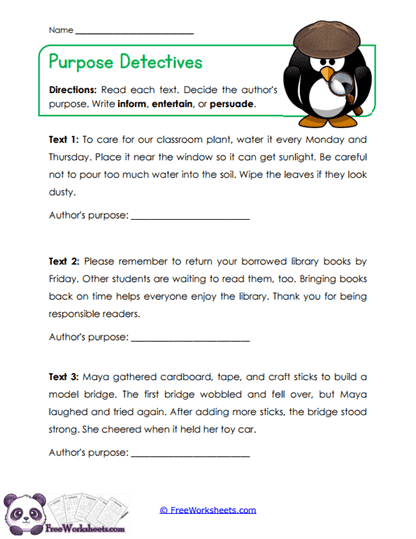
Author Purpose Hunt
What Kids Do:
Students read three short passages and determine whether each author wrote to inform, entertain, or persuade. The selections include instructions for caring for a classroom plant, a reminder about returning library books, and a story about Maya building a bridge. After examining each passage, children write the appropriate purpose on the response line. They must consider what the writer wants readers to learn, enjoy, or do rather than making their decision based only on the text’s subject. Teachers can encourage students to identify a specific phrase or detail that supports each choice.
Target Skill:
This activity strengthens the ability to recognize an author’s purpose by examining how writing communicates information, tells stories, or encourages action. Students learn to distinguish between informational, narrative, and persuasive texts while considering the intentions behind different writing styles. These skills support 3rd grade reading comprehension expectations and help children recognize how a text’s purpose influences its organization, language, and message. Understanding authorial intent also prepares students to evaluate more complex reading selections as they progress.
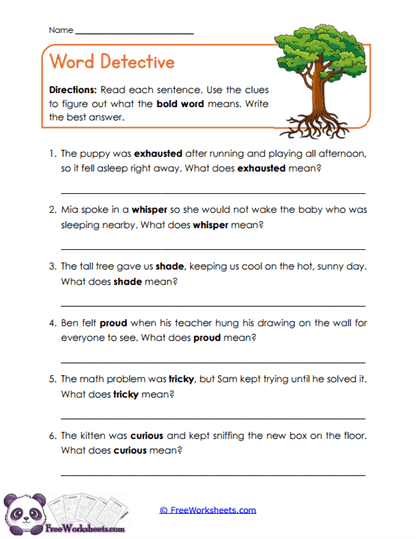
Context Clue Detective
What Kids Do:
Young readers investigate the meanings of six vocabulary words by examining the sentences in which they appear. Words such as exhausted, whisper, shade, proud, tricky, and curious are presented in meaningful contexts that provide clues about their definitions. Students read each sentence, consider the surrounding information, and write an explanation of the highlighted word in their own words. For example, a sentence describing a puppy falling asleep after an afternoon of activity helps children determine what exhausted means. The exercise encourages students to look beyond individual words and use the entire sentence to guide their thinking.
Target Skill:
The focus is on developing context clue strategies that allow students to determine unfamiliar word meanings independently. Rather than depending exclusively on memorized definitions, children practice making reasonable inferences from descriptive details, actions, and other information within sentences. This reinforces 3rd grade vocabulary development and reading comprehension goals while encouraging flexible word-learning strategies. Students also improve their ability to explain word meanings clearly, an important skill when encountering increasingly sophisticated vocabulary in literature and informational texts.
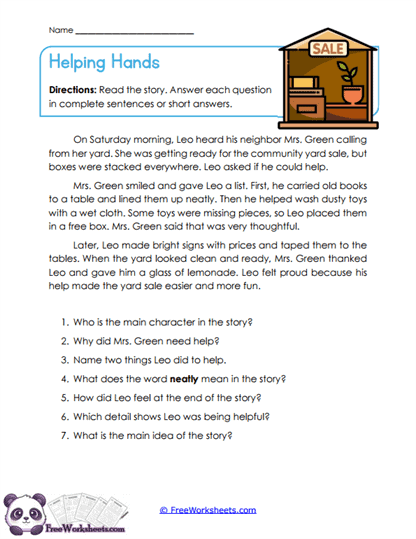
Helpful Story Review
What Kids Do:
Children read a narrative about Leo helping his neighbor, Mrs. Green, prepare for a yard sale. After following the events of the story, they answer seven comprehension questions involving characters, important details, vocabulary, feelings, and the central message. Students identify why Mrs. Green needed assistance, describe two tasks Leo completed, explain the meaning of a word from the passage, and consider how Leo felt after helping. They also select evidence demonstrating his helpful behavior and explain the story’s main idea. Each response requires students to return to the reading and think carefully about what happened and why it mattered.
Target Skill:
This reading exercise develops narrative comprehension by connecting story events, character actions, vocabulary, and main ideas. Students practice recalling explicit information while also making reasonable inferences about a character’s feelings and personal qualities. Identifying a detail that demonstrates helpful behavior introduces evidence-based reasoning, while explaining the main idea encourages children to distinguish central meaning from smaller events. Together, these abilities reinforce important 3rd grade literacy expectations involving story understanding, character analysis, vocabulary interpretation, and thoughtful responses to reading.
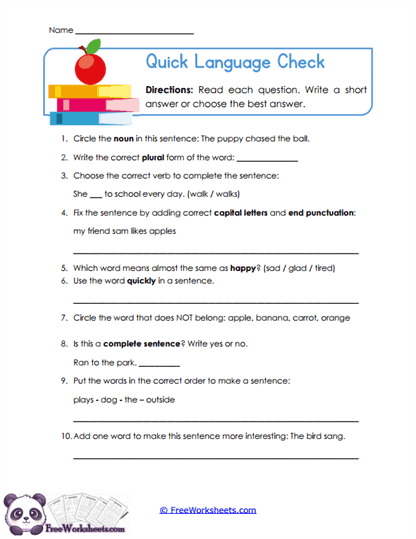
Language Skills Check
What Kids Do:
Students complete ten short tasks that sample a broad range of language arts skills. They identify a noun, write a plural word form, select a correct verb, repair capitalization and punctuation, find a synonym for happy, and use quickly in an original sentence. Additional questions ask children to recognize a word that does not belong in a category, determine whether a sentence is complete, rearrange mixed-up words, and add descriptive language to an ordinary sentence. Because the directions change from one question to another, students must carefully interpret each task and apply the correct language convention.
Target Skill:
This mixed review strengthens grammatical awareness, vocabulary knowledge, sentence construction, and basic editing skills through varied applications. Students demonstrate whether they can recognize parts of speech, use accurate word forms, understand relationships between words, and distinguish complete sentences from incomplete thoughts. Rearranging words and expanding descriptions also reinforce meaningful sentence structure and expressive writing. The broad coverage supports essential 3rd grade language arts curriculum goals while providing educators with a useful snapshot of individual strengths and areas requiring additional instruction.
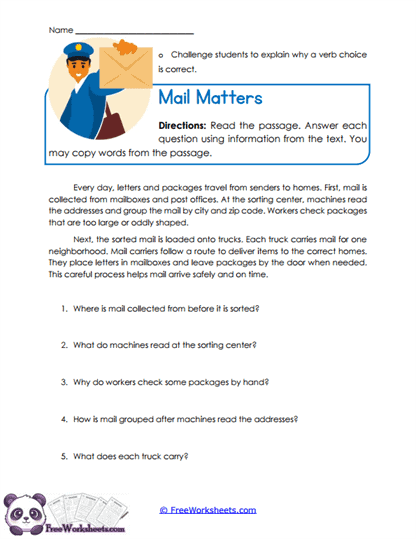
Mail Route Reading
What Kids Do:
Students explore an informational passage explaining how letters and packages move through the mail system. The reading describes collection from mailboxes and post offices, processing at a sorting center, checking certain packages by hand, grouping mail, and transporting items by truck for delivery. After reading, children answer five questions about important facts and the order of the process. They must locate information about what happens at different stages and explain the roles involved. The familiar subject makes the passage approachable while still requiring careful attention to multiple connected steps.
Target Skill:
The activity develops informational reading comprehension, sequencing, and accurate retrieval of text-based details. Students learn to follow a process from beginning to end and distinguish between different stages rather than treating the passage as a collection of unrelated facts. Answering questions about specific actions reinforces the ability to identify relevant information and support responses with evidence from nonfiction text. These skills align with 3rd grade reading expectations involving informational passages, logical sequence, key details, and understanding relationships among events or steps.
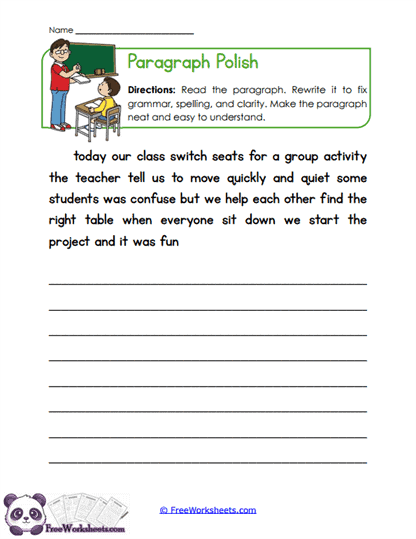
Paragraph Makeover
What Kids Do:
Children become editors as they examine a rough classroom paragraph containing several types of writing mistakes. The passage describes students changing seats for a group activity, listening to their teacher, helping classmates, and beginning a project. Students search for misspelled words, incorrect verb forms, missing capital letters, punctuation problems, and awkward phrases. Once they identify the errors, they rewrite the entire paragraph correctly using the provided writing space. Unlike activities involving isolated sentences, this exercise requires children to maintain the meaning and flow of a connected piece of writing while making several improvements.
Target Skill:
This comprehensive editing task strengthens proofreading, revision, grammar application, and written clarity. Students practice recognizing how spelling, verb tense, capitalization, punctuation, and word choice work together to create understandable paragraphs. They also begin distinguishing between correcting a technical mistake and improving wording so an idea sounds more natural. These abilities support 3rd grade writing and language conventions, particularly the expectation that students can revise and edit their work for greater correctness, organization, and readability.
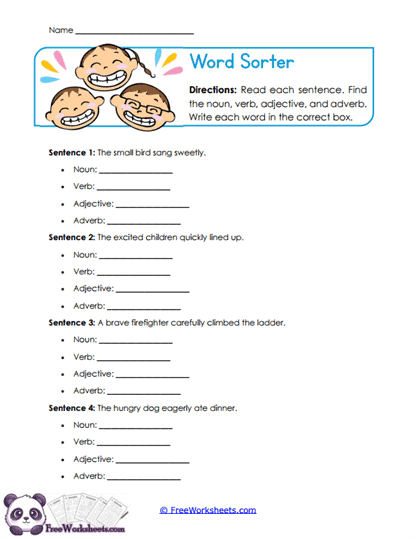
Parts of Speech Sort
What Kids Do:
Students investigate four sentences to identify nouns, verbs, adjectives, and adverbs. Each sentence contains examples of all four word types, allowing children to examine how different words contribute to a complete thought. After reading a sentence such as “The small bird sang sweetly,” they select an appropriate word for each labeled category and record their choices on separate lines. Other examples introduce descriptive actions involving familiar people, animals, and situations. The repeated sorting format encourages students to examine each word’s job rather than identifying parts of speech from memorized lists alone.
Target Skill:
The exercise reinforces grammatical classification and understanding of how words function within sentences. Students distinguish nouns that identify people or things from verbs that express actions, adjectives that describe nouns, and adverbs that modify actions. Particular attention to adjectives and adverbs helps address a common source of confusion among developing writers. This supports 3rd grade language conventions and improves students’ ability to analyze sentence structure, interpret descriptive language, and deliberately select words that make their own writing more precise and interesting.
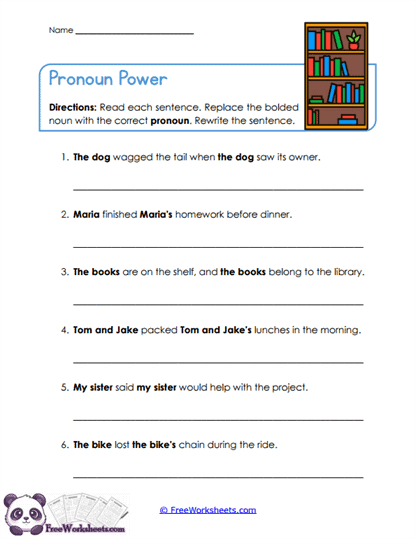
Pronoun Rewrite
What Kids Do:
Students revise six sentences containing repeated nouns and replace unnecessary repetition with appropriate pronouns. The examples feature familiar people, animals, and objects, including names, family members, books, and a bike. Children identify the repeated word, decide whether a pronoun such as he, she, it, they, or them fits the sentence, and rewrite the complete statement. A sentence mentioning Maria twice, for instance, may become smoother when the second reference is replaced with she. Each question asks students to consider both grammatical correctness and whether readers can still understand who or what the sentence describes.
Target Skill:
This grammar practice develops understanding of pronoun usage, noun-pronoun relationships, and clear sentence construction. Students learn to select pronouns that agree with the nouns they replace while maintaining understandable references throughout a sentence. They also recognize how appropriate pronoun use reduces repetition and improves the natural flow of written language. These concepts support 3rd grade grammar and writing expectations by helping children create more cohesive sentences, edit repetitive wording, and maintain clarity when discussing people, animals, or objects.
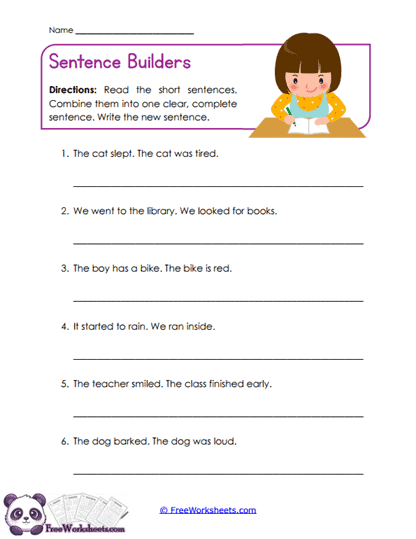
Sentence Combining Lab
What Kids Do:
Children transform six pairs of short, separate sentences into smoother, more complete statements. Examples describe a tired cat sleeping, a trip to the library, a red bike, rainy weather, a smiling teacher, and a barking dog. Students read each pair, identify the relationship between the ideas, and rewrite them as one sentence without leaving out important information. They may choose connecting words such as and, because, so, or when, depending on the meaning. Because several combinations may be acceptable, the exercise encourages thoughtful writing choices rather than requiring one memorized response.
Target Skill:
The primary focus is sentence fluency and the ability to combine related ideas using appropriate grammatical structures. Students practice recognizing connections involving sequence, cause and effect, and shared subjects while selecting words that communicate those relationships clearly. This reduces reliance on repetitive, choppy sentences and encourages greater variety in written expression. The activity supports 3rd grade writing conventions by developing sentence construction, logical connections between ideas, and the ability to revise simple statements into more natural and effective writing.
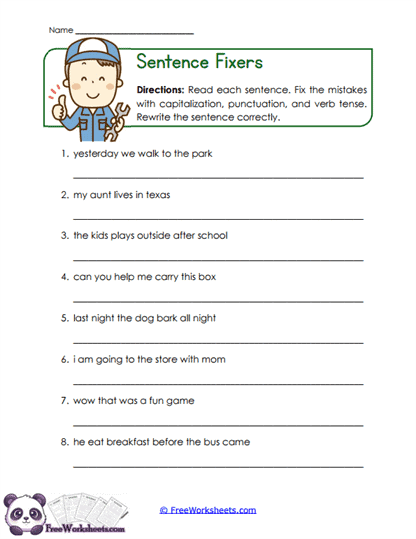
Sentence Repair Shop
What Kids Do:
Students inspect eight sentences containing common capitalization, punctuation, and verb errors. Some examples require a capital letter at the beginning, while others include incorrect verb tenses, subject-verb agreement mistakes, improperly written place names, or missing ending punctuation. Children examine each sentence, determine which changes are necessary, and rewrite the entire statement correctly on the line below. Certain sentences contain multiple mistakes, so students must check their work carefully instead of stopping after their first correction. Reading the revised sentence aloud can help them decide whether the grammar and punctuation now make sense.
Target Skill:
This editing exercise reinforces command of essential grammar conventions and develops a systematic approach to correcting written sentences. Students practice matching verb forms to subjects and time references, capitalizing sentence beginnings and proper nouns, and selecting punctuation that reflects a sentence’s meaning. The requirement to correct multiple errors helps children recognize that effective proofreading involves more than one grammatical rule. These skills support 3rd grade language arts expectations and encourage students to apply consistent editing habits to their own classroom writing.
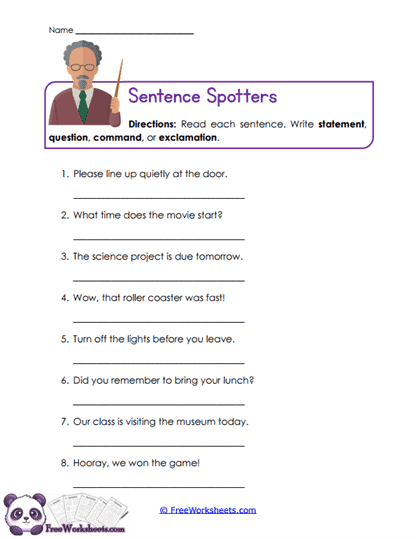
Sentence Type Sort
What Kids Do:
Children read eight examples and classify each as a statement, question, command, or exclamation. The sentences involve familiar situations such as lining up quietly, asking about movie times or lunch, discussing school events, and expressing excitement about a roller coaster or winning a game. Students consider what each sentence communicates and write the correct category on the response line. They must distinguish sentences that provide information from those that request answers, give directions, or express strong feelings. The activity also invites discussion about how punctuation supports the meaning of each sentence.
Target Skill:
The focus is recognizing sentence purposes and understanding their relationship to punctuation and communication. Students learn that statements convey information, questions request it, commands direct actions, and exclamations express strong emotion. Distinguishing these structures improves reading fluency because children can adjust their expression to match a sentence’s purpose. It also strengthens 3rd grade grammar and writing expectations by helping students construct varied sentence types, interpret punctuation accurately, and communicate different intentions clearly in their own writing.
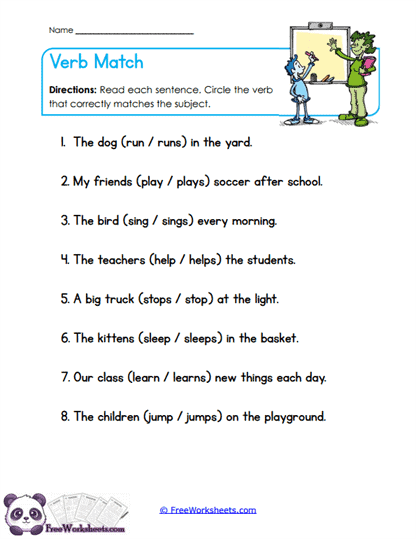
Verb Agreement Check
What Kids Do:
Students complete eight sentences by choosing the verb form that correctly matches each subject. Every question presents two options in parentheses, such as run/runs or play/plays, and children circle the appropriate choice. The examples feature singular and plural subjects, including a dog, friends, birds, teachers, trucks, kittens, a class, and children. Before selecting an answer, students must determine whether the subject refers to one person or thing or to more than one. This predictable format allows repeated practice with a fundamental grammar rule while introducing enough variety to check genuine understanding.
Target Skill:
The activity strengthens subject-verb agreement by helping students recognize how singular and plural subjects influence present-tense verb forms. Children practice noticing when a verb generally requires an -s ending and when the base form is appropriate. By examining the relationship between the subject and the action, they develop grammatical accuracy instead of relying entirely on which option sounds familiar. This supports 3rd grade language conventions and helps students avoid agreement errors when composing, revising, and proofreading sentences across different writing assignments.