
Multiplication Properties Worksheets
3rd grade math multiplication properties worksheets help students recognize, apply, and explain rules that change factor order, grouping, or expression structure. Free, ready-to-print worksheets in PDF format are designed for immediate classroom use, centers, guided practice, homework, or homeschool lessons. Students strengthen multiplication fluency, equation sense, and algebraic reasoning while developing skills that support curriculum expectations.
About This Collection of Worksheets
Multiplication properties help 3rd grade students understand why multiplication expressions can be rearranged, regrouped, decomposed, or simplified without changing their mathematical meaning. Students explore the Commutative, Associative, Distributive, Identity, and Zero Properties and learn how each rule affects factors and products. Understanding these relationships gives children useful tools for solving facts more efficiently instead of memorizing every expression separately.
The collection includes property identification, factor reversal, array models, regrouping, distributive breakdowns, missing-value equations, sorting, equivalent-expression analysis, true-or-false checks, and seasonal practice. Some worksheets focus on recognizing property names, while others ask students to rewrite, repair, or complete multiplication equations. Visual array activities also help connect abstract property rules with concrete multiplication models.
Teachers can use these worksheets during multiplication lessons, guided math, centers, intervention, homework, or review. Parents, tutors, and homeschool educators can begin with property identification and visual models before moving toward missing values and symbolic expressions. Because the collection progresses from recognizing multiplication properties to applying them as strategies, it supports stronger fact fluency and prepares students for area models, multi-digit multiplication, expressions, and later algebra.
Paul’s Teacher Tip
Teach students to describe what changed before asking them to name the property. If the factors switch places, think Commutative; if only the grouping changes, think Associative; and if one factor is broken into parts, think Distributive. Reinforce that multiplying by 1 keeps the other factor unchanged, while multiplying by 0 always produces 0. Use arrays whenever the Distributive or Commutative Property feels too abstract because the visual model makes the relationship easier to see. Once students recognize the rules confidently, encourage them to use the properties to make difficult multiplication facts easier to solve.
Worksheet Collection Skill Spotlights
Array Reversal
What Kids Do:
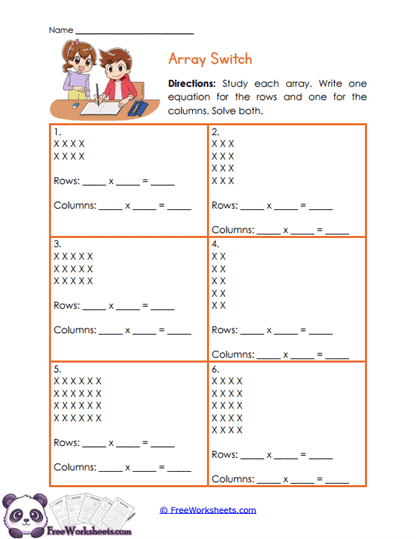
Students examine six arrays made with X marks and write two multiplication equations for each model. They first describe the array by its rows and objects per row, then reinterpret the same arrangement by columns and compare the two resulting products.
Target Skill:
This activity gives 3rd grade students a visual understanding of the Commutative Property. Learners see that switching the factors changes how an array is described but not how many objects it contains, strengthening factor-order reasoning and multiplication fluency.
Equation Repair
What Kids Do:
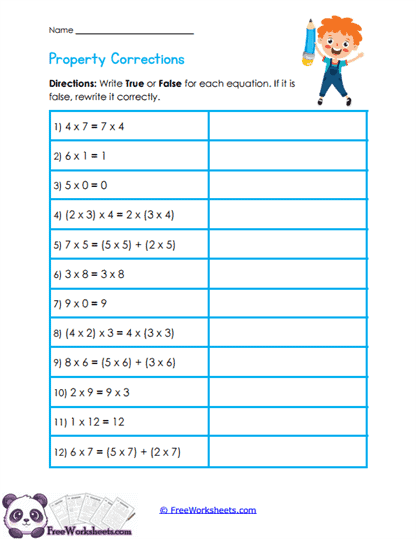
Students inspect twelve multiplication-property equations and decide whether each statement is true or false. They analyze switched factors, regrouped expressions, distributive breakdowns, multiplication by 1, and multiplication by 0, then rewrite any incorrect equation accurately.
Target Skill:
The worksheet strengthens error analysis and property fluency. 3rd grade students practice evaluating whether equation structure follows a stated multiplication rule and correcting mistakes involving factor order, grouping, decomposition, Identity, or Zero relationships.
Factor Breakdowns
What Kids Do:
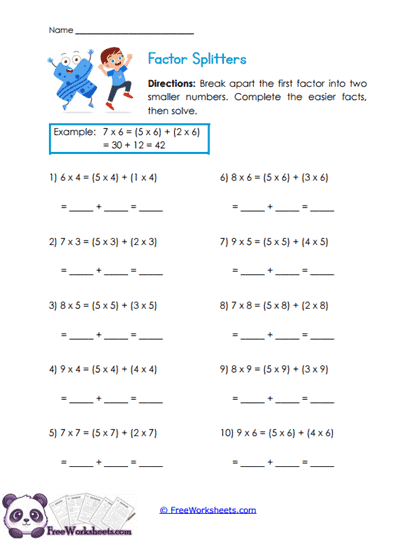
Students solve ten multiplication facts that have already been decomposed into two easier partial products. They calculate each smaller multiplication fact, add the two results, and use the combined total to determine the product of the original expression.
Target Skill:
This activity develops practical understanding of the Distributive Property. 3rd grade students learn to split one factor into manageable parts, solve familiar facts, and combine partial products while maintaining the value of the original multiplication expression.
Factor Reversal
What Kids Do:
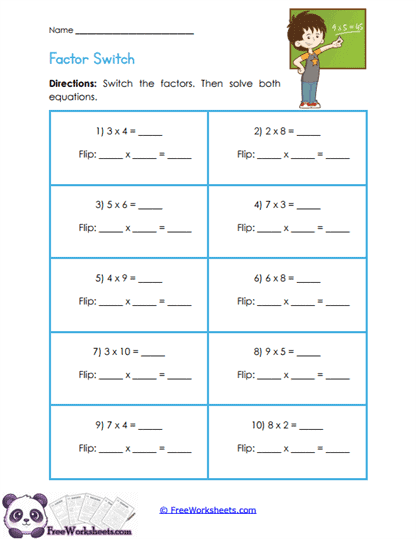
Students complete ten multiplication problems by solving an original fact, reversing the two factors, writing the new equation, and solving again. They compare each pair to confirm that the same factors in a different order produce the same product.
Target Skill:
The worksheet reinforces the Commutative Property and related-fact reasoning. 3rd grade students strengthen product recall while learning that knowing one multiplication fact automatically gives them its reversed partner, reducing unnecessary memorization.
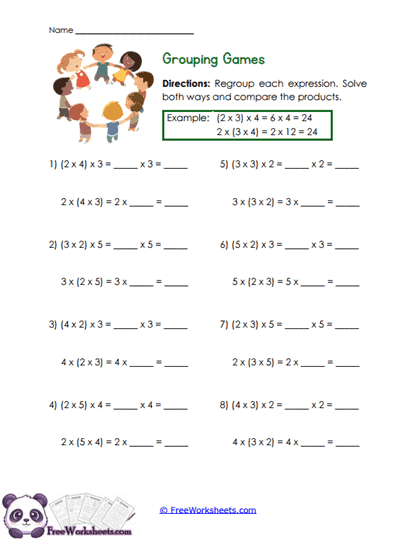
Grouping Connections
What Kids Do:
Students solve eight multiplication expressions containing three factors and parentheses. They evaluate one grouping, rewrite or study the same factors with a different grouping, solve again, and compare the products to determine what remains unchanged.
Target Skill:
This activity develops understanding of the Associative Property of Multiplication. 3rd grade students practice distinguishing a change in grouping from a change in factor order while using parentheses accurately and strengthening equation structure awareness.
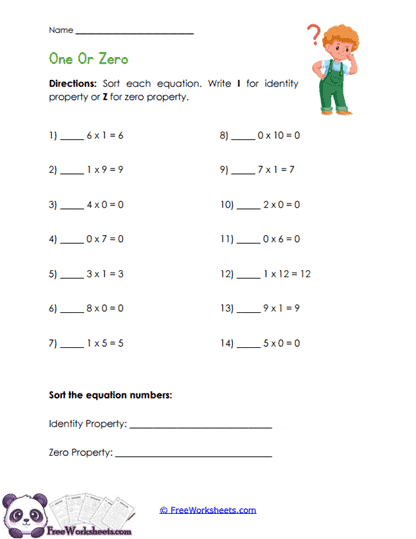
Identity Or Zero
What Kids Do:
Students examine fourteen multiplication equations containing either a factor of 1 or a factor of 0. They label each example I for Identity or Z for Zero and then sort the equation numbers into the correct property groups.
Target Skill:
The worksheet strengthens recognition of two important special multiplication rules. 3rd grade students learn that multiplying by 1 preserves the original factor while multiplying by 0 produces 0, building fast fact recall and accurate property vocabulary.
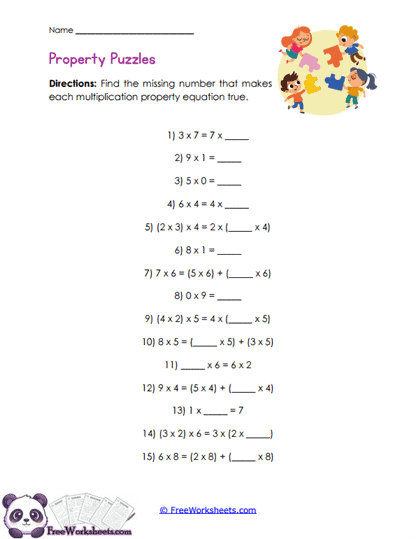
Missing Property Values
What Kids Do:
Students complete fifteen multiplication-property equations containing one missing number. They analyze factor switching, regrouping, distributive expressions, multiplication by 1, and multiplication by 0 to determine which value makes both sides of each equation equal.
Target Skill:
This activity strengthens early algebraic reasoning and equation sense. 3rd grade students practice using multiplication properties to solve unknown-value problems structurally instead of depending only on direct computation or trial and error.
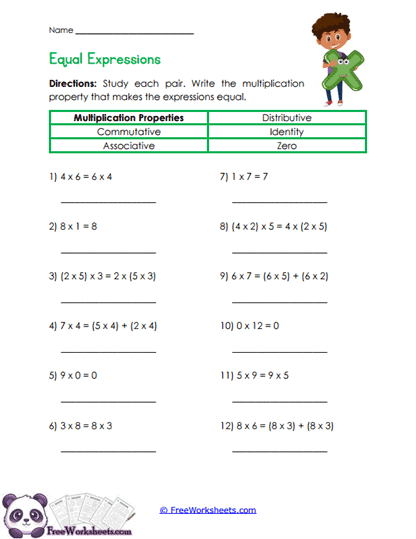
Property Connections
What Kids Do:
Students study twelve pairs of multiplication expressions and decide which property explains why the two forms are equivalent. They choose among the Commutative, Associative, Distributive, Identity, and Zero Properties and write the appropriate property name.
Target Skill:
The worksheet builds mathematical vocabulary and equivalent-expression reasoning. 3rd grade students practice identifying how order, grouping, decomposition, multiplication by 1, or multiplication by 0 affects an expression while preserving valid relationships.
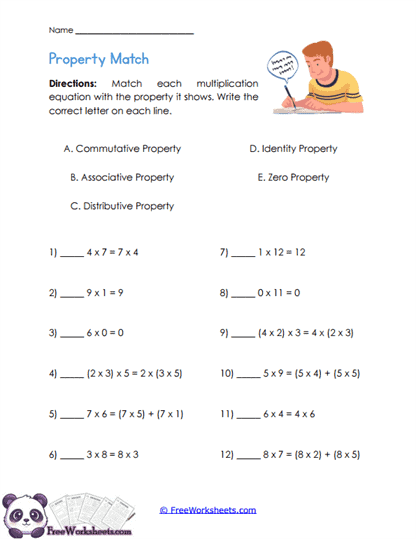
Property Identifier
What Kids Do:
Students examine twelve multiplication equations and classify each one using a property key. They identify examples involving switched factors, regrouped factors, broken-apart facts, multiplication by 1, and multiplication by 0 without needing to focus only on the product.
Target Skill:
This activity provides broad practice recognizing all five major multiplication properties. 3rd grade students strengthen equation-reading skills, mathematical vocabulary, and the ability to distinguish among structural patterns that may look similar at first glance.
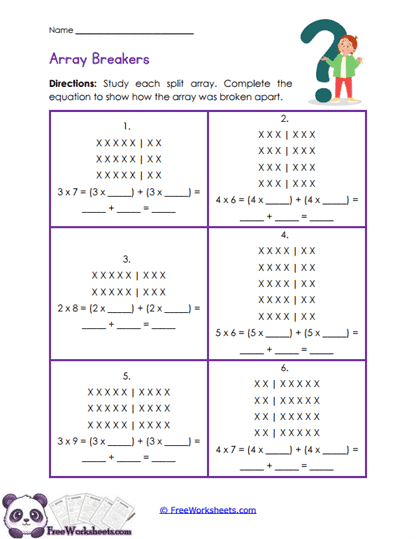
Split Array Proof
What Kids Do:
Students work with six arrays divided into two smaller sections. They identify the multiplication fact represented by each section, solve both partial products, add the results, and compare the combined total with the product represented by the entire array.
Target Skill:
The worksheet provides a visual foundation for the Distributive Property. 3rd grade students see how one larger multiplication fact can be decomposed into two smaller facts while preserving the total, strengthening partial-product and array reasoning.
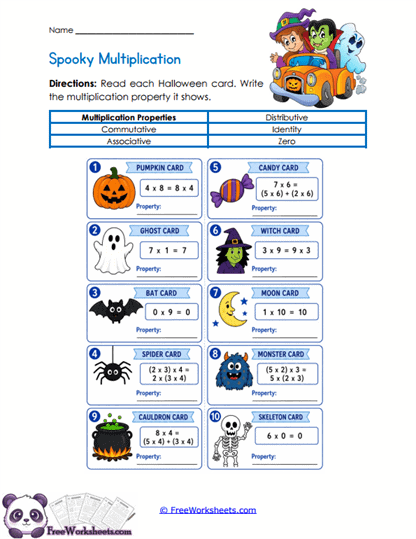
Spooky Property Sort
What Kids Do:
Students read ten Halloween-themed multiplication cards and determine which property each equation demonstrates. They analyze factor order, grouping, decomposition, multiplication by 1, and multiplication by 0 before writing the correct property name beneath each example.
Target Skill:
This seasonal review strengthens classification across all five multiplication properties. 3rd grade students practice moving among Commutative, Associative, Distributive, Identity, and Zero examples while focusing on equation structure rather than decorative context or computation alone.
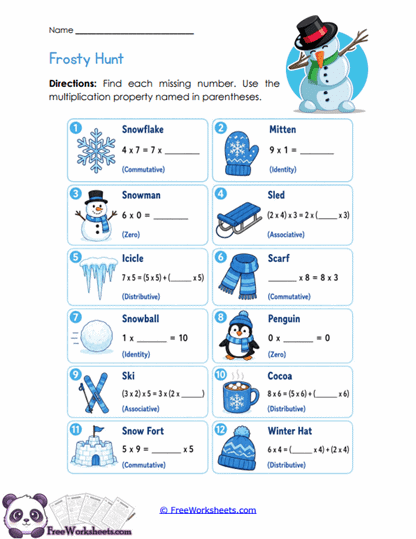
Winter Property Hunt
What Kids Do:
Students complete twelve winter-themed equations that each identify a multiplication property and contain one missing value. They use the named rule as a clue to determine the missing factor or number and complete equations involving order, grouping, decomposition, 1, and 0.
Target Skill:
This activity develops independent property application and missing-number reasoning. 3rd grade students practice using structural clues to complete equivalent multiplication expressions while strengthening fact fluency, algebraic thinking, and understanding of all five major properties.