
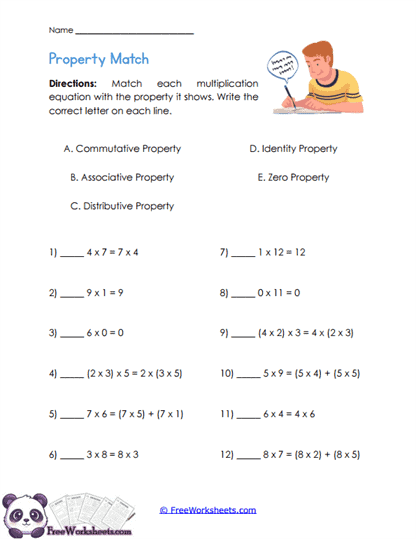
About This Worksheet
Property Identifier is a third grade activity that asks students to determine which multiplication property is represented by each equation. The worksheet includes examples of the Commutative, Associative, Distributive, Identity, and Zero Properties. Students study how the numbers or groups change from one side of the equation to the other and then write the matching property letter. For example, 4 × 7 = 7 × 4 shows the Commutative Property because the factors switch places. This gives children a broad review of all five multiplication properties on one page.
Curriculum and Grade Alignment
This worksheet is made for third grade learners who are beginning to recognize and name multiplication properties. The main goal is to help students connect each property name with the equation structure that demonstrates it. Before using this page, your child should understand basic multiplication facts and be comfortable reading equations with parentheses. The next step is rewriting multiplication expressions using a named property and explaining why the product stays the same. This activity supports multiplication concepts, mathematical vocabulary, and early algebraic thinking.
Student Tasks
Students will examine twelve multiplication equations. For each one, they decide whether it represents the Commutative, Associative, Distributive, Identity, or Zero Property and write the corresponding letter on the line. Examples include switched factors, regrouped factors, multiplication by 1, multiplication by 0, and facts broken apart into two smaller products. Students do not need to focus only on calculating products; instead, they study the structure of each equation. This builds property recognition and equation-reading skills.
Common Challenges and Misconceptions
Some students may confuse the Identity and Zero Properties because both involve special factors. Others may mix up the Commutative and Associative Properties because both can make an expression look different. The Distributive Property can also be harder to spot because it breaks one multiplication fact into two smaller facts that are added together. Encourage your child to ask, “Did the factors switch, did the grouping change, was the fact split apart, was there a 1, or was there a 0?” This gives them a simple checklist for identifying the rule.
Implementation Guidance
Teachers can use this worksheet after introducing all five multiplication properties. It works well as guided practice, independent review, or a quick formative assessment. Parents can make a small reference card with the five property names and one simple example of each. After the worksheet is finished, ask the child to explain one equation from each property type aloud. This helps make sure the answers come from understanding rather than memorizing letters.
Details and Features
This worksheet includes twelve multiplication-property equations in a clean two-column layout. A property key at the top lists the Commutative, Associative, Distributive, Identity, and Zero Properties. The examples include simple facts, parentheses, multiplication by 1 and 0, and decomposed multiplication expressions. The printable supports multiplication properties, equation analysis, vocabulary, and algebraic reasoning.