
Learning Division Facts Worksheets
3rd grade math learning division facts worksheets help students understand equal sharing, equal groups, quotients, arrays, and multiplication-division relationships. Free, ready-to-print worksheets in PDF format are designed for immediate classroom use, centers, guided practice, homework, or homeschool lessons. Students strengthen division fluency, fact-family reasoning, and equal-group understanding while developing skills that support curriculum expectations.
About This Collection of Worksheets
Learning division facts helps 3rd grade students understand division as both sharing a total equally and determining how many equal groups can be made. Students connect totals, group sizes, numbers of groups, and quotients while also using familiar multiplication facts to solve division more efficiently. These relationships help children see division as meaningful mathematical reasoning rather than a separate set of facts to memorize.
The collection includes equal-sharing stories, group-making activities, multiplication-to-division connections, fact-family triangles, arrays, direct fact practice, answer matching, true-or-false checks, quotient sorting, and themed applications. Some worksheets use visual models or familiar situations, while others require students to recall facts and use inverse relationships more independently. This range provides practice with both conceptual understanding and fluency.
Teachers can use these worksheets during division lessons, math centers, intervention, homework, review, or multiplication-division practice. Parents, tutors, and homeschool educators can begin with counters, equal groups, or arrays before moving toward direct quotient practice and fact-family reasoning. Because the collection progresses from concrete sharing and grouping to independent fact work, it helps students build confidence before moving into larger division problems and more advanced multiplicative reasoning.
Paul’s Teacher Tip
Keep connecting every division fact to a multiplication fact students already know. For a problem such as 24 ÷ 6, ask, “6 times what equals 24?” before encouraging repeated subtraction or counting. When using story problems, help students decide whether they are finding the number of groups or the amount in each group because both situations use division. Fact-family triangles are especially useful for showing how the same three numbers create related multiplication and division equations. Once students become more fluent, have them check difficult quotients by multiplying the divisor and quotient to see whether they get the original dividend.
Worksheet Collection Skill Spotlights
Answer Bank Match
What Kids Do:
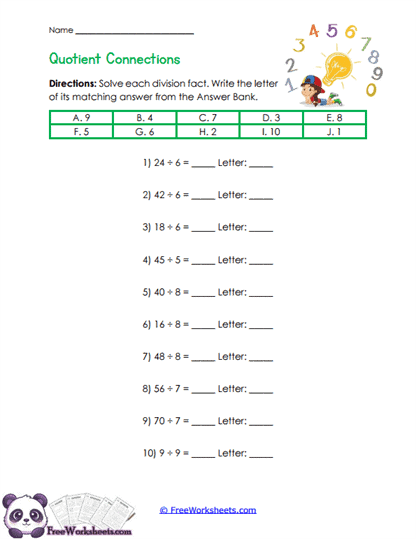
Students solve ten division facts and then locate each quotient in a lettered answer bank. They first calculate the numerical answer for problems such as 24 ÷ 6, 45 ÷ 5, or 56 ÷ 7, then record the letter connected with the matching quotient.
Target Skill:
This activity strengthens basic quotient fluency and self-checking. 3rd grade students practice recalling related multiplication facts, calculating division answers accurately, and using the answer bank to verify completed work rather than relying on guessing or elimination.
Array Quotients
What Kids Do:
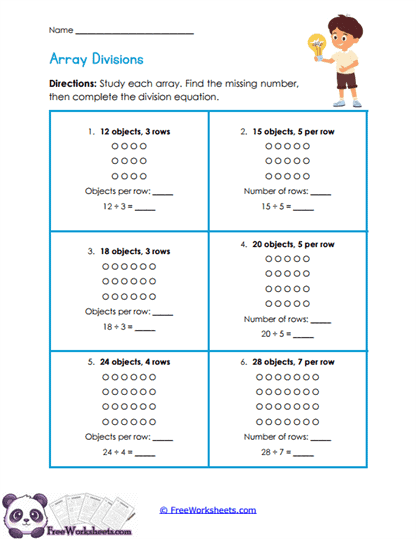
Students examine six arrays containing totals such as 12, 15, 18, 20, 24, and 28 objects. Using the known number of rows or objects in each row, they determine the missing group value and complete the corresponding division equation.
Target Skill:
The worksheet connects division with familiar multiplication arrays. 3rd grade students practice distinguishing between the number of groups and the size of each group while using visual models to understand how factors, products, divisors, and quotients are related.
Division Truth Check
What Kids Do:
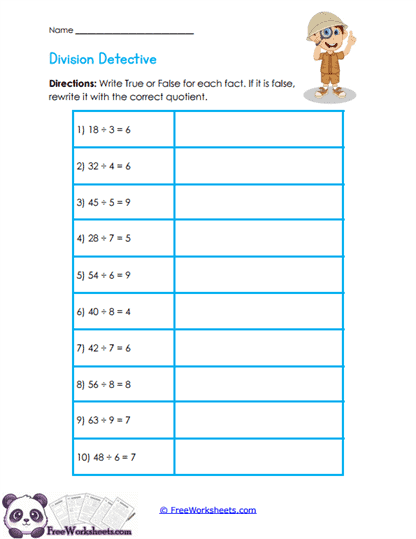
Students inspect ten completed division equations and determine whether each quotient is correct. They mark every statement True or False and rewrite any inaccurate equation using the correct quotient after checking the related fact.
Target Skill:
This activity develops division fluency along with mathematical verification. 3rd grade students practice checking quotients with multiplication, identifying incorrect fact relationships, and building the habit of evaluating completed work instead of automatically accepting a printed answer.
Equal Share Stories
What Kids Do:
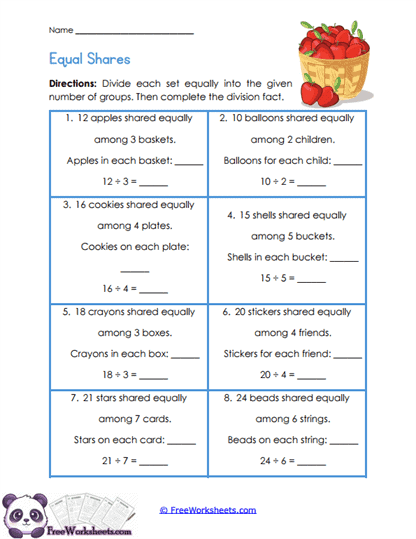
Students solve eight sharing stories involving apples, balloons, cookies, shells, crayons, stickers, stars, and beads. They divide each total equally among a given number of baskets, children, plates, boxes, or other groups and complete the matching division fact.
Target Skill:
The worksheet develops the equal-sharing meaning of division. 3rd grade students learn to identify the total and number of groups, determine how many belong in each group, and connect a concrete sharing situation with dividend, divisor, and quotient relationships.
Fact Connection
What Kids Do:
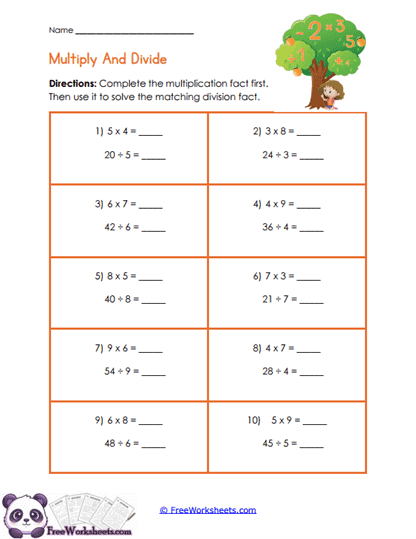
Students complete ten paired multiplication and division problems. They first solve a multiplication fact such as 5 × 4 = 20 and then immediately use that relationship to solve a connected division equation such as 20 ÷ 5 = 4.
Target Skill:
This activity strengthens the inverse relationship between multiplication and division. 3rd grade students practice using known products to retrieve quotients efficiently and recognize division as a missing-factor problem within a familiar multiplication fact family.
Fact Family Triangles
What Kids Do:
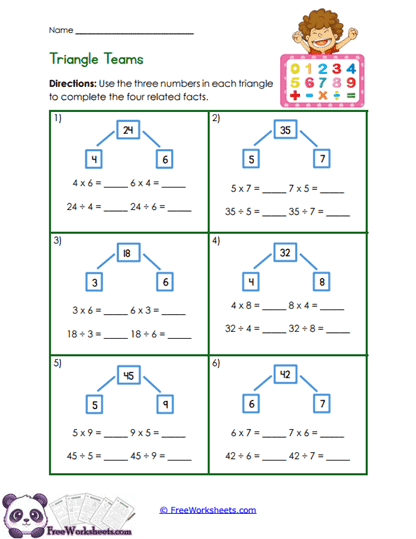
Students use six triangles containing three related numbers to write four equations for each set. They create two multiplication facts and two division facts, such as 4 × 6 = 24, 6 × 4 = 24, 24 ÷ 4 = 6, and 24 ÷ 6 = 4.
Target Skill:
The worksheet develops fact-family fluency and inverse-operation reasoning. 3rd grade students learn how the same factors and product can be rearranged into related multiplication and division statements, strengthening both fact recall and equation understanding.
Group Count
What Kids Do:
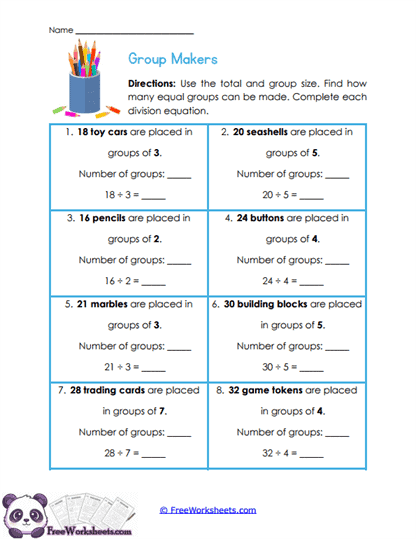
Students solve eight situations in which a total quantity and a fixed group size are provided. They determine how many equal groups can be formed from objects such as toy cars, shells, pencils, buttons, marbles, blocks, cards, and game tokens.
Target Skill:
This activity develops the measurement or group-making interpretation of division. 3rd grade students practice asking how many groups of a certain size fit into a total and connect skip counting or multiplication facts with the resulting quotient.
Quotient Finder
What Kids Do:
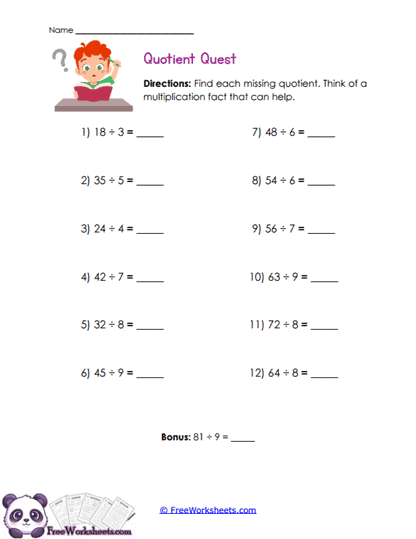
Students solve twelve basic division equations plus a bonus fact, working with divisors from 3 through 9 and products up to 81. They determine each quotient by recalling or mentally generating the related multiplication fact.
Target Skill:
The worksheet provides focused practice with division fact fluency. 3rd grade students strengthen rapid quotient recall, inverse-operation thinking, and missing-factor reasoning by repeatedly asking which factor multiplied by the divisor produces the dividend.
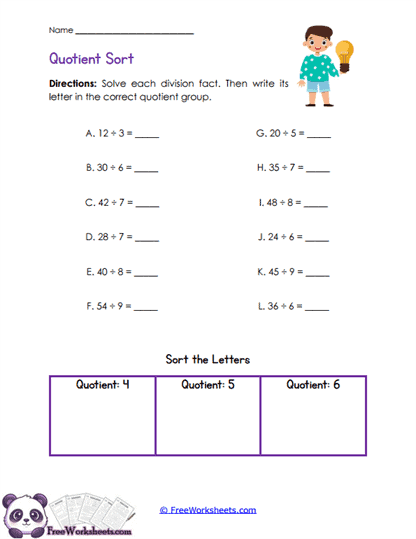
Quotient Sort
What Kids Do:
Students solve twelve lettered division facts and then classify each equation according to whether its quotient is 4, 5, or 6. They record the quotient first and place the corresponding problem letter in the correct sorting box.
Target Skill:
This activity combines division fluency with mathematical classification. 3rd grade students practice recognizing different fact families that share the same quotient while strengthening accuracy, organization, and awareness of relationships among multiplication and division facts.
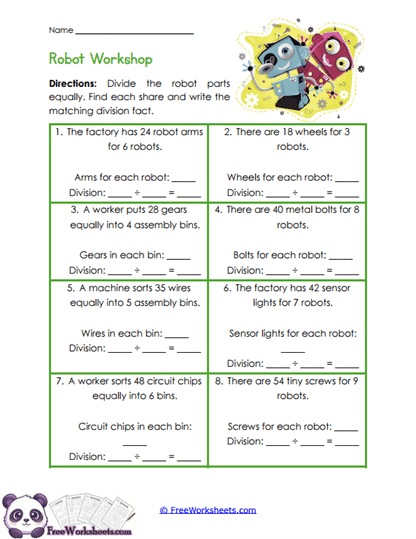
Robot Shares
What Kids Do:
Students complete eight robot-factory stories involving arms, wheels, gears, bolts, wires, sensor lights, circuit chips, and screws. They divide each total equally among robots or bins, determine the amount in one group, and complete the division equation.
Target Skill:
The themed problems reinforce equal-sharing division in context. 3rd grade students practice identifying a total and number of groups, determining each group’s share, and using related multiplication facts to solve quotients more efficiently and accurately.
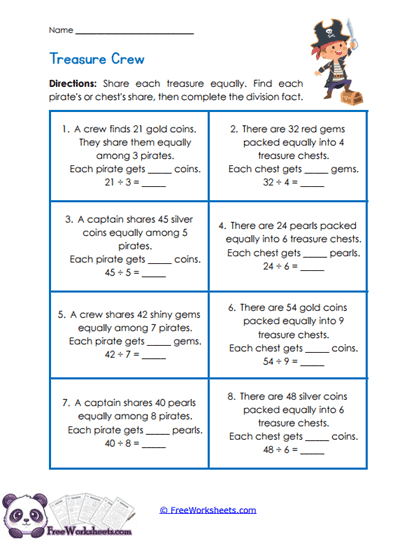
Treasure Shares
What Kids Do:
Students solve eight pirate-themed division problems involving gold coins, silver coins, gems, pearls, pirates, and treasure chests. They split each total into equal shares, determine how many objects belong in one share, and complete the matching division equation.
Target Skill:
This activity strengthens equal-group reasoning and quotient fluency. 3rd grade students practice translating story situations into division equations while connecting the dividend, divisor, and quotient with familiar multiplication fact families.
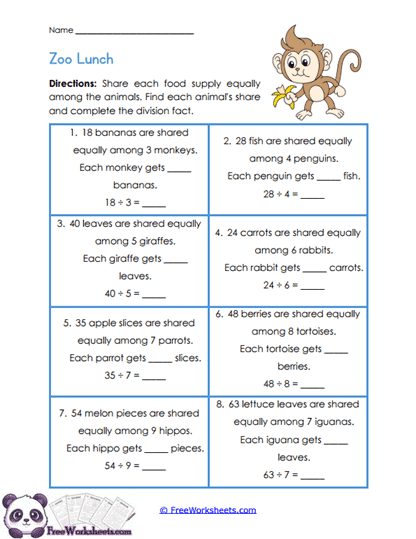
Zoo Lunch Shares
What Kids Do:
Students solve eight zoo-themed sharing problems involving monkeys, penguins, giraffes, rabbits, parrots, tortoises, hippos, and iguanas. They divide food supplies equally among the animals and record both the amount each animal receives and the matching division fact.
Target Skill:
The worksheet develops practical division reasoning and fact fluency across divisors from 3 through 9. 3rd grade students strengthen their understanding that total ÷ number of groups = amount in each group while using multiplication to check their quotients.