
Mixed Operations Addition And Subtraction Worksheets
3rd grade math mixed operations addition and subtraction worksheets help students choose operations, solve multi-digit problems, and reason about number relationships. Free, ready-to-print worksheets in PDF format are designed for immediate classroom use, centers, guided practice, homework, or homeschool lessons. Students strengthen computation fluency, operation sense, and problem solving while developing skills that support curriculum expectations.
About This Collection of Worksheets
Mixed operations with addition and subtraction help 3rd grade students practice deciding when to add, when to subtract, and how to work accurately with larger numbers. Students use place value and regrouping while also thinking about whether a situation represents combining, separating, comparing, or finding an unknown. This broader approach helps children understand the meaning behind each operation instead of simply following a printed symbol.
The collection includes direct computation, operation-choice problems, word problems, fact families, estimation, missing-number equations, answer matching, true-or-false checks, error analysis, data tables, and seasonal applications. Some worksheets focus on fluency with four-digit numbers, while others require students to reason about which operation or strategy makes sense. These varied formats connect calculation skills with number sense and mathematical decision-making.
Teachers can use these worksheets for morning work, centers, guided practice, homework, intervention, review, or informal assessment. Parents, tutors, and homeschool educators can use the more focused computation pages for fluency and the reasoning pages for deeper practice with operation choice and checking. Because the collection combines exact calculation, estimation, inverse relationships, and real-world applications, it supports stronger independence with multi-digit addition and subtraction.

Paul’s Teacher Tip
Have students identify the operation before they begin any calculation on a mixed page. For word problems, ask whether the amount is being combined, compared, increased, or decreased rather than relying on one keyword. Encourage students to estimate first on larger-number problems so they have a reasonable range for the exact answer. When a missing number appears, have them think about which inverse operation will undo what they see in the equation. After solving, students can use estimation or the opposite operation to check whether their answer makes sense.
Worksheet Collection Skill Spotlights
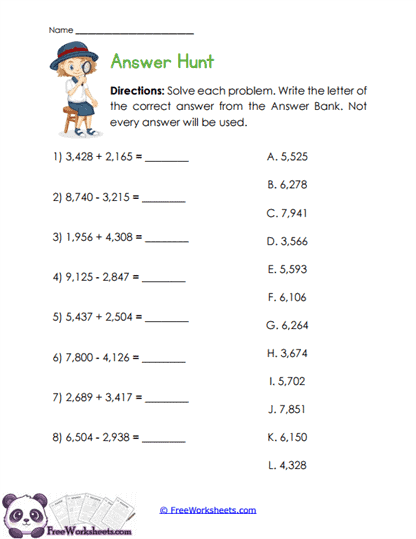
Answer Bank Challenge
What Kids Do:
Students solve eight four-digit addition and subtraction equations, writing each exact sum or difference before checking a twelve-choice answer bank. They then locate the matching value and record its letter, using the bank as a second-step verification tool rather than as a source for guessing.
Target Skill:
This activity strengthens multi-digit computation, regrouping, and answer checking. 3rd grade students practice switching accurately between addition and subtraction while using place-value alignment and a structured matching step to confirm that each result is reasonable and exact.
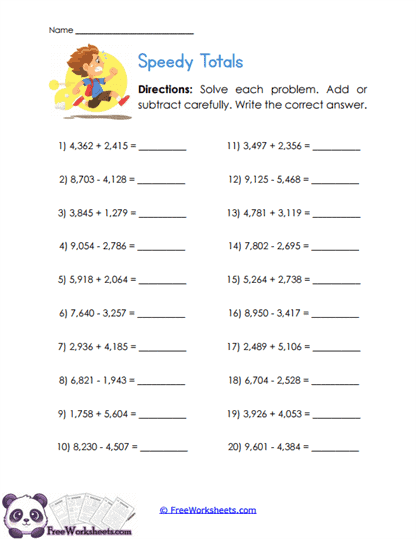
Calculation Sprint
What Kids Do:
Students solve twenty mixed addition and subtraction problems using four-digit numbers. The operations alternate throughout the page, so they must read each sign carefully, align digits by place value, regroup when needed, and record each sum or difference independently.
Target Skill:
The worksheet develops fluency with multi-digit addition and subtraction within 10,000. 3rd grade students strengthen place-value alignment, regrouping accuracy, operation recognition, and the ability to switch efficiently between two different computation procedures.
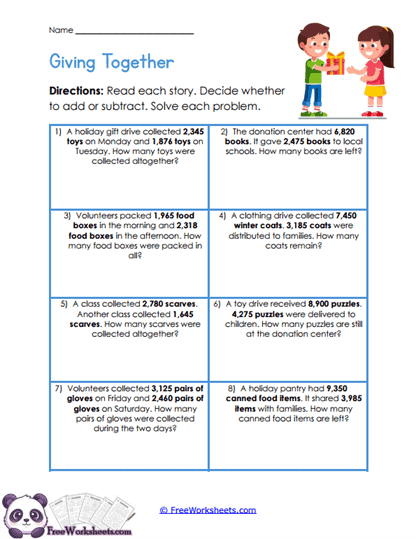
Community Giving
What Kids Do:
Students read eight community-themed stories involving toys, books, food boxes, coats, scarves, puzzles, gloves, and canned goods. They decide whether quantities are being combined or reduced, write the appropriate addition or subtraction equation, and calculate the result.
Target Skill:
This activity builds operation sense in real-world contexts. 3rd grade students practice identifying whether a situation asks for a total or a remaining amount, translating story information into equations, and applying accurate multi-digit computation with numbers in the thousands.
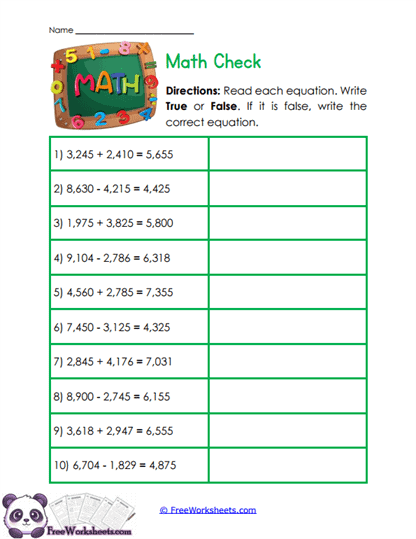
Equation Inspector
What Kids Do:
Students examine ten completed four-digit addition and subtraction equations and decide whether each printed answer is true or false. They recalculate the problem independently and correct any inaccurate result while leaving correct equations unchanged.
Target Skill:
The worksheet strengthens error analysis and mathematical verification. 3rd grade students practice checking regrouping, place-value alignment, and operation accuracy while developing the habit of evaluating completed work rather than automatically trusting a finished answer.
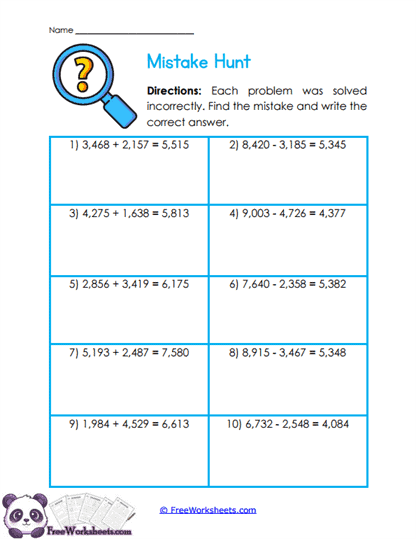
Error Detective
What Kids Do:
Students recalculate ten addition and subtraction equations that have all been solved incorrectly. They rewrite each problem as needed, work carefully across the ones, tens, hundreds, and thousands places, and replace every incorrect printed result with the accurate answer.
Target Skill:
This activity develops self-correction and computational accuracy with larger whole numbers. 3rd grade students strengthen regrouping, estimation, and place-value reasoning while learning to identify and repair mistakes rather than making small guesses about how an answer should change.
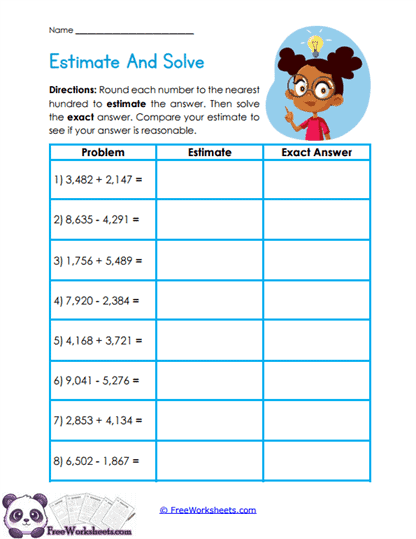
Estimate Then Solve
What Kids Do:
Students complete eight mixed-operation problems by first rounding both numbers to the nearest hundred and finding an estimated result. They then solve the original addition or subtraction equation exactly and compare the exact answer with the earlier estimate.
Target Skill:
The worksheet connects rounding with computation and reasonableness checking. 3rd grade students practice estimating sums and differences, calculating accurately with multi-digit numbers, and judging whether an exact result is close enough to the estimate to make mathematical sense.
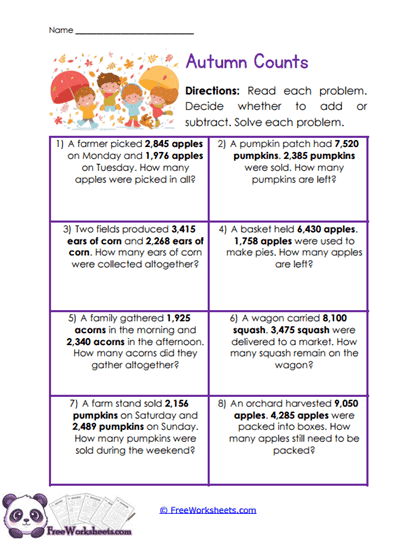
Harvest Math
What Kids Do:
Students solve eight autumn-themed word problems involving apples, pumpkins, corn, acorns, squash, orchards, and farm stands. They determine whether each story describes quantities being combined or removed and then calculate the resulting total or remainder.
Target Skill:
This seasonal activity strengthens operation selection and mathematical reading. 3rd grade students practice identifying join and separate situations, setting up multi-digit equations correctly, and applying addition or subtraction with regrouping to realistic quantities.
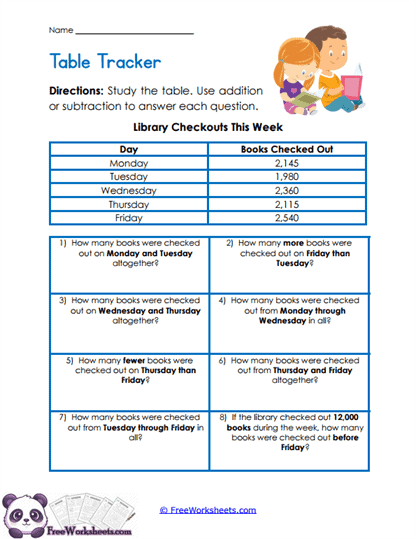
Library Number Table
What Kids Do:
Students read a weekly table showing library checkout totals from Monday through Friday and answer eight related questions. They locate the correct daily values, combine totals across days, compare amounts, and subtract to determine differences or remaining quantities.
Target Skill:
The worksheet develops data interpretation together with mixed operations. 3rd grade students practice extracting numerical information from a table, deciding whether to add or subtract based on the question, and organizing multi-digit calculations from several data points.
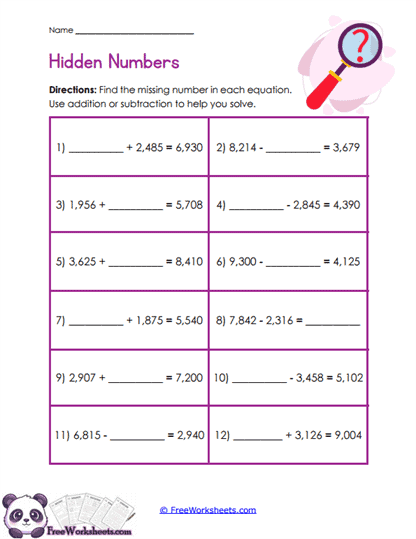
Missing Number Hunt
What Kids Do:
Students complete twelve multi-digit equations containing an unknown value in different positions. They determine whether the blank represents a missing addend, starting amount, or amount subtracted and use the inverse operation to work backward and make each equation true.
Target Skill:
This activity strengthens early algebraic reasoning and inverse-operation understanding. 3rd grade students learn to analyze equation structure, choose the operation that will isolate the unknown, and use addition and subtraction as related tools rather than unrelated procedures.
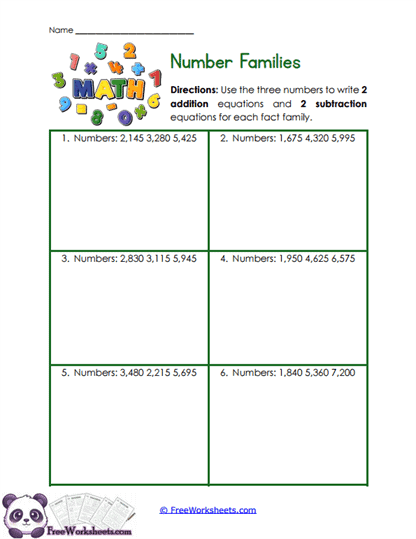
Number Family Links
What Kids Do:
Students use six sets of three related multi-digit numbers to write complete addition-and-subtraction fact families. For each set, they create two addition equations and two subtraction equations, using the largest number as the whole and the other two values as parts.
Target Skill:
The worksheet reinforces the inverse relationship between addition and subtraction. 3rd grade students practice recognizing part-part-whole relationships, writing equivalent equations with larger values, and using fact-family reasoning to support computation and answer checking.
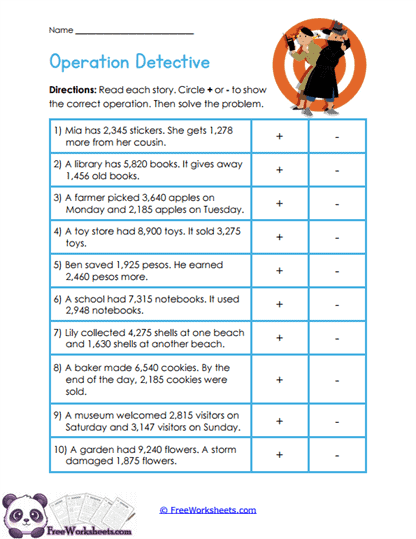
Operation Clues
What Kids Do:
Students read ten real-world word problems involving stickers, books, apples, toys, notebooks, visitors, flowers, and other familiar contexts. They decide whether each situation requires + or −, circle the correct operation, and then solve using the given multi-digit numbers.
Target Skill:
This activity develops operation choice through story meaning. 3rd grade students practice distinguishing situations where quantities are joined from those where amounts are removed or compared, helping them select addition or subtraction before beginning the arithmetic.
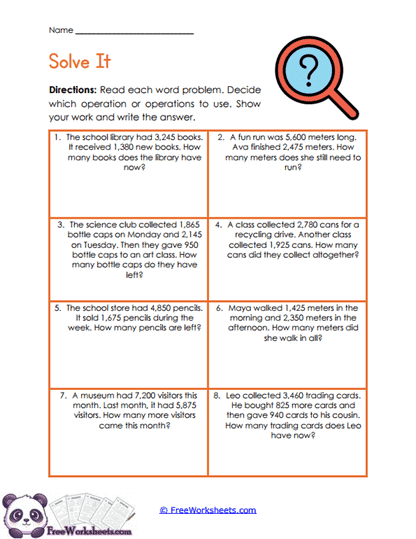
Story Strategy
What Kids Do:
Students solve eight multi-digit word problems without being given an operation symbol. They interpret each situation, determine whether addition, subtraction, or more than one calculation is needed, show their work, and record the final answer.
Target Skill:
The worksheet strengthens independent problem solving and strategic operation selection. 3rd grade students practice identifying what a question asks, organizing relevant information, sequencing calculations when necessary, and applying accurate addition or subtraction to larger whole numbers.