
Addition Properties Worksheets
3rd grade math addition properties worksheets help students recognize, apply, and explain the Commutative, Associative, and Identity Properties of Addition. Free, ready-to-print worksheets in PDF format are designed for immediate classroom use, centers, guided practice, homework, or homeschool lessons. Students strengthen addition fluency, equation sense, and algebraic reasoning while developing skills that support curriculum expectations.
About This Collection of Worksheets
Addition properties help 3rd grade students understand that addends can sometimes be rearranged or regrouped without changing the sum. Students explore the Commutative Property, Associative Property, and Identity Property and learn what each rule allows them to change. This understanding helps children move beyond memorizing property names and begin seeing how addition expressions are structured.
The collection includes property identification, definition matching, missing-number equations, expression rewriting, friendly-number strategies, true-or-false checks, sorting activities, equivalent expressions, strategy comparisons, and seasonal practice. Some worksheets focus directly on mathematical vocabulary, while others ask students to use a property to simplify an expression or decide whether two forms are equivalent. These varied tasks connect conceptual understanding with practical computation.
Teachers can use these worksheets during whole-class instruction, math centers, guided groups, homework, intervention, or review. Parents, tutors, and homeschool educators can begin with property identification and definition matching before moving to missing values, equivalent expressions, and strategic mental math. Because the collection progresses from recognizing properties to applying them independently, it helps students build a strong foundation for later work with expressions, equations, and algebraic reasoning.

Paul’s Teacher Tip
Teach students to ask three quick questions when identifying an addition property: “Did the order change, did the grouping change, or was zero added?” For the Commutative Property, emphasize that the addends switch places but the sum stays the same. For the Associative Property, remind students that the order stays the same while only the grouping changes. Encourage students to use these properties to make friendly sums instead of treating them as vocabulary words to memorize. Once students understand the rules, ask them to explain why two differently written expressions still have the same value.
Worksheet Collection Skill Spotlights
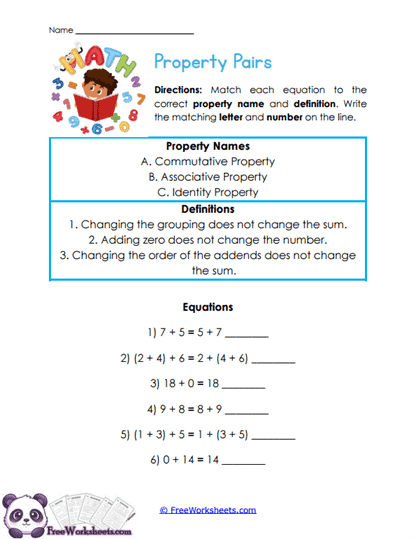
Definition Links
What Kids Do:
Students examine six addition equations and use a reference bank to match each one with both the correct property name and its plain-language definition. They compare switched addends, regrouped expressions, and zero-addition examples before recording the matching property letter and definition number.
Target Skill:
This activity strengthens mathematical vocabulary and conceptual understanding of addition properties. 3rd grade students connect the names Commutative, Associative, and Identity with the structural changes each rule permits, helping them explain properties rather than recognize patterns by sight alone.
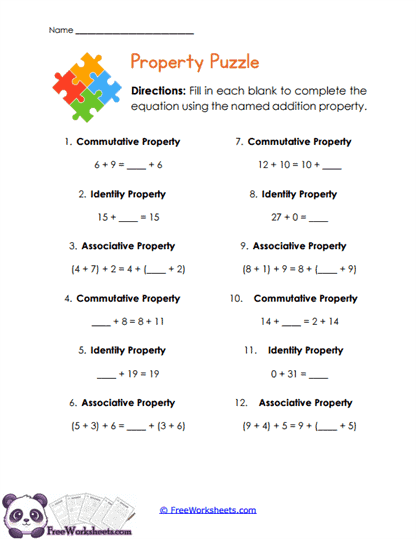
Equation Completer
What Kids Do:
Students complete twelve missing-number equations that are already labeled with the property they should demonstrate. They determine which addend, zero, or grouped value belongs in each blank so the equation remains true and correctly follows the named rule.
Target Skill:
The worksheet develops equation sense and structural reasoning. 3rd grade students practice applying addition-property rules to unknown values, recognizing how order, grouping, and zero affect an expression without simply calculating the total of each side.
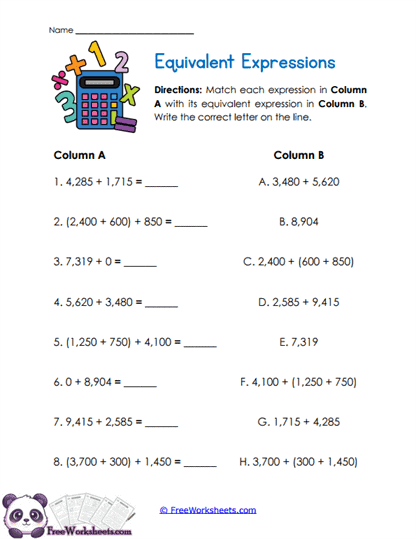
Expression Match-Up
What Kids Do:
Students study eight large-number expressions in one column and match each with an equivalent expression or value in another column. They look for switched addends, changed grouping, or zero-addition relationships and record the correct matching letter.
Target Skill:
This activity strengthens understanding of equivalent expressions and addition structure. 3rd grade students learn that expressions can look different while retaining the same value, using property relationships rather than lengthy computation to identify valid matches.
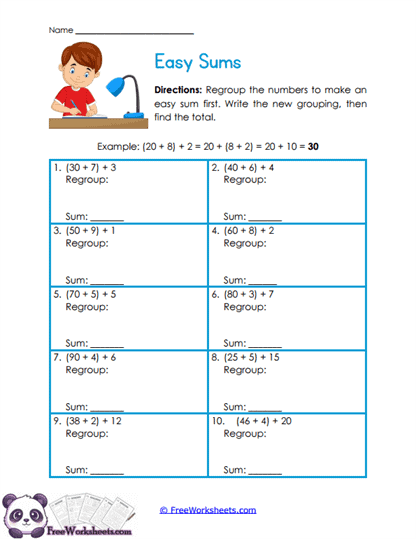
Friendly Sums
What Kids Do:
Students solve ten three-addend problems by regrouping numbers to create easier benchmark totals such as 10, 20, or 30. They rewrite each expression using a more helpful grouping and then calculate the final sum using the friendlier combination first.
Target Skill:
The worksheet applies the Associative Property as a practical mental-math strategy. 3rd grade students strengthen number sense and flexible computation by recognizing useful combinations and choosing an efficient grouping without changing the value of the expression.
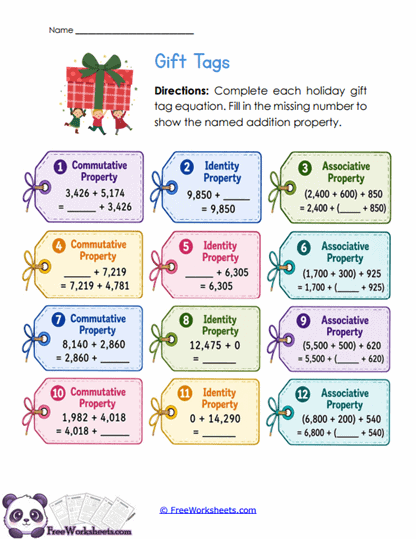
Holiday Property Tags
What Kids Do:
Students complete twelve holiday-themed gift-tag equations labeled Commutative, Associative, or Identity Property. They study each large-number expression, determine the missing value from the equation structure, and write the number that correctly demonstrates the named rule.
Target Skill:
This activity develops missing-number reasoning with larger values while reinforcing property fluency. 3rd grade students practice focusing on expression structure instead of unnecessary computation and applying addition rules consistently regardless of number size.
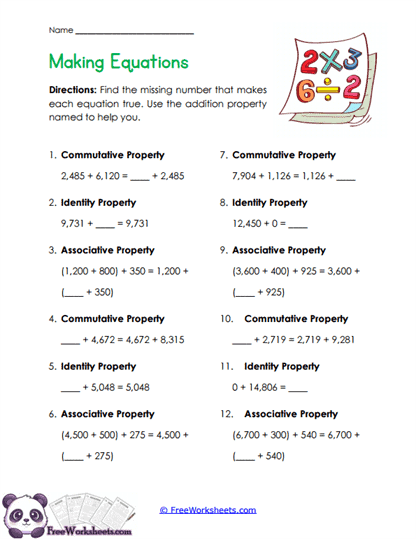
Missing Value Rules
What Kids Do:
Students solve twelve large-number equations containing one missing value. Each problem identifies the addition property being used, and students determine which number belongs in the blank by examining switched addends, regrouped terms, or zero-addition relationships.
Target Skill:
The worksheet strengthens early algebraic reasoning and recognition of numerical structure. 3rd grade students practice using properties to solve unknown-value equations efficiently, demonstrating that these rules remain valid even when expressions contain numbers in the thousands.
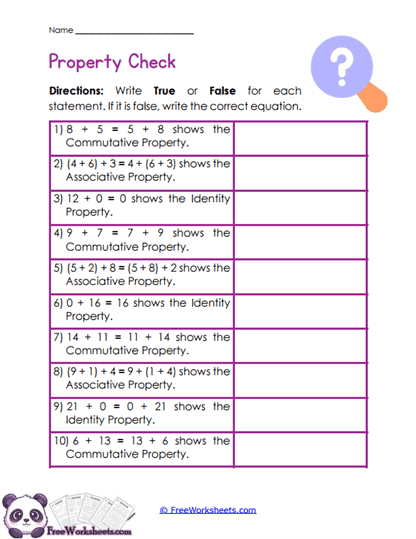
Property Proof
What Kids Do:
Students examine ten equations paired with claims about the Commutative, Associative, or Identity Property. They decide whether each statement is true or false and rewrite any incorrect equation so it accurately demonstrates the property named.
Target Skill:
This activity develops mathematical verification and error analysis. 3rd grade students practice judging whether an equation truly follows a stated property, correcting misconceptions, and explaining how order, grouping, or adding zero should affect an addition expression.
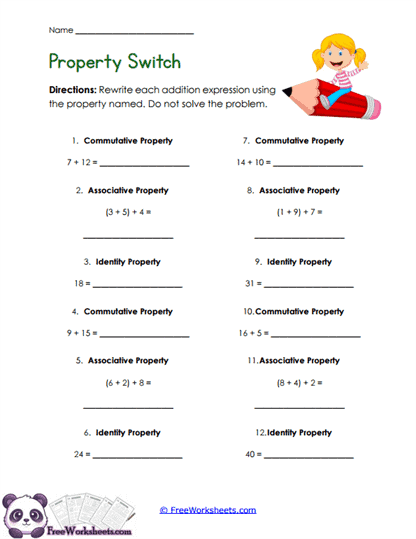
Property Rewrite
What Kids Do:
Students rewrite twelve addition expressions using a property named beside each problem without calculating the final sum. They switch addends for Commutative examples, move grouping symbols for Associative examples, and use zero correctly for Identity examples.
Target Skill:
The worksheet strengthens understanding of equivalent expressions and property application. 3rd grade students learn to preserve an expression’s value while changing its form, an important step toward flexible computation and later algebraic work with expressions.
Property Sort
What Kids Do:
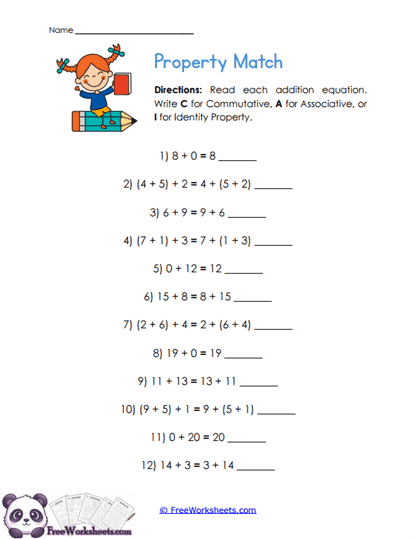
Students examine twelve addition equations and classify each as an example of the Commutative, Associative, or Identity Property. They write C, A, or I beside each equation after deciding whether the order changed, the grouping changed, or zero was added.
Target Skill:
This activity builds foundational property recognition and mathematical vocabulary. 3rd grade students practice distinguishing among three closely related rules by focusing on equation structure rather than calculating sums or relying on superficial visual similarities.
Property Sorter
What Kids Do:
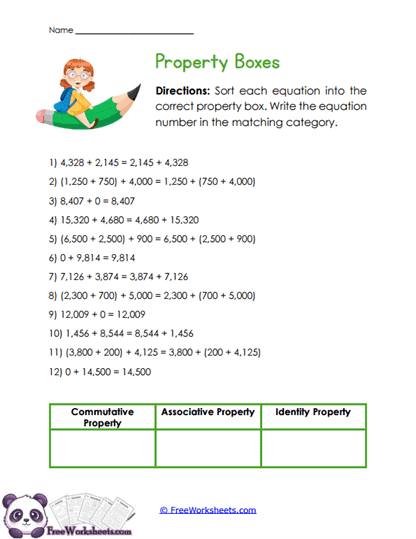
Students inspect twelve addition equations containing larger numbers and sort each equation number into one of three property categories. They ignore the size of the addends and focus on whether the equation switches order, changes grouping, or adds zero.
Target Skill:
The worksheet strengthens classification and algebraic thinking with more complex-looking expressions. 3rd grade students learn that addition properties apply consistently to both small and large numbers, reinforcing structural reasoning instead of dependence on arithmetic computation.
Pumpkin Property Sort
What Kids Do:
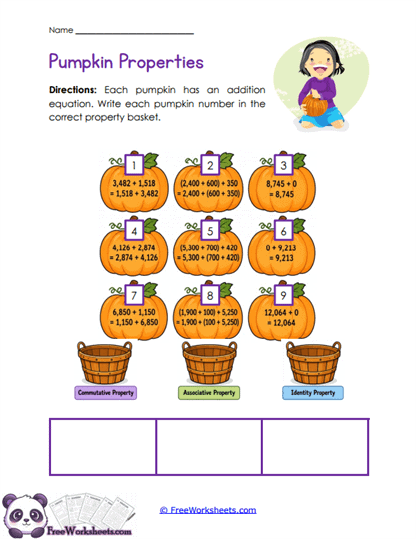
Students examine nine pumpkin-shaped equations and decide which addition property each one represents. They record the pumpkin number in the matching Commutative, Associative, or Identity basket after analyzing how the expression changes.
Target Skill:
This seasonal activity reinforces property classification through equation analysis. 3rd grade students practice recognizing order changes, grouping changes, and zero-addition relationships with larger numbers while strengthening mathematical vocabulary and structural reasoning.
Strategy Choice
What Kids Do:
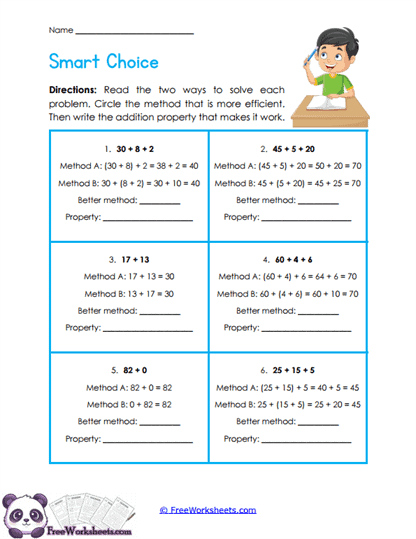
Students compare two possible ways to solve each of six addition expressions and decide which method is more efficient. They identify the better approach, note whether numbers were reordered or regrouped, and name the addition property that makes the strategy valid.
Target Skill:
This worksheet moves students from naming properties to using them strategically. 3rd grade learners strengthen mental math, number sense, and mathematical explanation by recognizing how the Commutative and Associative Properties can create easier calculations.