
About This Worksheet
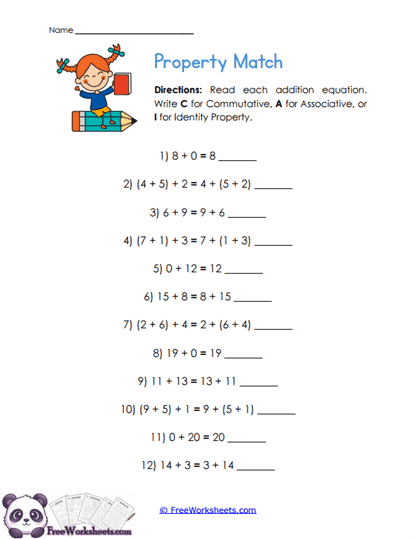
Property Sort is a third grade addition-properties activity that asks students to identify which rule is being shown in each equation. Students choose among the Commutative Property, Associative Property, and Identity Property and write the corresponding letter beside each number sentence. For example, 6 + 9 = 9 + 6 shows that the addends can switch order without changing the sum, while 19 + 0 = 19 shows what happens when zero is added. Other problems use parentheses to show a change in grouping. This gives children focused practice recognizing the visual clues that distinguish the three properties.
Curriculum and Grade Alignment
This worksheet is designed for third grade learners who are beginning to identify and name addition properties. The main goal is to help students connect the vocabulary Commutative, Associative, and Identity with the equation structure that represents each property. Before using this page, your child should understand basic addition and be comfortable reading equations with parentheses. The next step is explaining each property in words and using the properties to rewrite expressions independently. This activity supports addition reasoning, mathematical vocabulary, and early algebraic thinking.
Student Tasks
Students will examine twelve addition equations. For each one, they determine whether it demonstrates the Commutative, Associative, or Identity Property and write C, A, or I on the line. Some equations switch the order of two addends, some change the grouping of three addends, and others add zero to a number. Examples include 8 + 0 = 8, (4 + 5) + 2 = 4 + (5 + 2), and 15 + 8 = 8 + 15. Students must focus on what changed in each equation rather than simply calculate the sum. This builds property recognition and equation-reading skills.
Common Challenges and Misconceptions
Some students may confuse the Commutative and Associative Properties because both equations can look different on each side of the equal sign. A helpful distinction is that the Commutative Property changes the order of addends, while the Associative Property changes only the grouping. Other students may think the Identity Property means the answer is zero rather than understanding that adding zero leaves the original number unchanged. Encourage your child to ask, “Did the order change, did the grouping change, or was zero added?” That simple question can guide the correct choice.
Implementation Guidance
Teachers can use this worksheet after introducing the three addition properties with concrete examples. It works well as guided practice, independent review, or a quick formative assessment. Parents can write C for change order, A for change grouping, and I for adding zero on a small reference card while the child works. Ask the child to explain one example of each property aloud after completing the page. This makes sure the letters represent real understanding rather than memorized guessing.
Details and Features
This worksheet includes twelve addition equations in a clean single-column format. Students classify each equation as Commutative, Associative, or Identity using a simple letter code. The examples include one-, two-, and three-addend expressions as well as parentheses and zero. The uncluttered layout keeps the focus on identifying the property being demonstrated. The printable supports addition properties, equation analysis, mathematical vocabulary, and early algebraic reasoning.