
Interpreting Arrays And Models Worksheets
3rd grade math interpreting arrays and models worksheets help students connect equal groups, rows, columns, factors, and products with multiplication equations. Free, ready-to-print worksheets in PDF format are designed for immediate classroom use, centers, guided practice, homework, or homeschool lessons. Students strengthen multiplication reasoning, factor understanding, and visual problem solving while developing skills that support curriculum expectations.
About This Collection of Worksheets
Interpreting arrays and models helps 3rd grade students understand multiplication as equal groups organized into rows and columns. Instead of relying only on memorized facts, students learn to see what each factor represents and how the arrangement connects to the total product. These visual relationships also build a foundation for division, multiplication properties, area, and more advanced mathematical reasoning.
The collection includes array interpretation, equation matching, array drawing, incomplete models, rotated arrays, split arrays, missing-factor puzzles, multiple multiplication models, error analysis, and themed applications. Some worksheets ask students to count rows and objects in each row, while others require them to create, repair, compare, or analyze models. These varied tasks move students from basic visual recognition toward more independent multiplication reasoning.
Teachers can use these worksheets during multiplication lessons, guided math, intervention, centers, homework, or review. Parents, tutors, and homeschool educators can reinforce the ideas with counters, blocks, buttons, or other small objects arranged into equal rows before moving to printed models. Because the collection progresses from reading arrays to creating and analyzing them, it helps students develop both multiplication fluency and a deeper understanding of factors and products.
Paul’s Teacher Tip
Keep the language consistent by having students describe every array as “___ rows with ___ in each row.” Ask them to say that sentence before writing the multiplication equation so each factor stays connected to the visual model. When an array is turned, compare the two equations and discuss what changed and what stayed the same. For missing-factor problems, label the known information as rows, objects in each row, and total before solving. Once students are comfortable with arrays, connect them to equal groups, number lines, and bar models so they see multiplication represented in several useful ways.
Worksheet Collection Skill Spotlights
Array Clue Solver
What Kids Do:
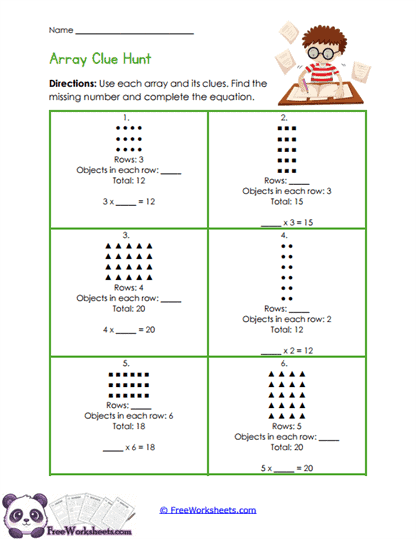
Students solve six array puzzles that provide some combination of rows, objects in each row, totals, and partially completed multiplication equations. They study the visual model, determine what information is missing, and fill in an unknown factor or product using the array as evidence.
Target Skill:
This activity develops missing-factor reasoning and prepares 3rd grade students for division thinking. Learners practice distinguishing between factors and products, connecting each number to a specific part of an array, and using known information to determine an unknown value.
Array Error Check
What Kids Do:
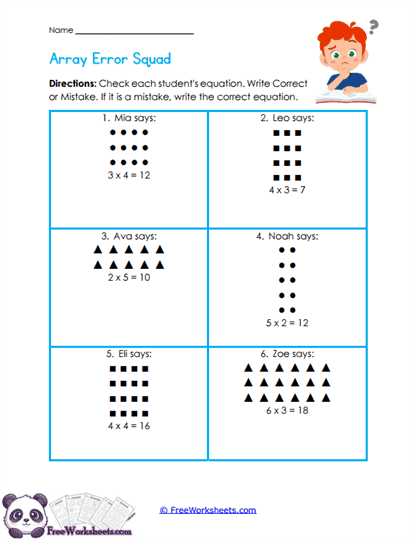
Students inspect six arrays paired with completed multiplication equations and decide whether each equation accurately describes the model. They count the rows and objects per row, mark the work as correct or mistaken, and rewrite any equation that does not match the array.
Target Skill:
The worksheet strengthens multiplication accuracy, visual analysis, and self-checking. 3rd grade students learn to verify that both factors describe the actual row structure instead of judging an equation only by whether its product happens to match the total number of objects.
Array Match
What Kids Do:
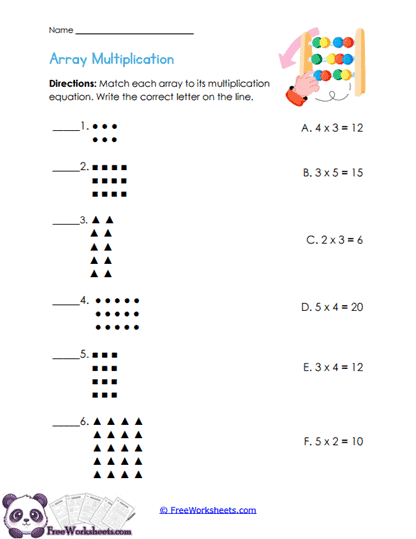
Students examine six arrays made with dots, squares, or triangles and match each model to a lettered multiplication equation. They count the rows, determine how many objects appear in every row, and compare that structure with the factors shown in the available equations.
Target Skill:
This activity strengthens the connection between visual arrays and symbolic multiplication notation. 3rd grade students practice interpreting the meaning of each factor, recognizing equal groups, and distinguishing between equations that may have the same product but different row arrangements.
Array Repair
What Kids Do:
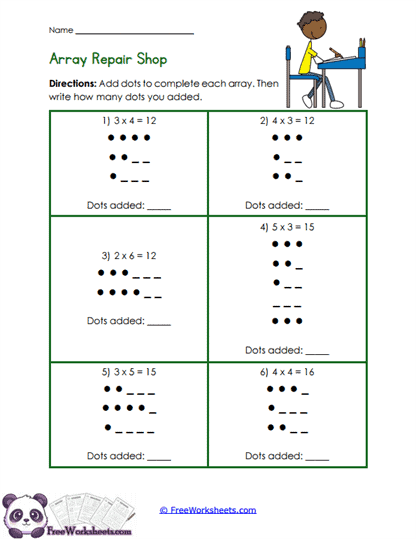
Students complete six unfinished arrays that are paired with multiplication equations. They determine the full number of rows and objects required, add the missing dots in the correct positions, and record how many additional dots were needed to finish each rectangular model.
Target Skill:
The worksheet develops missing-part reasoning through multiplication. 3rd grade students use factors and products to determine how much of an array is absent while also practicing equal-row organization, fact fluency, and the relationship between a complete model and its equation.
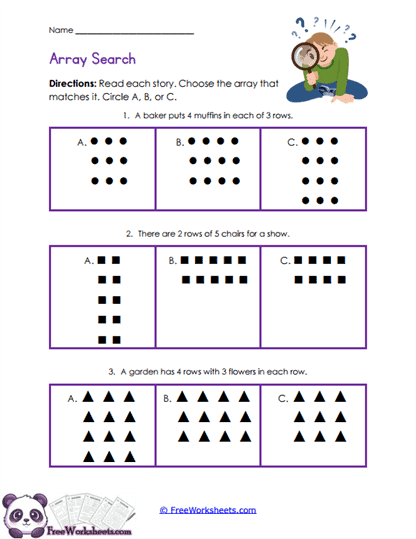
Array Story Match
What Kids Do:
Students read three short multiplication stories involving objects such as muffins, chairs, and flowers. They identify the stated number of rows and objects in each row, compare three possible visual arrays, and select the model that accurately represents each situation.
Target Skill:
This activity connects mathematical reading with multiplication modeling. 3rd grade students practice translating phrases such as “rows of” and “in each row” into visual factor relationships, helping them move from real-world descriptions to arrays and multiplication equations.
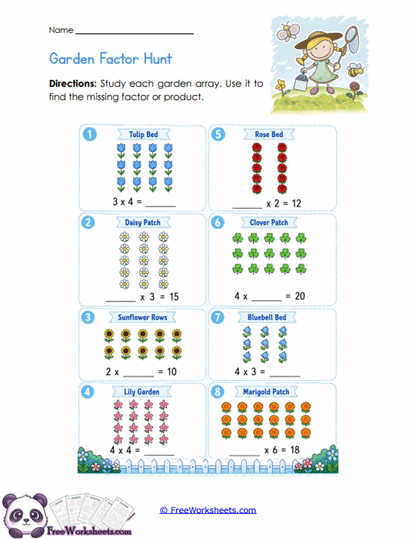
Garden Factor Hunt
What Kids Do:
Students solve eight garden-themed array problems featuring flowers and plants arranged in equal rows. Each model includes a multiplication equation with a missing factor or product, and students use the visual arrangement to determine which number correctly completes the equation.
Target Skill:
The worksheet strengthens factor relationships and unknown-value reasoning. 3rd grade students practice identifying whether a blank represents rows, objects per row, or the total, building a visual bridge between multiplication facts, missing-factor problems, and later division work.
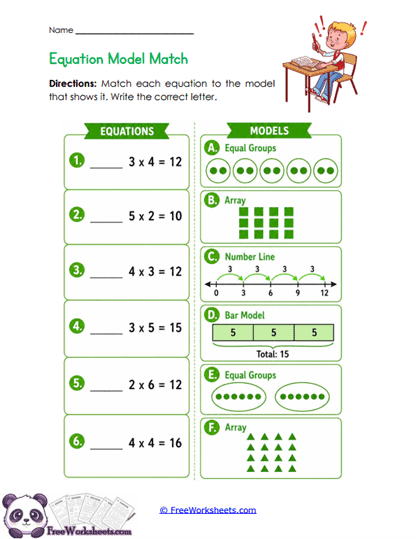
Model Connection
What Kids Do:
Students match six multiplication equations with visual representations that include equal groups, rectangular arrays, number-line jumps, and segmented bar models. They examine how each model organizes repeated quantities and write the letter of the representation that matches each equation.
Target Skill:
This activity develops flexible understanding of multiplication across multiple representations. 3rd grade students learn that the same mathematical relationship can be shown with groups, arrays, jumps, or bars while maintaining the same factors and product.
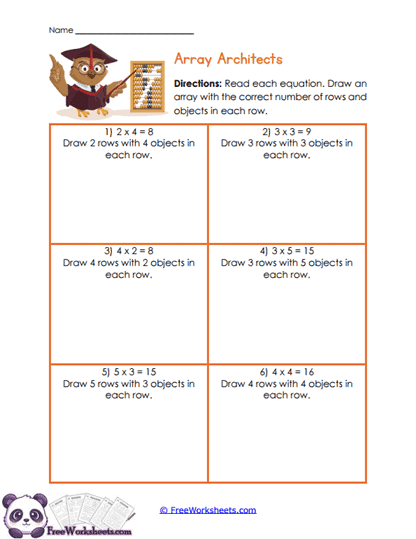
Model Makers
What Kids Do:
Students create six arrays from given multiplication equations and written directions. They draw the specified number of rows, place the correct number of objects in every row, and use the completed arrangement to confirm that the model matches the stated product.
Target Skill:
The worksheet strengthens mathematical modeling by requiring students to build rather than simply interpret arrays. 3rd grade learners practice connecting each factor with its visual meaning, organizing equal groups accurately, and representing multiplication facts with structured drawings.
Pumpkin Array Patch
What Kids Do:
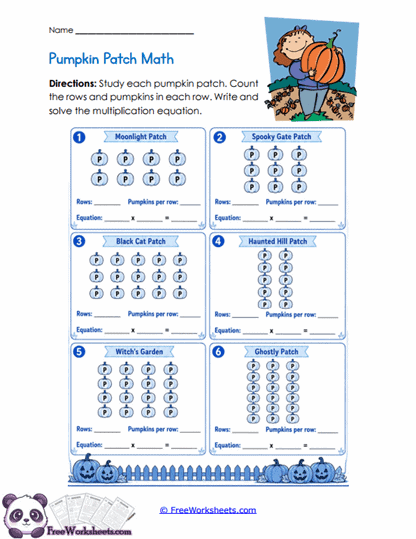
Students examine six pumpkin-patch arrays and count how many rows appear and how many pumpkins are placed in each row. They record both factors and then write the multiplication equation that represents the total number of pumpkins in each visual arrangement.
Target Skill:
This seasonal activity reinforces array interpretation and factor-product relationships. 3rd grade students strengthen multiplication fluency by identifying equal rows, connecting the arrangement with repeated groups, and writing equations directly from visual models.
Row Readers
What Kids Do:
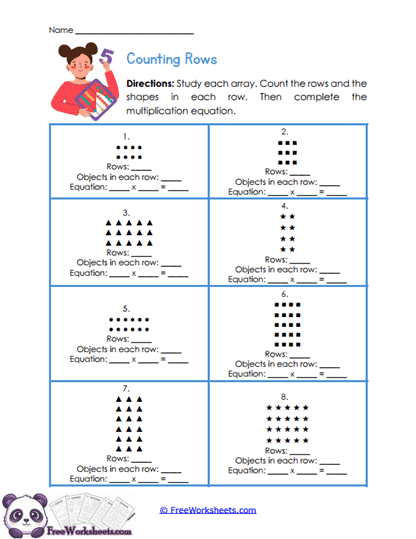
Students work through eight arrays made with dots, squares, triangles, and stars. They count the number of horizontal rows, determine how many objects appear in each row, and use those two quantities to write a complete multiplication equation and product.
Target Skill:
This worksheet builds foundational understanding of arrays as equal groups. 3rd grade students practice using row-and-column vocabulary, recognizing factors within a visual model, and connecting repeated addition with multiplication instead of counting every object individually.
Split Array Strategy
What Kids Do:
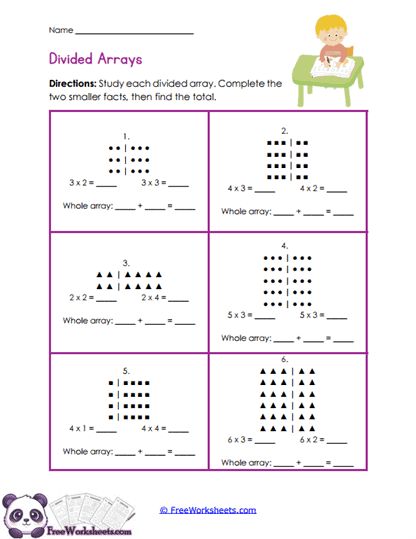
Students study six arrays divided into two smaller sections by a dotted line. They write and solve a multiplication fact for each section, find both partial products, and then add those amounts together to determine the total represented by the complete array.
Target Skill:
This activity introduces multiplication decomposition and the visual foundation of the Distributive Property. 3rd grade students learn that a larger product can be broken into easier facts and recombined, strengthening flexible computation and early algebraic reasoning.
Turned Arrays
What Kids Do:
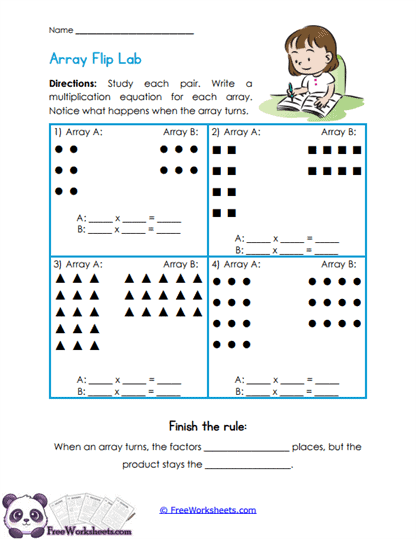
Students compare four pairs of arrays that contain the same total number of objects but have their rows and columns reversed. They write a multiplication equation for each orientation and then examine how the factors change when the array is turned.
Target Skill:
The worksheet provides a visual introduction to the Commutative Property of Multiplication. 3rd grade students discover that switching the order of the factors changes the array’s orientation but not its product, strengthening equivalent-fact and factor-order reasoning.